.svg)



%20(1).svg)
%20(2).svg)
.png?width=480&height=420&name=Img%20(1).png)
%20(3).svg)
%20(4).svg)

%20(5).svg)


 View all states

16 mins
In this blog
Key Takeaways:
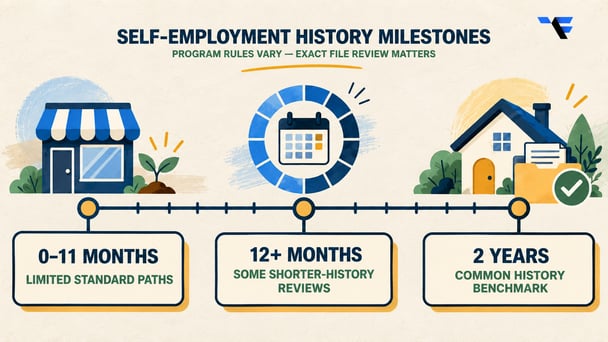
- Less than one year is different from less than two years. The conventional shorter-history provisions generally require at least a full 12 months of documented self-employment income.
- Previous same-field employment can matter, but it does not automatically replace the current self-employment history requirement.
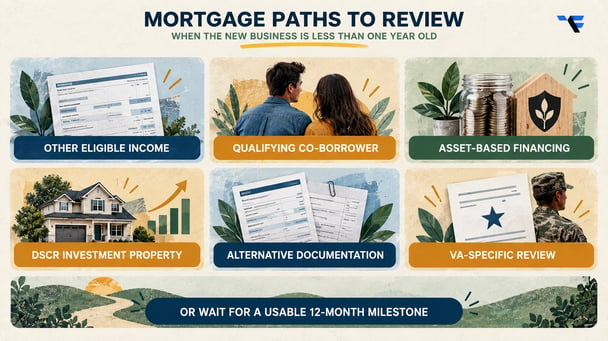
- Alternative paths exist, including qualifying without the new business income, eligible co-borrower income, asset-based financing, certain non-QM programs and, for investment properties, DSCR financing.
- Bank-statement and alternative-documentation loans still have rules. They are not automatically available to a six-month-old business.
- The right first step is a scenario review, because business age, ownership, income history, assets, credit, occupancy and property type all affect which programs can actually be considered.
Getting a mortgage when self-employed for less than one year is possible in limited circumstances, but it is not the same as having less than two years of self-employment history.
For conventional loans, Fannie Mae and Freddie Mac generally look for two years of self-employment history. Both, however, have provisions that can allow a borrower with less than two years of self-employment to qualify when the file meets specific conditions, including at least 12 months of documented self-employment income and relevant prior income or work history. Fannie Mae’s current guidance specifically requires the most recent signed tax returns to reflect a full 12 months of income from the current business for this shorter-history path.
There are still situations where a newly self-employed borrower may have a path to financing. The new business income may not need to be used at all. A co-borrower’s income may carry the application. Assets may provide another qualifying-income approach. An eligible investment property may fit a DSCR structure. A veteran may have a rare VA path. Certain non-QM programs may also use bank statements or other documentation instead of traditional tax-return calculations.
The important part is understanding which of those paths actually fits the borrower’s circumstances.
First, Confirm Whether The Lender Treats You as Self-Employed
Before worrying about how many months the business has been operating, it helps to establish whether the mortgage program will classify the borrower as self-employed in the first place.
Fannie Mae considers a borrower with a 25% or greater ownership interest in a business to be self-employed. This can include sole proprietors, partners, LLC owners, S-corporation owners and corporation owners. A freelance or independent contractor receiving 1099 income may also be treated as self-employed for underwriting purposes.
This can create confusion for business owners who pay themselves through their own company.
Receiving a W-2 from an S-corporation, for example, does not automatically make the mortgage file identical to that of someone who works for an unrelated employer. The lender still has to understand the ownership structure and determine how the income should be analyzed.
There are also several dates worth separating:
- When the business was formed
- When the borrower became an owner
- When the borrower began working in the business
- How long the borrower has actually received the income being used to qualify
A company that has existed for five years but was purchased by a borrower seven months ago is not necessarily the same underwriting situation as someone who has owned and operated that business for five years.
Likewise, someone who spent ten years working in an industry before opening a business seven months ago has valuable prior experience, but seven months of self-employment is still seven months.
For borrowers trying to understand how lenders document this kind of income, the Truss Financial Group guide to self-employed mortgages provides an overview of the documentation and alternative mortgage structures available to self-employed borrowers.
Why the 12-Month Line Matters
The two-year rule gets repeated so often that it can make the mortgage process sound binary: wait two years or don't apply. The reality is more nuanced.
Mortgage underwriting is fundamentally concerned with whether income is stable, documented and reasonably expected to continue. Two years of history is one way to establish that. Certain programs allow a shorter history when the borrower can demonstrate relevant previous income and work experience.
But the shorter-history provisions do not generally mean that three or six months of new business income is enough.
Fannie Mae states that borrowers with less than two years of self-employment history may have their income considered when their most recent signed personal and business federal tax returns reflect a full 12 months of self-employment income from the current business, along with documented prior income at the same or greater level in the same field or an occupation involving similar responsibilities.
Freddie Mac's current Chapter 5304 similarly says that two years of current self-employment is required in most cases. Its shorter-history provisions require the borrower to satisfy additional requirements, including federal tax returns reflecting at least one year of self-employment income.
That is why a business license, signed client contract, CPA letter or year-to-date profit and loss statement can support a mortgage file but cannot automatically manufacture missing income history.
Rules by Mortgage Program
| Mortgage program | General history position | What less than one year means |
|---|---|---|
| Fannie Mae | Generally two years of prior earnings | Certain shorter-history cases can qualify after a full 12 months of current self-employment income is reflected on signed tax returns, with qualifying prior income and related work history |
| Freddie Mac | Generally two years of current self-employment | Certain shorter-history cases are permitted, but the current guidance requires at least one year of self-employment income reflected on federal tax returns |
| FHA | Generally two years of self-employment | A one-to-two-year history can be considered when the borrower has the required prior same-line or related work history; this does not create a standard under-one-year path |
| VA | Generally two years for stable self-employment income | Less than one year can rarely qualify and requires in-depth development of the business and the borrower's prior experience |
| USDA | Two years of self-employment history for repayment-income analysis | Current USDA guidance calls for two years of self-employment income history and the applicable tax-return documentation |
Fannie Mae's current self-employed borrower guidance provides the specific conventional requirements. Freddie Mac's current Guide Chapter 5304 covers its self-employment history requirements.
For FHA borrowers, HUD's current Handbook 4000.1 is the controlling source for FHA policy. HUD published another handbook update in August 2026, so older articles should not be treated as current guidance.
VA guidance is particularly important for this topic because it expressly addresses the unusual under-one-year situation. The current VA Lenders Handbook says less-than-one-year self-employment can rarely qualify and requires in-depth development to establish stable income.
USDA's current Chapter 9 guidance lists a two-year required history for self-employment income and independent contractors, along with the most recent two years of federal tax returns or transcripts and a year-to-date P&L.
What Can Work When You Have Less Than One Year?
There is no single “newly self-employed mortgage.” Instead, the realistic paths depend on what else is present in the application.
1. Qualify Without the New Business Income
The simplest possibility may be not using the new business income at all.
If another stable, eligible income source is sufficient to qualify for the mortgage, the new business may not need to provide the qualifying income. That does not mean the lender ignores the business. Personally obligated business debts, losses and other financial obligations can still affect the overall underwriting analysis.
The distinction is simply that having new business income does not always mean that income has to be used to qualify.
2. Apply With an Eligible Co-Borrower
A co-borrower with sufficient eligible income may change the structure of the application. If the mortgage can qualify using the co-borrower's income and the other requirements are satisfied, the newly self-employed borrower's income may not need to be used.
But adding a co-borrower does not automatically make otherwise ineligible business income acceptable. Credit, debts, occupancy, assets and the complete property transaction still have to meet the applicable requirements.
3. Consider Asset-Based or Asset-Depletion Financing
For borrowers with substantial liquid assets but a short employment history, asset-based financing can be worth investigating.
An asset-depletion mortgage uses eligible assets to calculate qualifying income under a specific program rather than relying entirely on employment income. Truss Financial Group's asset-depletion mortgage program explains how qualifying assets can be used in this type of structure.
Eligible assets, account types, seasoning, reserves, withdrawal assumptions, loan purpose and occupancy can all matter. Assets used to close the transaction may also affect the amount available for qualifying purposes.
4. Buying an Investment Property? Look at DSCR
If the property being purchased is an investment property rather than a primary residence, the analysis can be very different.
A DSCR loan focuses primarily on the property's ability to generate rental income sufficient to support its debt obligations. Truss Financial Group's DSCR loan information describes this property-cash-flow approach.
The property still has to meet the program's requirements, and the borrower may need to meet specific credit, equity, reserve, appraisal and rental-income conditions.
5. Explore Alternative-Documentation Programs
Bank-statement, 1099 and P&L-based mortgages are often discussed when conventional income documentation does not reflect how a business owner actually earns money. These are generally non-QM structures that use different methods to evaluate income.
For example, a bank statement mortgage may analyze deposits over a specified period rather than relying entirely on taxable income shown on a federal return.
Many bank-statement programs require 12 or 24 months of statements. Business-age requirements can also apply. Credit, reserves, down payment, debt-to-income limits and pricing may differ from conventional financing.
6. Review a VA Exception if Eligible
VA guidance states that self-employment income is generally considered stable after two years. Less than two years may be considered when there is previous related employment or specialized training. Less than one year can rarely qualify, but the lender must conduct an in-depth analysis of the business and the likelihood that the income will continue.
A veteran who recently started a business after substantial related employment experience may have a different file from someone who entered an entirely new occupation six months ago.
7. Wait Until the File Reaches a Usable Milestone
For borrowers who need the new business income to qualify, reaching 12 months of documented self-employment income can materially change the available conventional options.
The waiting period can also be used productively:
- Keep business and personal accounts separate
- Maintain clean bookkeeping
- File accurate tax returns on time
- Keep contracts and invoices organized
- Maintain a current P&L and balance sheet when appropriate
- Avoid unexplained transfers between accounts
- Keep documentation of prior employment and related experience
Which Path Fits the Situation?
| Borrower situation | Direction to explore | Main caution |
|---|---|---|
| Under 12 months; other stable income is sufficient | Ask whether the loan can qualify without using the new business income | Business debts or losses may still affect the analysis |
| Under 12 months; substantial eligible assets | Compare asset-depletion or asset-utilization programs | Asset eligibility and calculation methods vary |
| Buying an investment property | Review an eligible DSCR structure | DSCR is generally for non-owner-occupied investment property |
| Eligible veteran with strong related history | Request a VA-specific review | Under-one-year cases are rare |
| Business income is necessary for a primary residence | Compare waiting with verified non-QM alternatives | Many bank-statement programs still require 12 or more months of statements or business history |
Documents to Gather Before a Scenario Review
Start with the previous employment history:
- W-2s or 1099s
- Previous job descriptions
- Resume
- Professional licenses or credentials
- Relevant education or training
- Evidence connecting the previous occupation to the new business
Then gather the business records that apply:
- Formation documents
- EIN confirmation
- Business license
- Operating agreement
- Ownership documentation
- Contracts and invoices
- Current P&L
- Balance sheet
- Business bank statements
- Personal bank statements where required
TFG's guide on how to show proof of income when self-employed explains why lenders may need several documents to establish the income story.
A CPA letter can sometimes support the file, particularly when the lender needs confirmation of business facts. But TFG's CPA letter guidance makes an important point: a CPA letter generally does not replace tax returns, bank statements or other required income documentation.
What Helps and What Does Not Replace Income History
- Strong credit can help.
- Cash reserves can help.
- A larger down payment can help.
- Relevant prior experience can help.
- Lower debt can help.
But none of those automatically erase a program's minimum income-history requirement.
A borrower with excellent credit and a substantial down payment does not automatically turn six months of self-employment into 12 months. A signed contract for future work does not automatically become qualifying income. And regular transfers from a business account to a personal account do not turn business income into ordinary salaried employment.
Questions to Ask a Loan Officer Before Applying
Before submitting a mortgage application, ask:
- Will the new self-employment income need to be used?
- How is the ownership interest being classified?
- Which exact program permits the current self-employment history?
- Is that requirement coming from the agency, investor or lender overlay?
- What is the minimum business age?
- How many months of bank statements are required?
- How will business expenses, losses and personally obligated business debts be treated?
- Can business funds be used for the down payment or reserves?
- Is a P&L or CPA letter actually required?
- Can the scenario be reviewed before making an offer or paying for an appraisal?
The First Year Is Also About Building the Mortgage File
A W-2 employee can usually point to a pay stub, W-2 and employer. A business owner may need to explain invoices, deposits, expenses, distributions, ownership, tax deductions and the relationship between the business and personal finances.
A borrower with six months of self-employment, substantial prior experience, strong assets and another qualifying income source may have a very different mortgage conversation from a borrower whose new business is the only source of income and whose previous work was unrelated.
Truss Financial Group's scenario review and mortgage quote process can be used to examine the available conventional, government-backed and non-QM possibilities based on business history, income documentation, credit, assets, property type and occupancy.
Frequently Asked Questions
1. Can I get a mortgage with only six months of self-employment?
Possibly, but the standard Fannie Mae and Freddie Mac shorter-history paths generally require at least 12 months of documented self-employment income. VA guidance allows less-than-one-year cases only rarely and requires in-depth analysis. Other possibilities may include qualifying without the new business income, using eligible assets, adding a qualifying co-borrower or exploring a verified alternative-documentation program.
2. Does previous W-2 work in the same industry count?
It can be important. Fannie Mae and Freddie Mac consider prior income and relevant work history in their shorter-history provisions. FHA also considers prior work in the same line of work or a related occupation for its one-to-two-year provision. Previous experience does not, however, eliminate every current-history requirement.
3. Can one year of tax returns be enough for a mortgage?
Sometimes. It depends on the program and the business history. Fannie Mae, for example, permits certain borrowers to use one year of personal and business tax returns when the business has existed for at least five years and the borrower has maintained at least 25% ownership for five consecutive years. That is different from a newly created business with only one year of history.
4. Do bank-statement loans require 12 or 24 months of statements?
It depends on the individual program. TFG's current bank-statement material describes programs using 12–24 months of bank statements. Business-age requirements may also apply, so a six-month-old business should be reviewed against the exact program rather than assuming six months of statements will be sufficient.
5. Can a CPA letter replace tax returns or self-employment history?
Generally, no. A CPA or self-employment letter can verify certain facts about a business, but it does not automatically replace tax returns, bank statements or a program's minimum history requirements.
6. Can a larger down payment make up for less than one year in business?
A larger down payment can strengthen an otherwise eligible file, but it does not automatically waive a mortgage program's minimum income-history or documentation requirements.
7. Can a spouse or another co-borrower qualify without using the new business income?
Potentially. If the co-borrower's eligible income is sufficient, the mortgage may not need to rely on the newly established business income. However, the complete application still has to satisfy the applicable requirements, and business debts or losses may still need to be considered.
8. Can a DSCR loan be used for a primary residence?
Generally, no. DSCR loans are structured around the cash flow of eligible investment properties. TFG describes its DSCR program as investment-property financing based on property cash flow rather than personal income.
9. Is a 1099 contractor always treated as self-employed?
Not necessarily in every situation, but 1099 contractors are commonly analyzed as self-employed for mortgage purposes. The income structure, ownership arrangement and applicable underwriting rules determine how the income is treated.
10. Should I wait until I have filed a full year of business income?
If the mortgage depends on the new business income and the borrower is currently below the 12-month threshold, reaching a full year of documented income can materially change the available conventional options. However, waiting is not necessarily the only path, so a scenario review can help determine whether another qualifying structure exists.

.svg)

Discuss your unique requirements
Get direct answers and a roadmap for your future.
.png?width=202&height=202&name=image%20588255187%20(1).png)





.svg)

.svg)
.svg)