.svg)



%20(1).svg)
%20(2).svg)
.png?width=480&height=420&name=Img%20(1).png)
%20(3).svg)
%20(4).svg)

%20(5).svg)


 View all states

16 mins

In this blog
If a big bill shows up, the equity in your home might be able to cover it. Many homeowners look at two choices – one is a home equity loan, and the other is a home equity line of credit, often called a HELOC. Both options use your home as security. That can mean access to a large amount of money. It also means you could face foreclosure if you do not pay back what you owe.
Knowing the difference between a line of credit and a home equity loan can help you pick the right fit for your plan. It can also help you match your budget. Let’s discuss.
What Is a Home Equity Loan?
A home equity loan lets you borrow based on the equity already in your property. Equity is what is left after you subtract what you still owe on your mortgage from your home’s current value.
Say your home is worth $400,000. If you owe $300,000 on your mortgage, you have about $100,000 in equity. This is before you consider other liens. It is also before lender limits and closing costs.
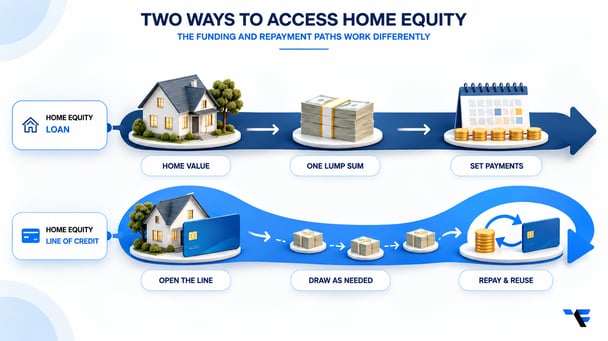
This is where the difference between a line of credit and a home equity loan split feels clear. A home equity loan is a closed-end setup. You receive the funds one time. Then you make regular payments until the loan is paid off.
How a Home Equity Loan Works
- You ask for a loan up to a set dollar amount.
- Next, the lender checks your pay, credit history, the equity you have, and the home’s value.
- After that, the lender sends you the approved money as one payment.
- Then you pay back the loan each month.
- Those monthly bills cover both principal and interest.
- The loan is finished once the remaining balance is paid off.
Still, there is a downside. Interest starts building on the full amount you borrow. So if you borrow $50,000 but you only need $25,000 at the start, you still owe interest on the full $50,000.
What Is a Home Equity Line of Credit?
A home equity line of credit, or HELOC, works like a revolving line. Your home serves as the security. You do not have to take all the cash at once. You can request funds only when you need them.
Say your lender approves a HELOC with a $50,000 limit. You might pull $12,000 for the first phase of your renovation. Later, you could take another $15,000 a few months down the road. The rest can stay unused for now.
With a HELOC, interest is usually charged on what you actually borrow, not on the entire limit. And as you pay down the balance during the draw period, you may be able to borrow those amounts again, based on the terms.
How a HELOC works
A HELOC typically runs in two parts.
- Draw phase: During this time, you can use the money that is available. Some plans let you pay only the interest. Others require payments that include both principal and interest.
- Payback phase: In this period, you usually cannot take out more new money. Instead, you start paying down what you already borrowed. This repayment happens over a defined term.
For many HELOCs, the draw phase lasts about five to ten years. Then the repayment phase may run for another ten to twenty years. Lender rules can change those time frames. Interest rates on most HELOCs move over time. The rate is often tied to a market index plus a lender-added amount. If the index goes up, your rate can increase too, and your monthly payment may follow.
A few lenders add a fixed-rate HELOC option. With that feature, you can move some of your balance to a fixed interest rate. Still, there can be extra costs, limits on the minimum balance, or other rules to follow. You should not assume this is the same thing as a regular fixed-rate home equity loan.
HELOC vs Home Equity Loan at a Glance
| Feature | Home Equity Loan | HELOC |
|---|---|---|
| Funds received | One lump sum | Borrowed as needed |
| Credit reuse | No | Generally available during the draw period |
| Interest rate | Often fixed | Usually variable |
| Payment structure | Principal and interest | May be interest-only or principal and interest |
| Main advantage | Predictability | Flexibility |
| Main risk | Interest on the full amount upfront | Rate and payment changes |
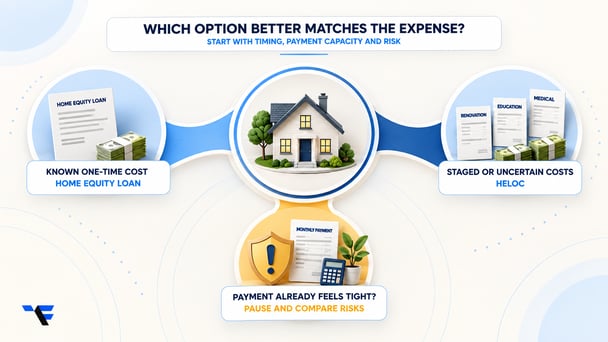
| Best suited for | Known, one-time expenses | Staged or uncertain expenses |
Access to Funds and Repayment: Home Equity Line of Credit vs Loan
Home Equity Loan Example
Say you borrow $50,000 with a home equity loan. The rate is fixed at 8%, and the term is 10 years. If you look at the numbers, your monthly payment for principal plus interest lands at about $607. At closing, you get the full $50,000 right away. Even if you are not ready to use it, interest starts building on the whole balance from the day you receive it.
Then you pay the regular amount each month. After 120 months of payments, the loan should be cleared. This assumes you stay on schedule and that no extra fees show up. This kind of setup fits a cost you can plan for.
HELOC Example
Now compare that with a HELOC for $50,000. Early on, you pull money as you need it. For example:
- In month one, you may take out $15,000 as a deposit for a contractor.
- In month three, you draw another $10,000.
- By month five, you pay back $5,000.
That $5,000 repayment option can let you borrow more again while the draw period is still open.
With HELOC approval factors, interest is based on what you actually owe at each point in time. So if your bills come in steps, you may end up owing less interest, since you do not pay interest on funds you never used yet.
The catch is what happens when the draw period ends. You may no longer be able to borrow new money. After that, you have to pay down the principal. If the rate goes up, or if you took out a lot early, your monthly payment could end up higher than what you saw at the start.
Rates, APR, and Monthly Payments
Home Equity Loan Rates and Payment Certainty
Fixed home equity loan rates usually stay the same, so your monthly bill is simpler to set in your budget.
Take a sample case: a $50,000 loan at 8% paid over 10 years. The expected monthly payment comes out to about $607. If you run it through the full term, the total paid is about $72,840. That includes nearly $22,840 in interest.
These numbers are only examples. Your real rate and payment depend on things like your credit, income, the home value, the loan-to-value ratio, the lender, and other details. A steady payment can help a lot when money is tight. It also reduces the stress of changes tied to market rates.
To see how the numbers may look for your situation, speak with a Truss Financial Group loan officer about the home equity options available to you.
HELOC Payment Changes
A HELOC payment can be different because it depends on your current balance, your interest rate, and what phase you are in. During the interest-only part, payments are based on interest only. With a $50,000 balance at 8%, the cost is about $333 per month. At 10%, it is about $417 per month. That is roughly an $84 jump each month, even if you did not take any extra money.
Bills can also change once the payback period starts. For instance, if you owe $40,000 and repay it over 15 years, the monthly cost might be around $382 at 8% and about $430 at 10%. This can vary by how the lender calculates the payment.
So a smaller “intro” payment should not be assumed to mean the loan is cheaper overall. Interest-only payments can keep the monthly amount low while the principal may stay close to the same.
Fees, Closing Costs, and Disclosures
Possible charges can include:
- Application or origination fees
- Appraisal or property valuation fees
- Title and recording costs
- Yearly HELOC fees
- Fees tied to inactivity or certain transactions
- Costs to switch to a fixed rate
- Early closure or early repayment fees
Some lenders say they have no closing cost products. When that happens, they may cover the costs by charging a higher interest rate, requiring a minimum time before you can end the account, or taking a fee if you close the account early.
Home Equity Loan Closing Costs
Home equity loan closing costs can be anywhere from a few hundred dollars to a few thousand. The final figure changes based on the bank, the home, where the property is, and the loan setup.
Say you take out $50,000 and roll $2,500 of fees into the loan. Your total borrowed amount becomes $52,500. After that, interest is calculated on that higher sum, not just the original amount. You should also look at the APR, not only the interest rate. The APR can include some costs tied to the loan. That can give you a clearer picture of what you pay over time.
The paperwork is not the same either. With a home equity loan, you typically get a Loan Estimate and a Closing Disclosure. With a HELOC, you see open-end credit disclosures that cover the credit cap, how the rate can change, the draw term, the payback term, the fee list, and what the lender can do.
Application and Qualification
The steps for the two products look a lot alike. During review, a lender may look at several items, such as:
- Credit score and credit history
- Income and employment
- Existing debts
- Home value and available equity
- Loan-to-value or combined loan-to-value ratio
- Property condition
- Mortgage and title information
An appraisal is not required in every case. Some lenders rely on automated tools or desktop valuations for people who meet their basic needs. The closing timeline can differ. Delays can come from title problems, property issues, missing paperwork, or how long the lender takes to process your file. Also, a HELOC is not always faster than a home equity loan.
Risks and Consumer Protections
HELOC-Specific Risks
A HELOC carries several additional concerns:
- The interest rate may rise as market conditions change.
- The payment may increase when the draw period ends.
- The lender may freeze or reduce your available credit if your property value falls or your financial situation changes.
- Some agreements require the balance to be repaid in full when the draw period ends.
- Certain lenders may require a minimum initial withdrawal.
- Easy access to available credit may encourage additional debt.
Home Equity Loan Risks
A home equity loan can come with downsides.
- You start paying interest right away on the whole amount.
- Your monthly bill often stays the same even if your income drops.
- If you use the money to pay off credit cards or other unsecured debt, that old debt can end up tied to your house.
Also, many qualifying HELOC plans tied to a main home and many non-purchase home equity loans include a federal right to cancel within three business days. Still, there can be exceptions. State rules may differ too. Make sure you read your closing papers closely.
When Each Option Usually Makes Sense
| Situation | Usually Stronger Option | Why/What to Verify |
|---|---|---|
| Fixed-price renovation | Home equity loan | Known amount and predictable repayment; compare total fees. |
| Renovation completed in stages | HELOC | Draw only as bills arrive; test higher rates and repayments. |
| One-time debt consolidation | Often home equity loan | Fixed payoff amount and schedule; confirm behavior and total-interest plan. |
| Ongoing or uncertain expenses | Often HELOC | Costs occur over time; avoid treating the line as permanent income. |
| Emergency reserve you may never use | Usually neither | A lender may freeze a HELOC; compare savings and unsecured options. |
| You cannot afford a higher payment | Neither variable-rate option | Using the home as collateral may worsen the risk. |
Real-World Examples
A Renovation Completed in Stages
Let’s say your renovation has three bills. You pay $18,000 for the kitchen, $22,000 for the roof, and $5,000 for the finishing work. That adds up to $45,000.
If you take a home equity loan, you may get $50,000 at once. Interest starts on the whole amount right away. This can be true even if the job takes longer than planned or if the final cost ends up under what you expected. With a HELOC, you can pull funds in parts. You can take each amount when the bill comes due. Interest then goes on only what you have used so far.
A HELOC can cost less while you work on the project. Still, things can change later. If you end up owing $45,000 and the rate moves up, your payments during the payback period can be far higher than what you first paid during the draw period.
Debt Consolidation
Now picture $35,000 in credit card debt at 18% APR. A home equity loan might let you swap several card balances for one lower-rate loan. You would also get one set payoff schedule.
You can also use a HELOC to clear the cards. In some cases, the early payment is mainly interest so that it can feel smaller. But that does not mean the balance is shrinking on its own. If you do not cut the principal, you may hit a tougher payment later.
One more thing to watch – you would be moving debt from unsecured credit cards to debt backed by your home. If you go this way, try not to keep adding new card balances after you consolidate.
How to Compare Offers
Before applying, decide how much you need and when you expect to use it. Then request offers from at least two lenders and compare them using the same assumptions.
For a home equity loan, review:
- Interest rate and APR
- Loan term
- Monthly payment
- Total interest
- Cash required at closing
- Home equity loan closing costs
- Early repayment terms
For a HELOC, review:
- Credit limit
- Draw period and repayment period
- Index and lender margin
- Introductory rate
- Rate caps
- Payment formula
- Annual and transaction fees
- Fixed-rate conversion options
- Credit-freeze provisions
HELOC Draw Period vs. Repayment Period
The HELOC draw period is the time when you can access available credit. Depending on the agreement, you may make interest-only payments, pay down principal, and borrow again as you repay.
The HELOC repayment period begins when new borrowing stops. You must then repay the outstanding balance over the stated term. Some contracts may require the entire balance to be paid off, so do not assume every HELOC automatically converts into a long repayment schedule.
Frequently Asked Questions
1. Can I borrow again after repaying a HELOC?
Yes, in some cases. The repaid amount can show up again while the draw period is open, but only if you stay within the credit cap and the lender allows it.
2. Is a HELOC the same as a home equity loan?
No. A HELOC works like a line of credit that you can draw from and pay back. A home equity loan is different. It gives you a set sum up front, and you repay it on a schedule over a set term.
3. Which option usually has the lower rate?
It depends. You have to look at what is offered now. Check the APR, any fees, the repayment length, and how the lender sees your finances.
4. Can a HELOC have a fixed rate?
Some lenders let you switch to a fixed rate. You should confirm if the switch covers the full balance or just part of it. Also ask if there are extra charges for the switch.
5. Do I pay interest on the full HELOC limit?
No. Interest is usually charged on what you borrow. Still, there can be yearly fees or other costs, even if you do not use the full credit line.
6. Is HELOC interest tax-deductible?
For IRS rules, interest might qualify for a tax break if the money is used to buy, build, or make major upgrades to the home that secures the debt. Limits and other conditions can apply. Talk with a tax advisor so you know how it fits your case.
The Bottom Line
A line of credit and a home equity loan both use home equity, but they work in different ways. The main difference between a line of credit and a home equity loan is how you take the money, how interest is set, and whether your monthly payment stays steady.
A home equity loan can fit well when you already know the amount you want. You get the funds at the start, and you may like having a fixed payment each month. A HELOC may fit better when the spending comes in pieces.
If you do not know the exact total yet, you can pull funds as needed. During the draw period, you might be able to pay some back and then borrow again. The drawback is that rates can change. You may also face limits on access to credit, and the payment later could end up higher.
- Do not judge by the headline rate or the first low payment you see.
- Read the full terms.
- Run the numbers using higher rate cases.
- Add up all costs and charges.
- Then check that the new payment can fit with your current mortgage.
Not sure whether a HELOC or home equity loan is right for you? Contact Truss Financial Group for a side-by-side review based on your borrowing needs, purpose, and repayment timeline.

.svg)

Discuss your unique requirements
Get direct answers and a roadmap for your future.
.png?width=202&height=202&name=image%20588255187%20(1).png)

.png?width=389&height=221&name=Blog%20covers%20(1).png)
%20(1)-1.png?width=40&height=40&name=image%20(65)%20(1)-1.png)
.png?width=389&height=221&name=Blog%20covers%20(2).png)




.svg)

.svg)
.svg)