.svg)



%20(1).svg)
%20(2).svg)
.png?width=480&height=420&name=Img%20(1).png)
%20(3).svg)
%20(4).svg)

%20(5).svg)


 View all states

14 mins
In this blog
Yes, you can refinance a mortgage with a balance below $150,000. But whether you should is a different question. With a smaller loan, closing costs can take up a larger share of your potential savings. A first-lien HELOC may be another option for homeowners with enough equity who want more flexibility than a traditional refinance provides.
Why a Small Mortgage Balance Changes the Math
A $150,000 mortgage isn't automatically too small to refinance. The economics just need a little more attention. Think about what you actually pay when refinancing. There may be lender charges, appraisal or valuation fees, title services, recording costs, and other closing expenses. Most of these don't shrink in proportion to your mortgage balance.
For example, $4,000 in closing costs equals 4% of a $100,000 mortgage. On a $400,000 mortgage, that same $4,000 represents just 1%. That's a pretty big difference.
So if you're shopping around for refinance mortgage low rates, don't judge an offer by the interest rate alone. You need to know what the new loan costs upfront and how long it would take for the monthly savings to make up that expense.
There's also no universal answer to what the minimum mortgage loan amount you can refinance is. Fannie Mae doesn't impose a minimum original loan amount requirement for loans it purchases, but lenders can establish their own minimums.
Start With the Break-Even Point
A simple calculation can give you a useful starting point:
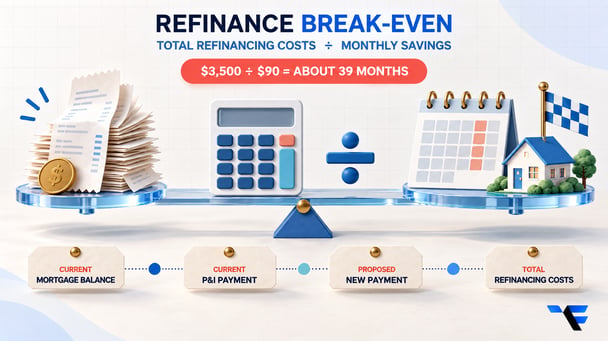
Break-even period = Total refinancing costs ÷ Monthly savings
Suppose refinancing costs $3,500 and lowers your monthly payment by $90.
$3,500 ÷ $90 = about 39 months
You'd need around 39 months of savings to recover that upfront cost, assuming the monthly difference remains consistent.
That doesn't mean the refinance is automatically a bad move. If you're staying in the home for several more years, you may have plenty of time to recover the expense. If you're likely to move soon, however, the numbers could look very different.
That's why low refinance mortgage rates are only one part of the decision. A homeowner comparing low refinance mortgage rates should also look at points, lender fees, the new loan term, and the total amount paid over time.
How a Traditional Mortgage Refinance Works
When you refinance a mortgage, you're taking out a new home loan to pay off your existing mortgage. After closing, you make payments on the new loan under its new terms. The new mortgage may have a different interest rate, repayment period, monthly payment, or loan structure. The right setup depends on what you're trying to accomplish.
Your rate isn't based on your mortgage balance alone. Lenders may consider your credit history, loan-to-value ratio, debt-to-income ratio, property type, loan program, and market conditions. That matters when you're searching for the lowest mortgage refinance rate. The lowest advertised rate isn't necessarily the lowest-cost option once fees, points, and other charges are included.
One lender might offer a slightly lower rate with higher upfront costs. Another could quote a higher rate but charge less at closing. Looking at the complete loan estimate is much more useful than comparing one percentage.
If you're evaluating mortgage refinance best rates, check the annual percentage rate and estimated cash needed at closing as well. A rate that looks attractive on a search page may come with costs that don't work for a smaller balance. The new loan term deserves attention, too. Extending a mortgage to a longer term can reduce the monthly payment, but you could pay interest for more years as a result.
What Happens to Your Credit?
A mortgage application generally involves a hard credit inquiry. FICO says multiple mortgage inquiries made during a 45-day rate-shopping window are generally treated as a single inquiry by newer FICO scoring models.
So, if you're comparing lenders, concentrated rate shopping doesn't necessarily mean every inquiry will be treated as a separate one for scoring purposes. The specific scoring model still matters.
If you're planning to refinance a home mortgage, it makes sense to compare lenders within a focused shopping period and review the complete loan terms rather than chasing every rate advertisement you see.
Where a First-Lien HELOC Comes In
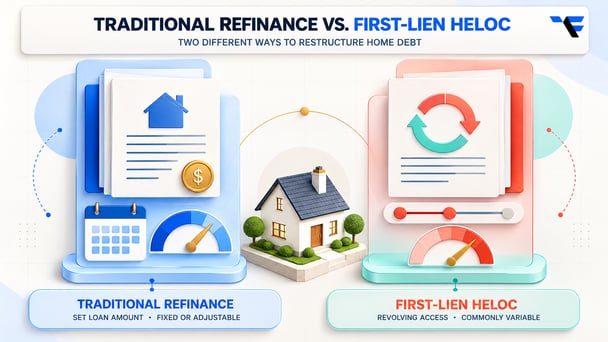
A first-lien HELOC isn't the same thing as a standard second-lien HELOC. With a traditional HELOC, your existing mortgage generally stays in first position while the HELOC sits behind it. A first-lien HELOC takes the primary lien position and may replace the existing first mortgage.
Truss Financial Group describes its First Position HELOC as a product that can replace a primary mortgage while giving the borrower access to a revolving credit line. The exact product features and eligibility requirements can change, so Truss Financial Group can help confirm the current terms.
The structure is different from a standard mortgage, too. A HELOC is a revolving line of credit secured by your home. During the draw period, you can generally borrow against the available credit, repay what you've used, and potentially borrow again, subject to the agreement.
The Consumer Financial Protection Bureau explains that HELOCs generally have a draw period followed by a repayment period and commonly use variable interest rates. That flexibility can be useful. It also comes with a trade-off. If the rate is variable, your borrowing costs can change. A first-lien HELOC isn't simply a conventional mortgage refinance with a different name. It's a different way of structuring the debt.
For someone comparing refinance mortgage low rates, that distinction matters because a HELOC may not provide the same payment certainty as a fixed-rate mortgage.
Traditional Refinance vs. First-Lien HELOC
| Factor | Traditional Refinance | First-Lien HELOC |
|---|---|---|
| Structure | Replaces the existing mortgage with a new mortgage | Can replace the existing first mortgage with a revolving credit line |
| Interest rate | May be fixed or adjustable, depending on the loan | Commonly variable, depending on the product |
| Access to funds | Generally provides a set loan amount | Can provide revolving access during the draw period |
| Payment structure | Usually principal and interest | Depends on the HELOC terms and outstanding balance |
| Rate certainty | Fixed-rate loans provide greater payment predictability | Variable rates can cause payments to change |
| Main comparison points | Rate, term, closing costs and payment | Rate, fees, credit limit, draw period and repayment terms |
For someone searching for mortgage refinance best rates, it's important to understand that these aren't just two versions of the same loan. They're different borrowing structures.
The CFPB's HELOC rules require disclosures covering details such as the draw period, repayment period, payment calculations, and applicable rate information. That information can be useful when comparing the overall cost of a first-lien HELOC with the cost of a traditional refinance or mortgage transaction.
Could a First-Lien HELOC Work for a $150,000 Mortgage?
It really comes down to what you want the financing to do. If you're simply trying to replace an existing mortgage with a lower, more predictable payment, a traditional refinance may be the more straightforward option to compare.
But what if you have substantial equity and also want access to some of it later? That's where a first-lien HELOC may enter the conversation. A homeowner could potentially replace a relatively small mortgage while retaining access to a revolving line of credit. That flexibility can be useful when future borrowing needs are uncertain.
Still, don't assume that a HELOC automatically saves money. Searches for HELOC loan refinance can be confusing because a first-lien HELOC changes the structure of your debt rather than simply giving your existing mortgage a new interest rate.
A borrower searching for refinance mortgage low rates may be focused entirely on the rate, while someone considering a HELOC may care more about future access to equity. Those are different goals. And there is another important distinction: a second-lien HELOC leaves your first mortgage in place. A first-lien HELOC takes the primary position.
What if You Already Have a HELOC?
The question of whether you can refinance a HELOC loan doesn't have one universal answer. Depending on the existing HELOC, its lien position, your equity, property, credit profile, and lender requirements, it may be possible to replace it with another HELOC, a home equity loan, or another mortgage product.
If you're asking this because you already have a line of credit, start by checking whether it is in first or second position. That detail can affect which refinancing structures are available. The options can be different if the existing HELOC is already in first position. That's why it's worth discussing the actual loan structure with a lender before assuming a particular refinance will work.
What Lenders Consider Before Approval
Whether you're trying to refinance a home mortgage or apply for a first-lien HELOC, the lender will look at your overall financial picture.
- Credit history: There isn't a single credit score that guarantees approval or a particular interest rate because requirements differ between lenders and loan programs.
- Equity position: Lenders use the home's value and outstanding debt to calculate loan-to-value. For a HELOC, they may also consider combined loan-to-value if other liens exist on the property.
- Income: You'll generally need documentation showing that you can handle the proposed debt. The documents required can vary, particularly if you're self-employed or have nontraditional income.
- Debt-to-income ratio: A homeowner can have plenty of equity and still have trouble qualifying if their existing obligations and proposed housing payment create too much debt relative to income under the lender's guidelines.
- Property characteristics: A single-family home, condo, investment property, or second home may not be treated exactly the same way.
- Lender-specific rules: These can include minimum loan amounts, minimum HELOC credit lines, documentation standards, and geographic restrictions. So if you've seen a particular requirement online, don't assume it automatically applies to your situation. If you're planning to refinance a mortgage, confirm the lender's minimum loan size before spending time on an application.
Use the Break-Even Test Before Refinancing
Before you start comparing offers, write down four numbers:
- Current mortgage balance
- Current principal and interest payment
- Proposed new payment
- Total refinancing costs
Then use this formula:
Break-even period = Total refinancing costs ÷ Monthly savings
A HELOC needs a slightly different analysis. Don't just compare the current rate with your mortgage rate. Look at the credit limit, fees, amount you actually expect to use, payment structure, variable-rate exposure, and what happens once the draw period ends.
A HELOC may be useful because it gives you access to funds when you need them. That doesn't necessarily mean its initial interest rate will be lower than your mortgage. For borrowers focused on the lowest mortgage refinance rate, the break-even calculation is especially useful. It puts the rate into context by showing how long the upfront expense could take to recover.
Risks Worth Considering
Neither option is risk-free. With a traditional refinance, one obvious concern is paying closing costs without keeping the new mortgage long enough to recover them. A longer repayment term can also mean more total interest, even when the monthly payment is lower. First-lien HELOCs have their own considerations.
Variable Rates Can Change the Payment
The CFPB HELOC guidance notes that HELOCs usually have adjustable interest rates. If the underlying rate increases, the cost of borrowing can increase as well. That makes payment predictability different from what you'd get with a typical fixed-rate mortgage.
The Draw Period Eventually Ends
During the draw period, you may be able to borrow from the available line and repay it according to the account terms. Once that period ends, the account moves into repayment. Your payment can change at that point, particularly if you still have a substantial outstanding balance.
Your Home Secures the Debt
This is the big one. A first-lien HELOC is secured by your property. If you don't meet the required payments, you could put your home at risk. The same basic concern applies to a traditional mortgage. When you're comparing low refinance mortgage rates, don't overlook these structural differences simply because the rate looks attractive.
Which Option Fits a Smaller Mortgage?
There isn't a single answer that works for every homeowner. A traditional refinance may be worth exploring if your priority is a new mortgage with a predictable payment structure. A first-lien HELOC may be worth considering if you want revolving access to equity and are comfortable with variable rates and the way the repayment structure works. Instead of asking which product is universally better, look at your own numbers. Consider:
- Your current mortgage rate and balance
- The total cost of the new loan
- Your expected monthly payment
- How long you'll remain in the home
- Your available equity
- Whether you genuinely need future access to funds
- Whether variable payments fit your budget
- What happens when the HELOC enters repayment
- Any lender minimums that apply
Those details are much more useful than searching only for refinance mortgage low rates.
Frequently Asked Questions
1. Can I refinance a mortgage under $150,000?
Yes. A mortgage below $150,000 can be refinanced if you meet the applicable lender and loan-program requirements. The bigger question is whether the new loan's costs and terms make financial sense for the amount you owe.
2. What is the minimum mortgage loan amount I can refinance?
There isn't one minimum that applies to every lender. Agency requirements and lender-specific policies can differ, so homeowners with smaller balances should confirm the minimum loan amount before applying.
3. How can I find low refinance mortgage rates?
Compare several offers, but don't focus exclusively on the advertised rate. Look at the APR, points, lender fees, closing costs, loan term, and monthly payment. A lower rate with significantly higher upfront costs isn't necessarily the cheaper option. If you're comparing mortgage refinance best rates, request comparable loan estimates so you're looking at the same costs and terms.
4. Can you refinance a HELOC loan?
Potentially. The available options depend on the existing HELOC, lien position, home equity, property, income, credit profile, and lender requirements. Depending on the circumstances, an existing HELOC may potentially be replaced with another HELOC, home equity product, or mortgage.
5. Is a first-lien HELOC the same as a second-lien HELOC?
No. A first-lien HELOC occupies the primary lien position and may replace an existing first mortgage. A second-lien HELOC generally sits behind the existing first mortgage.
Look at the Whole Loan, Not Just the Rate
A mortgage balance below $150,000 doesn't automatically rule out refinancing. It does mean the numbers deserve a closer look.
Closing costs can represent a larger percentage of a smaller loan, so a lower rate isn't enough by itself to determine whether refinancing makes sense. At the same time, a first-lien HELOC can provide flexibility that a traditional mortgage doesn't, although that flexibility comes with variable-rate and repayment considerations.
Start with the basics. Look at your current balance, rate, home value, available equity, potential closing costs, and expected monthly payment. Then consider how long you plan to stay in the home.
If you're evaluating refinancing a home mortgage, Truss Financial Group can help you explore available refinance and first-position HELOC options based on your individual circumstances. Product availability, rates, fees, qualification requirements, and terms vary by lender, borrower profile, property, and state.

.svg)

Discuss your unique requirements
Get direct answers and a roadmap for your future.
.png?width=202&height=202&name=image%20588255187%20(1).png)

.png?width=389&height=221&name=Blog%20covers%20(6).png)

.png?width=389&height=221&name=Blog%20covers%20(3).png)




.svg)

.svg)
.svg)