.svg)



%20(1).svg)
%20(2).svg)
.png?width=480&height=420&name=Img%20(1).png)
%20(3).svg)
%20(4).svg)

%20(5).svg)


 View all states

20 mins

In this blog
The 5 C's of credit (Character, Capacity, Capital, Collateral, and Conditions) are the five criteria every mortgage lender uses to evaluate how risky it is to extend credit to a borrower. They're not a checklist so much as a framework: a structured way for lenders to build a complete picture of the borrower before committing to a loan that may run 15 or 30 years.
If you're approaching a mortgage application or considering tapping your home equity through a HELOC, understanding this framework gives you a meaningful edge. Most borrowers walk into the process knowing they need a decent credit score and some money for a down payment. What's less obvious is how lenders weigh all five factors together, and how deliberate preparation across each one can materially improve both your approval odds and the terms you receive.
This guide covers what each C means in practice, how lenders evaluate it for home loans specifically, and what you can do to put your best foot forward before you apply. Mortgage brokers like Truss Financial Group help borrowers understand exactly where they stand across all five criteria before they ever fill out an application.
What Are the 5 C's of Credit (Character, Capacity, Capital, Collateral, and Conditions) and Why Do Lenders Use Them?
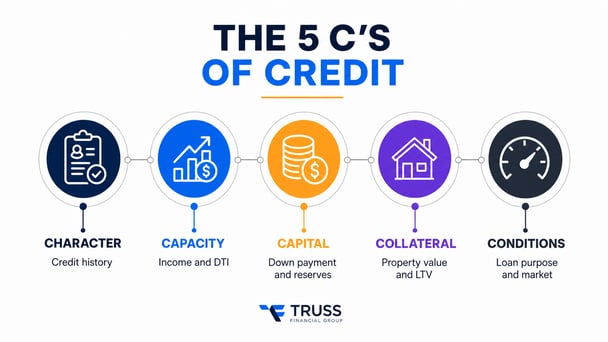
When a lender evaluates a mortgage application, the decision to lend money is a long-horizon risk calculation. They need to assess the borrower's creditworthiness and the likelihood that they'll repay, in full and on time, across decades of monthly payments, before committing hundreds of thousands of dollars. The 5 C's of credit exist as a structured way to make that assessment consistently.
The framework applies whether you're applying for a purchase mortgage, a cash-out refinance, a HELOC, personal loans, or auto loans. Banks, credit unions, and mortgage lenders across the country use some version of it, though how each C is weighted varies by institution, loan type, and loan size. For borrowers, financial literacy around this framework means you can assess your own profile honestly, identify weak spots before an underwriter does, and address them proactively rather than discovering them mid-process. It also puts you in a stronger position when comparing different lenders and evaluating the lending decisions being offered to you.
The five criteria are not evaluated in isolation. Lenders look at the full picture, and here's what each one covers:
- Character: your track record of repaying debt, reflected primarily in your credit history and FICO score
- Capacity: whether your income and cash flow are sufficient to carry the new mortgage or HELOC payment alongside existing obligations
- Capital: the personal financial reserves you bring to the table, including your down payment and post-closing savings
- Collateral: the property itself, assessed through an independent appraisal to establish its value and the lender's security
- Conditions: the specifics of the loan request and the broader economic environment at the time of application
A strong showing in one area can partially offset weakness in another. That's both the challenge and the opportunity for a well-prepared borrower.
How Do Lenders Evaluate Character, and What Does Your Credit Score and Credit History Tell a Mortgage Lender?
Character, in lending terms, is the lender's assessment of your willingness to repay; not your intentions, but your demonstrated track record. The primary evidence is your credit history.
How lenders evaluate Character:
- They pull your credit report from one or more of the three major credit bureaus: Equifax, Experian, and TransUnion
- They review your payment history, outstanding debt balances, length of credit history, credit mix, and recent credit inquiries
- According to the FDIC, the higher your credit score, the more likely you are to qualify for credit on favorable terms
- A FICO score of 620 is typically the minimum credit score requirement for a conventional mortgage; scores of 740 and above generally unlock the most favorable rates and terms
- For HELOC applicants, most lenders prefer a score of 680 or higher, with many setting 700 as the practical floor given the revolving nature of the credit line
What your credit history tells a mortgage lender:
- Payment history is the single most important signal. The Federal Reserve's financial education resources confirm it accounts for roughly 35% of a FICO score, more than any other single factor
- A pattern of on-time payments signals reliability; a pattern of missed or late payments is a serious red flag, even if recent months look clean
- The depth and age of your credit file matter too; a thin history with few accounts can raise questions even when there are no negative marks
- Lenders are looking for evidence that you've managed credit responsibly over time, not just recently
What you can do:
- Pay every bill on time in the months leading up to your application
- Reduce revolving balances below 30% of your credit limit to improve your credit utilization ratio; lenders view high credit usage on cards and revolving lines as a risk signal
- Avoid opening new credit accounts in the months before applying; how much credit you've recently sought is factored into your score, and new inquiries can temporarily lower it
- Pull your credit report from all three major credit bureaus and dispute any errors, as inaccuracies are more common than most people expect, and correcting them costs nothing
What Is Capacity and How Do Lenders Use Your Debt-to-Income Ratio to Measure Repayment Ability?
Capacity is the lender's assessment of whether your income and cash flow are sufficient to service the new mortgage or HELOC payment alongside your existing financial obligations. It's the most data-intensive of the five C's, and for many borrowers, it's where loan approval is won or lost.
How lenders evaluate Capacity:
- The primary metric is the debt-to-income ratio (DTI): your total monthly debt payments divided by your gross monthly income
- To make it concrete: if your household income generates $8,000 in gross monthly income and your total monthly debt payments, including the proposed mortgage, come to $3,000, your DTI is 37.5% - which tells the lender whether you can comfortably afford the new obligation
- The CFPB's Ability-to-Repay rule established that for qualified mortgages, total monthly debt must not exceed 43% of gross monthly income; many lenders prefer 36% or lower for their most competitive rates
- For HELOC applicants, lenders apply the same thresholds but factor in the full potential draw on the line, not just a minimum payment
What your income profile tells a mortgage lender:
- Employment stability matters as much as the income amount; two years of consistent history with the same employer signals lower risk than frequent job changes or income gaps
- Lenders verify income through pay stubs, W-2s, and two years of tax returns for salaried borrowers
- All income sources are considered, but only those that can be documented and verified count toward the qualifying figure
What you can do:
- Pay down high-interest debt before applying, as even modest reductions in total monthly debt can meaningfully lower your DTI
- Avoid financing a vehicle or taking on any new debt obligations in the three to six months before you apply
- Gather income documentation early, including any rental, freelance, or investment income that can be verified and documented
What Role Does Capital Play, and How Do Your Down Payment and How Much Debt You Carry Affect Approval?
Capital refers to your personal financial reserves, including savings, personal investments, retirement accounts, and other assets, beyond the income stream you'll use to make monthly payments. For mortgage and HELOC applicants, it's where your down payment and home equity enter the picture.
How lenders evaluate Capital:
- For mortgage applicants, a down payment of 20% eliminates private mortgage insurance (PMI) and typically secures more favorable rate terms
- Many programs allow lower down payments; conventional loans as low as 3%, FHA loans as low as 3.5%, but the impact on your monthly mortgage payment, including PMI where applicable, is real and worth calculating before you settle on a number
- For HELOC applicants, capital is assessed through your existing equity stake; most lenders require at least 15% to 20% equity remaining after the line is issued, with the CLTV as the governing metric
- Lenders look not just at the down payment amount but at what's left in reserve after closing; post-closing savings signal that you have a backup plan if income is disrupted
What your capital position tells a mortgage lender:
- A larger down payment reduces LTV and lender risk exposure, which can translate directly into better rates and terms
- Substantial reserves signal that a borrower is more likely to continue making payments through a financial disruption rather than default
- Unexplained large deposits raise underwriting flags; the source of funds matters as much as the amount
What you can do:
- Build savings deliberately in the months before applying
- Document the source of any large deposits, as lenders scrutinize unexplained cash infusions as part of underwriting
- Calculate whether increasing your down payment would eliminate PMI or meaningfully improve your rate, and model the break-even point on that decision
How Does Collateral Work in a Mortgage or HELOC, and What Happens During the Appraisal?
Collateral is the asset you pledge to secure the loan; on a secured loan like a mortgage, the lender can seize and sell that asset to recover losses if you default. For mortgages and HELOCs, that asset is always the property itself.
How lenders evaluate Collateral:
- The lender orders an independent appraisal to establish the property's current market value, which determines the LTV on a mortgage and the CLTV on a HELOC
- For HELOCs, most lenders allow access to up to 80% to 85% of the home's appraised value minus the outstanding mortgage balance; if the appraisal comes in lower than expected, the accessible equity shrinks accordingly
- Property type matters: lenders apply more scrutiny to non-standard properties, such as condominiums in certain developments, rural properties, and fixer-uppers, that may be harder to sell in a default scenario
- A home in poor condition or in a declining market presents more collateral risk than a well-maintained property in a stable neighborhood
What your collateral position tells a mortgage lender:
- Lower LTV means lower risk exposure for the lender, which typically translates to better rates and more flexibility for the borrower
- The quality, condition, and marketability of the property are as important as its appraised value; a hard asset that's difficult to sell quickly carries more risk
- Collateral stacks alongside the other C's: strong equity can partially offset weaknesses elsewhere in the application, and as a borrower decreases their principal balance over time, the lender's exposure shrinks with it. If a borrower defaults, the lender is not solely responsible for absorbing the loss when collateral is in place.
What you can do:
- Get a realistic current estimate of your home's value before applying, based on comparable sales in your area, not what you hope it's worth
- Keep the property in good condition ahead of the appraisal, as deferred maintenance can affect the appraised value
- For HELOC applicants, calculate your CLTV using a conservative home value estimate to avoid surprises when the appraisal comes back
How Do Conditions Factor Into a Mortgage Decision, and What's Actually in Your Control?
Conditions encompass two things: the specifics of the loan itself, and the broader environment in which the application is made. Some of it you control directly; some of it you don't.
How lenders evaluate Conditions:
- Property type significantly affects rate and terms; a primary residence carries the most favorable rates, a second home slightly higher, and an investment property higher still
- The loan amount, term, and rate structure (fixed vs. adjustable) all factor into the lender's risk assessment
- For HELOCs, lenders consider the draw period and repayment structure; a variable-rate HELOC in a rising rate environment carries more risk than a fixed-rate product
- External factors like the interest rate environment, local housing market conditions, and broader economic stability all influence lender risk appetite and underwriting standards, shaping how lenders weigh the potential risks of a new loan
What Conditions tell a mortgage lender about your loan:
- A clearly stated, documentable loan purpose signals lower risk than a vague or speculative one
- Industry trends and regional economic health factor in, particularly for investment property or business-purpose loans; for the latter, lenders may also want to see a business plan and evidence of sufficient working capital to service the new debt
- Macro conditions are largely outside a borrower's control, but timing the application to a period of personal financial stability is within it
What you can do:
- Apply when your income and employment are stable, as external conditions you can't control are easier to weather with a strong personal profile
- Be specific and documentable about the loan's purpose; lenders respond better to clear, concrete explanations
- Understand how the current rate environment should inform your product choice; a fixed-rate mortgage protects you from rate volatility, that's worth factoring in even if the starting rate is slightly higher
How Are the 5 C's of Credit Evaluated Differently for Self-Employed Borrowers?
Self-employed borrowers are evaluated on the same five criteria as everyone else, but the documentation process, particularly around Capacity, is significantly more complex. The core issue is that lenders use net income as reported on tax returns, not gross revenue. A borrower who earns $200,000 in revenue but deducts $90,000 in legitimate business expenses qualifies on $110,000 of income, not $200,000. That gap catches many self-employed applicants off guard.
The CFPB's Regulation Z commentary recognizes that a CPA-reviewed profit-and-loss statement qualifies as a verified income document for underwriting purposes, making it a meaningful asset for self-employed applicants.
|
C |
Salaried Borrower |
Self-Employed Borrower |
|---|---|---|
|
Character |
Standard credit report and FICO score review |
Same; personal credit history evaluated identically |
|
Capacity |
Pay stubs, W-2s, two years of tax returns; stable income assumed |
Two-year average of net income from tax returns (Schedule C or K-1); bank statements or CPA-prepared P&L may be accepted as alternatives |
|
Capital |
Standard reserves and down payment documentation |
Same requirements, but strong reserves carry extra weight; they can partially offset income documentation complexity |
|
Collateral |
Property appraisal and LTV/CLTV assessment |
Same; property is evaluated identically regardless of employment type |
|
Conditions |
Loan purpose, property type, rate environment |
Same macro factors apply; lenders may scrutinize business stability and industry trends more closely |
Maintaining clean separation between business and personal accounts simplifies the documentation process considerably. And one year of self-employment history is generally not sufficient; most conventional mortgage products require a two-year track record with stable or improving income year over year.
If you're self-employed and approaching a mortgage or HELOC application, working with a lender experienced in evaluating non-traditional income profiles makes a real difference. Lenders like Truss Financial Group specialize in exactly this, giving self-employed borrowers a clear picture of how their income is evaluated and which documentation path puts their application in the strongest light.
How Do the 5 C's Work Together, and Which One Matters Most for Home Loans?
Lenders don't evaluate the 5 C's in sequence or in isolation; they assess them as a system. Here's how the weighting plays out for home loans specifically:
- For conventional mortgage applications, Character and Capacity tend to carry the most weight; they speak directly to willingness and ability to repay over a long horizon
- For HELOC applications, Collateral (home equity and CLTV) and Capacity tend to dominate, since the home's value is the primary security and the lender needs confidence the borrower can service the line throughout the draw period
- Capital becomes more critical as the loan size increases; whether you put down 10% or 20% affects the LTV, the rate, the PMI obligation, and the monthly payment all at once
- A borrower with a slightly lower FICO score but a 25% down payment and six months of reserves is a materially different risk than the same score with 5% down and minimal savings
- Strength in one C can partially offset weakness in another, but no single C can compensate for a severe deficiency elsewhere
- The practical implication: understanding all five dimensions lets you identify your weakest area and address it before your loan application, rather than discovering it during underwriting when the lender's decision is already in motion
How Can You Strengthen Your Profile Across All 5 C's Before Your Mortgage Application?
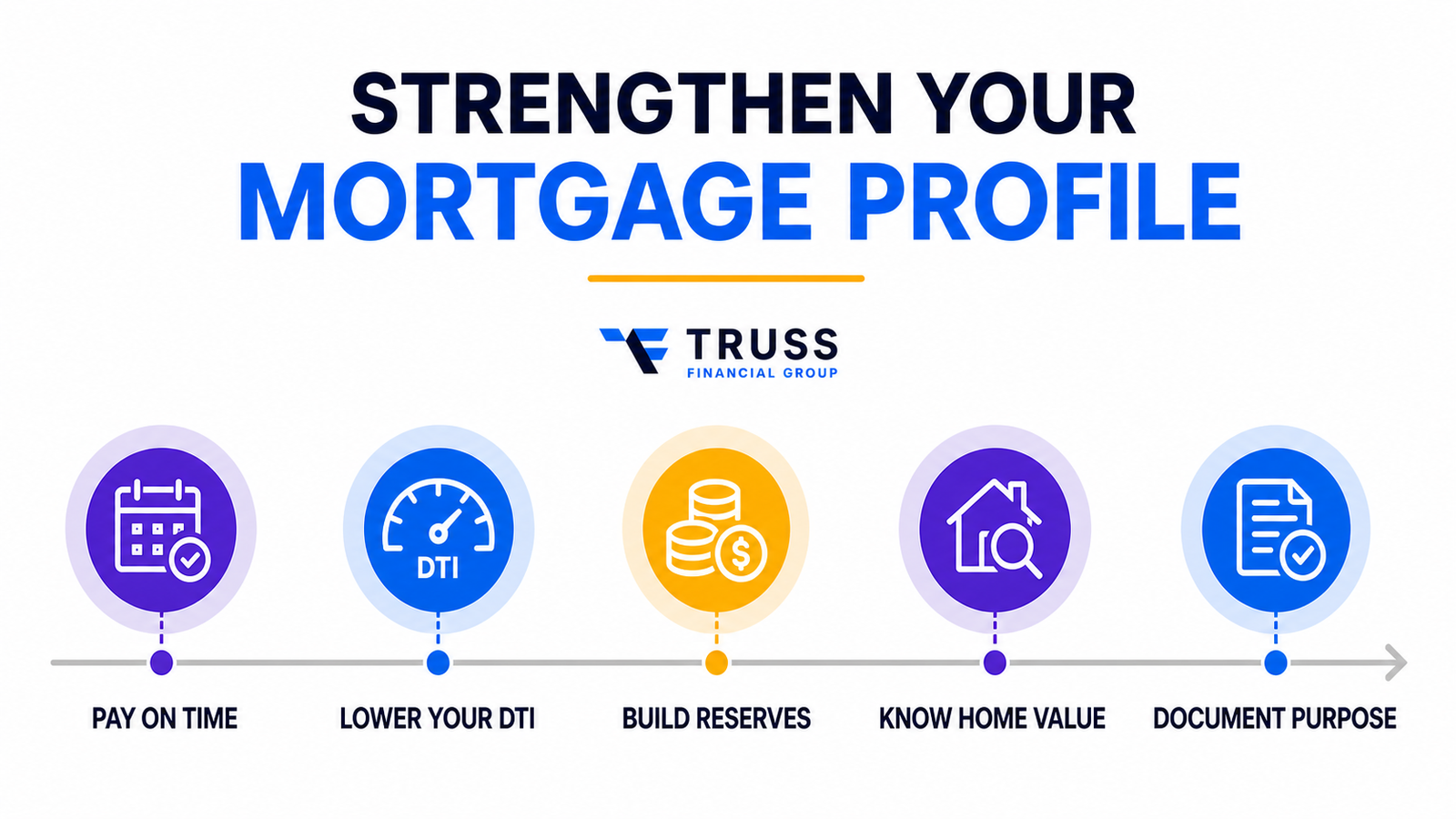
Most borrowers have a three-to-six-month window before they apply, enough time to move the needle on several C's if used deliberately. The highest-impact moves:
- Pay every bill on time and reduce revolving balances (Character)
- Pay down existing debt to lower your DTI (Capacity)
- Build reserves and model the PMI break-even on a larger down payment (Capital)
- Get a realistic home value estimate and maintain the property ahead of the appraisal (Collateral)
- Apply when your finances are stable, and your loan purpose is clearly documented (Conditions).
|
C |
What Lenders Evaluate |
Key Action Before Applying |
|---|---|---|
|
Character |
FICO score, payment history, credit file depth |
Pull all three credit reports; dispute errors; reduce revolving balances |
|
Capacity |
Debt-to-income ratio, income stability, employment history |
Pay down existing debt; document all income sources |
|
Capital |
Down payment, savings reserves, home equity |
Build reserves; model the PMI break-even on a larger down payment |
|
Collateral |
Property appraisal, LTV, CLTV (for HELOCs) |
Know your home's current market value; calculate accessible equity |
|
Conditions |
Loan purpose, property type, rate environment |
Be specific about purpose; understand fixed vs. variable tradeoffs |
Frequently Asked Questions
What are the 5 C's of credit and how do they affect mortgage approval?
The 5 C's (Character, Capacity, Capital, Collateral, and Conditions) are the five criteria every mortgage lender uses to evaluate how risky it is to approve a home loan. Lenders assess all five together as a system; no single C is automatically decisive, and strength in one area can partially offset a weakness in another.
Which of the 5 C's matters most for a mortgage vs. a HELOC?
For mortgages, Character and Capacity tend to carry the most weight because they speak directly to willingness and ability to repay over a long term. For HELOCs, Collateral (home equity and CLTV) and Capacity are the dominant factors, since the home's value is the primary security and the lender needs confidence the borrower can service the line throughout the draw period.
What credit score do I need to qualify for a mortgage or HELOC?
Most conventional mortgage lenders require a minimum FICO score of 620, though scores of 740 and above unlock the most favorable rates. For HELOCs, most lenders prefer 680 or higher, with many setting 700 as the practical threshold given the revolving structure of the credit line.
What is a good DTI ratio for a home loan?
Most conventional mortgage lenders prefer a DTI at or below 43%, the threshold established by the CFPB's Ability-to-Repay framework for qualified mortgages. Many lenders prefer 36% or lower for their most competitive rates. The lower the DTI, the stronger the capacity signal.
How do lenders evaluate income for self-employed mortgage applicants?
Self-employed borrowers are typically evaluated on a two-year average of net income as reported on tax returns, not gross revenue. Lenders use Schedule C for sole proprietors and K-1s for partnerships and S-corps. Bank statement loans are an alternative path for borrowers whose tax returns significantly understate their actual cash flow.
What is a combined loan-to-value ratio and why does it matter for a HELOC?
The CLTV accounts for both the outstanding primary mortgage balance and the new HELOC limit relative to the home's appraised value. Most HELOC lenders cap the CLTV at 80% to 85%, meaning borrowers need at least 15% to 20% equity remaining after the line is issued.
Can a larger down payment offset a lower credit score on a mortgage application?
Yes, to a degree. A larger down payment reduces the LTV, lowers the lender's risk exposure, and signals stronger Capital, which can partially offset a lower Character score. The degree of offset depends on the lender and the specific score; it won't compensate for a very low score, but it can improve approval odds and terms at the margins.
What are bank statement loans and who are they designed for?
Bank statement loans are mortgage products that use 12 or 24 months of business or personal bank statements to verify income in place of tax returns. They're designed for self-employed borrowers whose tax returns significantly understate actual cash flow due to legitimate business deductions. They typically carry slightly higher rates than conventional products but provide a more accurate picture of the borrower's actual financial health.
Ready to See How Your Profile Stacks Up for a Mortgage or HELOC?
The 5 C's of credit are the framework every mortgage and HELOC lender uses, and understanding them is the most practical preparation a borrower can do before starting an application. The real question isn't what the 5 C's are in theory; it's how your specific profile looks across all five dimensions before you take on a new loan, and what, if anything, is worth addressing first.
That's especially true for self-employed borrowers, where the documentation path alone can make a meaningful difference in how income is evaluated and what loan options are available to support their financial goals.
Mortgage brokers like Truss Financial Group will look at your actual profile (credit history, income, reserves, equity position, and loan purpose) and give you a clear read on where you stand and what your options are before you commit to an application.

.svg)

Discuss your unique requirements
Get direct answers and a roadmap for your future.
.png?width=202&height=202&name=image%20588255187%20(1).png)









.svg)

.svg)
.svg)