.svg)



%20(1).svg)
%20(2).svg)
.png?width=480&height=420&name=Img%20(1).png)
%20(3).svg)
%20(4).svg)

%20(5).svg)


 View all states
First Lien HELOC Texas: Rules, Costs & How It Works

18 mins

In this blog
Key Takeaways
- A first lien HELOC in Texas is a revolving line of credit secured by your home in first position. It may be used on a paid-off home or replace an existing first mortgage.
- Texas homestead rules generally limit the combined principal amount of qualifying home-secured debt to 80% of the home's fair market value when the credit is established. A lender may impose a lower limit.
- A first-lien HELOC can provide flexible access to funds, but its variable-rate structure can also mean changing payments and borrowing costs.
- If you already have a low fixed-rate mortgage, compare the cost of replacing it with a first-lien HELOC against keeping the mortgage and using a second-lien HELOC.
- Texas has specific requirements covering HELOC advances, fees, waiting periods, closing procedures, rescission and other borrower protections.
- Before applying, compare the rate, margin, fees, CLTV, payment structure, draw and repayment periods, and total cost rather than focusing only on the initial HELOC rate.
There is a point in the home-equity conversation when the question stops being, “How much equity do I have?” and becomes, “Where should the new debt sit?”
That distinction matters in Texas.
A first lien HELOC in Texas is a revolving line of credit secured by your home in first position. It can be the only lien on a home you own free and clear, or it can replace an existing first mortgage when that mortgage is paid off as part of the transaction.
The flexibility can be useful. But if you already have a mortgage with a favorable fixed rate, moving that entire balance into a new potentially variable-rate line deserves careful consideration.
Quick Answer For Texas Homeowners
A first-lien HELOC may be worth considering if you own your Texas homestead free and clear, need flexible access to equity over time, or have an existing mortgage whose rate and remaining balance make repayment worth evaluating. It may be a different story if you have a low fixed-rate mortgage that you would have to give up.
The important distinction is that the first lien describes lien priority, not a particular interest rate or a guarantee of better terms. A first-position HELOC can have different pricing, fees, payment rules and HELOC qualification requirements from one lender or program to another.
Texas adds another layer. A HELOC secured by a Texas homestead has to satisfy federal HELOC requirements as well as the state’s constitutional home-equity protections.
For that reason, it is worth comparing a first-lien HELOC with keeping your existing mortgage and taking a second-lien HELOC, as well as a home equity loan or cash-out refinance where appropriate.
What is a First-Lien HELOC?
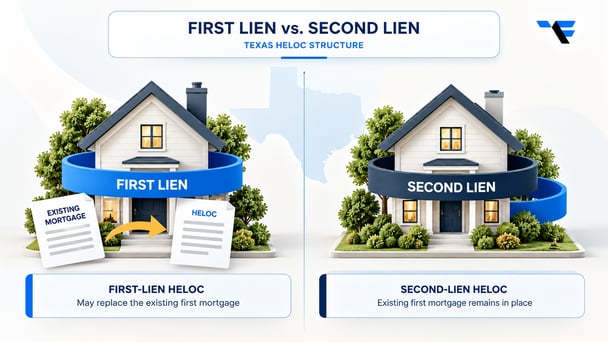
The simplest way to understand a first position HELOC in Texas is to think about priority. A first lien has priority over later voluntary mortgage liens on the property. If you already have a mortgage and a new HELOC is placed behind it, the HELOC is a second lien. If the existing mortgage is paid off and the HELOC takes its place, the HELOC becomes the first lien.
There are two common starting points. The first is a homeowner with a paid-off property. Because there is no existing mortgage, the new HELOC can occupy first position. The second is a homeowner who still has a mortgage. The new HELOC can be structured to pay off that mortgage, leaving the HELOC as the primary home-secured debt.
This is different from a conventional second-lien HELOC, where the existing first mortgage stays in place.
A HELOC itself is revolving credit. During the advance period, you can generally draw against the available line, repay what you have borrowed, and potentially borrow again, subject to the terms of the agreement. The CFPB HELOC guide says it’s an open-end line of credit secured by the home.
If you want a detailed explanation of the mechanics, see our guide on how a HELOC works.
First-Lien HELOC vs. Traditional Mortgage
The biggest difference is how the money is structured.
| Decision factor | First-lien HELOC | Traditional mortgage |
|---|---|---|
| Structure | Revolving credit line | Closed-end installment loan |
| Rate | Commonly variable | May be fixed or adjustable |
| Access to funds | Borrow as needed during the advance period | Generally funded as a lump sum |
| Reborrowing | May be available during the advance period | Requires new financing or another credit facility |
| Payment certainty | Can change with balance and rate | Usually more predictable with a fixed rate |
| Existing mortgage | May replace it | Remains in place if not refinanced |
| Main question | Is flexibility worth the payment and rate uncertainty? | Is predictable long-term repayment more important? |
This is where the decision becomes more personal.
Suppose you have an existing mortgage with a rate you consider attractive. Replacing it with a first-lien HELOC does not mean you are refinancing only the amount of new cash you want.
You are changing the financing on the mortgage balance that gets paid off, too.
That means the comparison should not stop at the HELOC's advertised or initial rate. Look at the rate structure, margin, caps, fees, payment formula, and what your payment could look like if rates rise.
A low initial payment can tell only part of the story.
First-Lien vs. Second-Lien HELOC in Texas
This is often the more important comparison for a homeowner who already has a mortgage.
A second-lien HELOC sits behind the existing first mortgage. You keep that mortgage and open a separate revolving line against available equity.
A first-lien HELOC moves into first position. If an existing mortgage is being replaced, the mortgage balance is paid off as part of the transaction.
The trade-off is straightforward:
Second lien: preserve the existing mortgage, but add another secured debt.
First lien: consolidate the primary mortgage and equity-access facility into one first-position account, but potentially replace the terms of the existing mortgage.
Neither structure is automatically cheaper. Pricing depends on the lender, property, credit profile, CLTV, loan amount, lien position, documentation and program.
Texas also requires homeowners to identify existing home-equity debt early. Only one loan described under Section 50(a)(6) may be secured by the homestead at a time.
For someone with a very favorable existing mortgage, that makes the first-lien vs. second-lien comparison especially important.
How Draws and Payments Work
A HELOC normally has an advance period followed by a repayment period, but you should not assume that every product uses the same timeline or payment structure.
During the advance period, you can access available credit according to the line agreement. The balance can rise when you draw money and fall when you repay principal.
Texas law requires scheduled payments during the advance period to at least cover accrued interest. A lender may require more than that, so “interest-only” should never be assumed without reading the actual agreement.
Once advances end, Texas law requires the loan to be scheduled for substantially equal installments. The actual contract determines how that repayment works, including the length of the repayment period and whether any fixed-rate conversion feature is available.
For example, imagine a hypothetical $100,000 line where you draw $40,000. If the applicable annual rate were 8%, the interest on a $40,000 balance would be approximately $267 for a 30-day month before considering the actual daily accrual and payment terms. If you later draw another $20,000, the balance rises to $60,000, and so does the interest cost.
The point is simple: you pay based on what you borrow, not merely on the size of the approved line, but the rate applied to that balance can change.
Texas Rules You Need to Understand
Texas home equity lending is unusual because key protections are embedded in the state constitution.
For a Texas homestead equity loan, the principal amount extended, together with other debt secured by the homestead, generally cannot exceed 80% of the home's fair market value when the credit is established. That is a state ceiling, not a promise that a particular lender will approve 80% CLTV.
The 80% Homestead Limit
Consider a hypothetical home with a fair market value of $500,000.
Eighty percent of that value is $400,000.
If there were no other qualifying home-secured debt, the constitutional framework would permit total principal secured by the home up to that amount. But a lender can impose a lower CLTV limit based on its own underwriting and product requirements.
For a homeowner with an existing mortgage, the relevant calculation includes that debt.
This is why “80%” should be treated as a legal ceiling rather than a borrowing promise.
Advance and Account Restrictions
Texas imposes rules specific to home equity lines.
Each HELOC advance must be at least $4,000. The constitution also restricts the use of credit cards, debit cards, solicitation checks and similar devices to obtain advances. A lender cannot charge a fee in connection with an individual advance, and the lender may not unilaterally amend the terms of the line.
These are Texas-specific requirements, not universal features of every HELOC nationwide.
That distinction matters when you compare a Texas HELOC with descriptions you may find online for products in other states.
Waiting Period, Closing and Rescission
Texas also imposes timing and closing requirements for qualifying home-equity transactions.
A qualifying loan generally cannot close before the applicable 12-day period following the written application and required notice. The transaction must also follow Texas requirements for final cost disclosure and the location of closing.
After closing, a three-day right of rescission may apply under the applicable federal and state framework.
This does not mean a Texas first-lien HELOC can always be funded in exactly 15 days. Underwriting, title work, valuation, documentation, holidays and other transaction-specific issues can extend the timeline.
Fee Cap and Prepayment
Texas limits certain fees and charges associated with qualifying home-equity loans. The commonly cited 2% cap does not mean every dollar a homeowner pays at closing is subject to a blanket 2% ceiling.
Certain third-party costs, such as qualifying appraisal, survey and title-related expenses, are treated separately under the constitutional framework.
A qualifying Texas home-equity loan can also be prepaid without a penalty or charge. The exact transaction should still be reviewed for the costs and terms that apply to the specific product.

Who Might Consider a First-Lien HELOC?
A first-lien HELOC may deserve consideration if you own your Texas homestead free and clear and prefer a revolving line rather than taking one large lump sum.
It may also be worth examining if your existing mortgage is relatively expensive compared with the financing available to you today, and replacing it does not create an unfavorable long-term trade-off.
Another potential fit is a homeowner facing staged expenses. Renovations are an obvious example: instead of borrowing the entire projected cost on day one, the homeowner may want access to funds as different stages of the project arise.
The key is having a repayment strategy.
A HELOC should not automatically be treated as an emergency fund simply because the credit is available. Federal rules allow lenders to freeze or reduce access under certain circumstances, including significant changes in property value or the borrower's financial circumstances.
When a First-Lien HELOC May Be the Wrong Fit
Sometimes the most important number in the decision is the mortgage rate you already have.
If you have a low fixed-rate mortgage and would have to replace the entire balance with a variable-rate first-lien HELOC, the flexibility of the line may not compensate for the change in financing cost.
The structure may also be less suitable if you know exactly how much money you need and prefer a predictable principal-and-interest payment from the beginning. A traditional home equity loan may be easier to evaluate in that situation.
Similarly, if your budget cannot comfortably absorb a higher rate or a larger payment once the advance period ends, the line deserves a second look before you sign.
And if you routinely need amounts below Texas's $4,000 minimum advance, a Texas HELOC may not work the way you expect.
First-Lien HELOC Rates, Fees and Total Cost
One mistake I see homeowners make is comparing only the opening rate.
HELOC pricing is commonly variable and may be based on an index plus a lender margin. The offer may also specify a floor, periodic rate cap, lifetime cap or fixed-rate conversion option.
When comparing first lien HELOC rates, ask for the actual APR and the components that determine it. Then compare that with the rate on the entire mortgage balance that would be replaced.
Also request a written breakdown of:
- Lender charges
- Appraisal or other valuation costs
- Survey costs, if applicable
- Title work and title insurance
- Recording costs
- Annual or maintenance fees
- Any fixed-rate conversion costs
- Any permitted early account-closure charges
Avoid relying on a generic online rate range. HELOC pricing can change, and the rate available to one borrower may not be available to another.
Qualification and Documents
There is no single Texas-wide credit score, DTI ratio or income threshold that guarantees approval for a first-lien HELOC.
Lenders may evaluate:
- Homestead status
- Existing liens
- Property value
- Requested credit line
- CLTV
- Credit history
- Income and repayment ability
- Debt-to-income ratio
- Occupancy
- Homeowners insurance
- Assets and reserves
Documentation may include identification, the current mortgage statement, insurance information, property-tax records, income documentation and asset statements. Self-employed borrowers may need additional business or bank-statement documentation depending on the program.
Property valuation also varies. A lender may require a full appraisal, or an eligible program may use another permitted valuation method.
The important thing is to confirm the valuation method before assuming an appraisal will or will not be required.
Owner and spouse consent requirements also matter under the Texas homestead framework.
Applying for a First-Lien HELOC in Texas
The process usually starts with a question that sounds administrative but is actually critical: what liens are currently attached to the property?
From there, the process generally involves:
- Reviewing your current mortgage and equity position.
- Comparing a first-lien HELOC with a second-lien HELOC and other financing options.
- Submitting the application and required documentation.
- Receiving the applicable Texas notices and HELOC disclosures.
- Completing credit, income, title and property-value review.
- Reviewing the final costs and loan terms.
- Closing at a permitted location.
- Completing any applicable rescission period before accessing funds.
If your existing mortgage is being paid off, confirm exactly how that payoff will occur and when the old lien will be released. Also ask when the HELOC can actually be used. The constitutional waiting period is only one part of the overall transaction timeline.
Risks and Consumer Protections
The biggest risk is not complicated: the HELOC is secured by your home. If you fail to make the required payments, foreclosure can become a possibility.
Then there is variable-rate risk. A payment that feels comfortable at today's rate may become less comfortable if the applicable rate rises. There is also the risk of carrying a balance without making meaningful progress on principal. If your payment only covers accrued interest, the balance does not fall simply because you are making payments. Finally, there is the risk of losing a mortgage rate you would have preferred to keep.
Texas provides meaningful protections around qualifying home-equity transactions, including the 80% framework, consent requirements, waiting periods, closing requirements, rescission rights, limits on certain fees and prepayment protections. Those protections do not make a HELOC risk-free.
For questions about how Texas law applies to a particular transaction, homeowners should consult qualified Texas mortgage lenders or legal counsel rather than relying on a general article.
How to Compare Texas First-Lien HELOC Offers
If you are comparing offers, put them next to one another rather than evaluating them separately.
Ask each lender for:
- Credit-line amount
- Initial draw requirement, if any
- Current APR
- Index and margin
- Rate floor and caps
- Payment formula
- Advance-period terms
- Repayment-period terms
- Annual or maintenance fees
- Fixed-rate conversion options
- Permitted line-freeze provisions
- Valuation method
- Title and closing costs
- Expected processing timeline
Then model at least three scenarios.
First, calculate what happens under the expected rate and borrowing pattern. Second, test the payment at a meaningfully higher rate. Third, calculate what the payment looks like once the advance period ends and principal repayment begins. And do not compare the first-lien HELOC in isolation. Put it next to:
- Keeping your existing mortgage + second-lien HELOC
- A fixed home equity loan
- A cash-out refinance, where available and appropriate
The best structure depends on what you are giving up as much as what you are gaining.
The Bottom Line for Texas Homeowners
A first-lien HELOC can be a useful way to turn home equity into flexible borrowing capacity. For a homeowner with a paid-off property, it can create a first-position line without an existing mortgage to replace. For someone with a mortgage, it can potentially consolidate the existing debt and future equity access into one revolving facility.
You may be moving from a known mortgage payment into a structure where the rate and payment can change. You may also be giving up an existing mortgage rate that is difficult to replace.
For Texas homeowners comparing the options, a side-by-side review of a first-lien HELOC in Texas, a second-lien HELOC and the existing mortgage can make that decision much clearer.
Truss Financial Group can review the available structure for your property and financial profile, but approval, pricing, lien position, program availability and final terms remain subject to underwriting, licensing requirements, Texas law and the specific loan program.
Frequently Asked Questions
Can a HELOC be the first lien in Texas?
Yes. A HELOC can occupy first position when the property is free and clear or when an existing first mortgage is paid off and released as part of the new transaction.
Does a first-lien HELOC replace my mortgage?
It can. When an existing first mortgage is paid off through the transaction, the HELOC can become the first-position lien. It does not have to be structured this way in every situation.
What is the maximum LTV for a Texas HELOC?
For a qualifying Texas homestead equity transaction, the constitutional framework limits the principal amount extended, together with other debt secured by the homestead, to 80% of the home's fair market value when the credit is established. A lender may impose a lower limit.
Is every Texas HELOC draw at least $4,000?
Under the Texas constitutional requirements for a home equity line, each advance must be at least $4,000.
Can I have two home equity loans on my Texas homestead?
Only one loan described by Texas Constitution Section 50(a)(6) may be secured by the homestead at a given time.
How soon can a Texas HELOC close?
The Texas framework includes a 12-day waiting period tied to the application and required notice, but that is not a guaranteed total processing timeline. Title work, valuation, underwriting and documentation can take longer.
Are all Texas HELOC closing costs capped at 2%?
No. The 2% limitation applies to specified fees and charges, while certain qualifying third-party costs are excluded from that calculation.
Can I sell or refinance with a first-lien HELOC?
Generally, the lien has to be paid, released or otherwise addressed in the subsequent transaction. Texas home-equity refinance rules can also affect the structure, so this should be reviewed before proceeding.
Does a sweep strategy pay off the home faster?
No strategy guarantees faster payoff or interest savings. Interest costs depend on the outstanding balance, applicable rate and how quickly principal is actually reduced. A homeowner should evaluate any “sweep” or velocity-banking strategy using actual cash flow and loan terms rather than assuming the strategy itself creates savings.
Is HELOC interest tax deductible?
It depends on how the borrowed money is used and whether the homeowner meets the other applicable federal requirements.
Current IRS guidance generally allows home-equity loan or HELOC interest to qualify as home mortgage interest only when the borrowed funds are used to buy, build or substantially improve the home securing the debt, subject to applicable limitations. Interest used for personal expenses such as paying off credit-card debt generally does not qualify under these rules.
Tax treatment can change and depends on the borrower's circumstances, so speak with a qualified tax professional before assuming any interest will be deductible.

.svg)

Discuss your unique requirements
Get direct answers and a roadmap for your future.
.png?width=202&height=202&name=image%20588255187%20(1).png)









.svg)

.svg)
.svg)