.svg)



%20(1).svg)
%20(2).svg)
.png?width=480&height=420&name=Img%20(1).png)
%20(3).svg)
%20(4).svg)

%20(5).svg)


 View all states

15 mins
In this blog
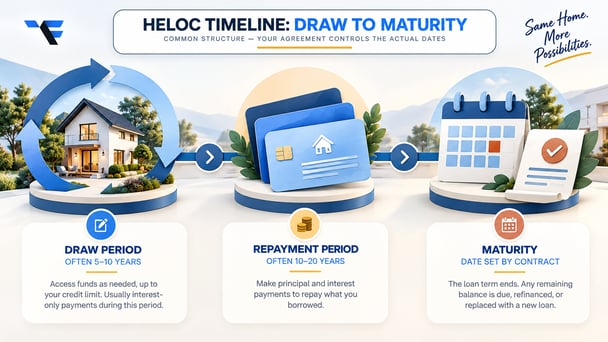
Many HELOCs can extend for roughly 20 to 30 years from start to finish. A common structure is a 5- to 10-year draw period followed by 10 to 20 years of repayment. However, those numbers aren't universal. Your actual timeline depends on the HELOC agreement that will outline when borrowing ceases, when repayment is required, how minimum payments are calculated, and when the balance is fully paid.
The end of the draw period is generally the point of greatest interest for most borrowers who can find themselves struggling to make payments with relatively low, interest-only payments that suddenly require the borrower to start contributing principal as well.
What Determines the Length of a HELOC?
The question of how long are HELOC loans is deceptively simple, with a number of factors that determine the final answer. A Home Equity Line of Credit generally has two phases. First is the draw period, in which the borrower can access funds on the line of credit. Then comes the repayment period, in which you stop borrowing and begin paying down what you've received.
That's why you may hear someone describe their HELOC as lasting 10 years while another person describes their HELOC as lasting 25 years. They may have been referring to different phases of the same loan.
The HELOC loan structure can vary based on the lender, the product, the property, the lien position, applicable state regulations, and the terms outlined in the agreement. Your credit limit isn't necessarily a factor in your HELOC's length of time.
A HELOC isn't the same thing as a traditional home equity loan. With a HELOC, you generally get a revolving line of credit that you can access repeatedly through the draw period. A home equity loan generally provides one lump sum of funds to the borrower, with repayment beginning soon after the loan is funded.
Therefore, if someone asks how long are HELOC loans for, the answer depends on more than just the draw period.
HELOC Timeline at a Glance
| Stage | Common Structure | Can You Draw? | What Happens to Payments? |
|---|---|---|---|
| Draw period | Often 5–10 years | Generally yes | Interest-only minimum payments are common, although some plans require principal payments as well. |
| Repayment period | Often 10–20 years | Generally no | Principal and interest are generally paid according to the repayment schedule. |
| Maturity | Date specified in the agreement | No | Any remaining balance must be handled according to the contract. |
Those are common structures, but your own disclosures and loan agreement are your true guide.
How the HELOC Draw Period Works
The HELOC draw period is your borrowing window.
Say you have a $75,000 line and use $20,000. If your agreement permits it, you may continue to have access to the remaining available line of credit. As you pay back portions of the principal, the available credit may be refreshed during the draw period, allowing you to draw again.
You're generally only charged interest on the amount you've actually borrowed, rather than the unused portion of the line. Some plans have minimum draw requirements or other conditions, so be sure to ask about how your line works in advance of assuming that it operates a particular way. Then there's your monthly payment.
Some HELOCs allow interest-only payments during the draw period. Others require you to pay principal and interest from the beginning. An interest-only payment can make the monthly payment look relatively favorable, although you'll need to understand that you're not reducing the main balance of the loan with that payment.
That's another reason why the answer to how long are HELOC loans isn't sufficient on its own. You'll need to know what happens to your payment when the window for borrowing closes.
Rates are another consideration. HELOCs commonly have variable interest rates, so you're likely to find that your HELOC payment will change even as your HELOC balance remains constant. The rate may be tied to an index, with a particular margin added to reach the final rate, and the agreement will specify applicable rate caps and other details.
Having a 10-year draw period isn't necessarily something that means you'll have uninterrupted access to the full line for all 10 years. In certain situations, as permitted by the agreement and applicable law, your lender may restrict future advances or reduce the credit line. Changes in property value or the borrower's financial situation may be a factor.
What Happens When the Draw Period Ends?
This is the point where what happens after a HELOC draw period ends matters a great deal.
Once the draw period expires, you generally can no longer borrow additional money from the line. The balance that you've accumulated begins to enter the repayment phase, assuming that your agreement follows the typical structure of draw followed by repayment. And yes, your payment can move higher.
If you were making interest-only payments during the draw period, you'll have to start making payments to reduce the principal, and the remaining balance will have to be amortized across the repayment period. If the HELOC has a variable rate, changes to that rate can affect the payment, too.
Let's take an example:
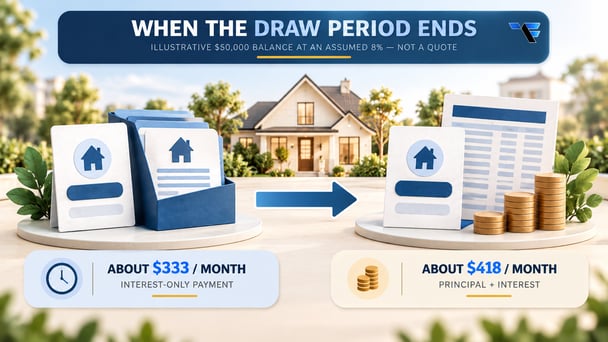
HELOC balance: $50,000
Assume you have a $50,000 balance with an applicable interest rate of 8%.
With an interest-only payment, your monthly interest would be:
$50,000*8% ÷ 12 = about $333 per month
Now imagine the same $50,000 balance moves into a 20-year repayment schedule at an assumed 8% rate, with principal and interest amortized over 240 months. The monthly payment would be roughly $418.
Obviously, this is only an example. It isn't a quote, and an actual HELOC payment could be higher or lower, depending on the interest rate, the balance, and the lender's calculation. The important takeaway is far more interesting – a payment that looked manageable can become much tougher during the repayment period. You'll need to budget accordingly.
Some HELOC agreements contain balloon-payment provisions. Instead of amortizing the full outstanding balance, the contract requires you to pay a large amount of the outstanding balance at a particular point. The CFPB recommends that borrowers understand whether their HELOC contains such a provision.
How the HELOC Repayment Period Works
The HELOC repayment period is all about repaying that line of credit. So, there's no single answer to how long do you have to repay a HELOC. You may have 10 or 20 years for repayment, with individual plans containing different timelines. During the repayment period, your monthly payment will generally include both principal and interest. Assuming you're paying roughly as expected, the balance should reach zero by the maturity date.
The interest rate may remain variable during this period. That's important because even as you're no longer borrowing any additional money, the rate can continue to increase, pushing your payment higher month after month.
Some lenders offer a fixed-rate conversion option. Where available, this may allow you to convert a portion or the entirety of your outstanding balance into a fixed-rate component. However, the converted balance isn't guaranteed to have the same rate or term as the rest of the HELOC, and other conditions, including fees, may apply.
You can generally make additional payments above and beyond the minimum if your agreement permits it. Doing so is a smart move, as it accelerates payoff and reduces the outstanding balance, which can reduce your interest expenses in the long term. However, you'll need to know how additional payments are applied and whether early payoff or closure of the account triggers a fee.
Can You Extend, Renew, or Refinance a HELOC?
If you're approaching the end of your draw period, you may be asking yourself how long are HELOC loans allowed to continue and how long can they keep going. You won't necessarily have an automatic extension just because you have a balance or because you wish to continue using the line. Depending on the lender and your circumstances, you may have several options:
- Request an extension or renewal, if one is offered
- Apply for a new HELOC
- Replace the balance with a home equity loan
- Refinance through a cash-out mortgage
- Pay the balance using another source of funds
Each option works differently, and none are guaranteed. A new HELOC or other loan will generally require a new review of your credit, income, equity, property value, title, and financial situation. New closing costs and disclosures will be required.
Refinancing can change the structure, but it isn't something to assume will always be available. Your circumstances can change before the end of the original term, with extending the debt carrying the potential of additional interest payments.
Truss Financial Group offers HELOC options, including no-appraisal options for borrowers and properties that meet the applicable requirements.
Events That Can Shorten or Change the Timeline
The original term isn't necessarily the one that you'll keep. You may pay off the balance early. You may sell the property. You might refinance the balance and effectively extend the repayment period. Or, you may be restricted from further borrowing by the lender if applicable circumstances detailed in the agreement arise.
Selling the house is certainly something that requires attention. Since a HELOC is secured by the property, the balance generally has to be paid off when the property is sold, in order to allow the lender to release the lien. The CFPB notes that a borrower will generally need to repay a HELOC when the home is sold.
Another detail that's easy to forget is the fact that paying the balance down to zero isn't necessarily the same thing as closing the account. You could have no balance while the account remains open, with fees applying depending on the agreement. If you wish to close the account, ask the lender what steps need to be taken in order to do so.
HELOC vs. Home Equity Loan Terms
Both products utilize home equity as collateral, but the way in which you access and repay them is fundamentally different.
| Feature | HELOC | Home Equity Loan |
|---|---|---|
| Access to funds | Reusable line of credit during the draw period | One lump sum |
| Typical phases | Draw period, followed by a repayment period | Repayment begins after funding |
| Interest rate | Usually adjustable | May be fixed or adjustable |
| Payments | Can change based on the outstanding balance and interest rate | Depends on the loan structure |
| Borrowing style | Access funds as needed | Receive a defined amount upfront |
A HELOC is a revolving line of credit secured by your home, while a home equity loan generally provides a lump sum of funds with no revolving aspect. Both options use the home as collateral, meaning that failure to repay the loan can lead to the loss of the property.
Neither structure is automatically right for everyone, but you should consider which one works best for your own financial needs. Consider if you want a line that allows you access to funds gradually, or if you'd prefer to receive a lump sum. Consider if you have a set amount that you want to borrow, or if you want to have the ability to use the funds as you need them.
Terms and Costs to Check Before Signing
Before applying for a HELOC, you should look beyond the introductory rate. The agreement can contain a number of terms that can affect your finances significantly several years down the road. Check:
- Draw-period length
- Repayment-period length
- Maturity date
- Minimum-payment calculation
- Whether interest-only payments are allowed
- Index and margin
- Rate caps
- Fixed-rate conversion options
- Minimum draw requirements
- Balloon-payment provisions
- Annual or maintenance fees
- Transaction or inactivity fees
- Valuation, appraisal, title, and recording costs
- Early-termination or cost-recapture fees
The CFPB notes that HELOCs can come with a number of costs, including application, appraisal, closing, title, and other costs, depending on the specific plan.
One thing to note is the fact that you shouldn't confuse loan duration with application speed. If you're asking how long does a HELOC approval take or how long does it take to fund a HELOC, you're asking a different question entirely that depends on the lender and application.
How to Choose a HELOC Term That Fits
Rather than asking the question of how long are HELOC loans, you should ask yourself whether the timeline is right for your own financial circumstances.
Consider the reason for your borrowing. If you need funds for expenses that will be incurred gradually, you may find a revolving line more beneficial than taking a lump sum and having to deal with that later. If you already know that you need a specific amount of cash, another form of borrowing may be worth investigating.
Then, consider your repayment period. What would your payment be like if the entire balance had to be amortized? What will happen if the variable rate moves higher? Will you be able to make the payment without relying on another loan?
Those are far more valuable questions than asking how long the draw period can be. With the ability to pay some of the principal down during the draw period, you could reduce the balance that you'll carry once the repayment period begins, assuming that your budget allows for it. However, you shouldn't sacrifice your emergency savings account in order to reduce a HELOC balance.
When looking at HELOC offers, look at the entire package. Consider the length of the draw period, the payment formula, the fees, rate adjustments, conversion options, and maturity provisions. The starting APR is just one part of the picture.
FAQs (Frequently Asked Questions)
How long does a typical HELOC last?
A HELOC commonly has a 5- to 10-year draw period followed by a 10- to 20-year repayment period. This can create a total timeline of roughly 20 to 30 years, although actual terms will vary by lender and agreement. Your disclosures should outline the maturity date and repayment structure.
What happens to a HELOC after 10 years?
If 10 years marks the end of the draw period, new borrowing will generally stop. The existing balance moves into the repayment period, and the monthly payment can increase if you were paying interest only. A variable rate could also be a factor. (consumerfinance.gov)
Can a HELOC draw period be extended or renewed?
Possibly, but don't assume it will happen. Any extension or renewal will depend on the lender and the plan. You may also need to go through a new credit or financial review before receiving a new line or extension.
Can I pay off a HELOC early?
Generally, you can repay the balance before maturity, but you should check the agreement first. Some plans may charge an early-termination or cost-recapture fee, particularly if the account is formally closed soon after its opening.
Can I borrow again during the repayment period?
New borrowing generally stops when the draw period ends. Some plans can have different provisions, so check your agreement rather than assuming that you can continue borrowing once you enter repayment.
Does a HELOC close automatically if the balance is zero?
Not necessarily. A zero balance means you don't currently owe money, but the account itself may remain open. Fees can apply depending on the agreement, and you should contact the lender to learn what it takes to formally close the account.
Can a lender freeze a HELOC before the draw period ends?
Yes, certain circumstances can allow a lender to suspend additional advances or reduce the credit line. The specific circumstances depend on the agreement and applicable law. Changes in the property's value or the borrower's financial situation may be a factor. (consumerfinance.gov)
What happens if a HELOC is not paid off by maturity?
The remaining balance will have to be handled according to the agreement. Depending on the structure of the HELOC, that could involve a final payment or a balloon payment. Don't assume the lender will automatically renew or refinance the debt when the maturity date arrives.
Next Step
Knowing how long are HELOC loans is interesting, but the more important question is what this timeline means for your budget. You should consider the length of the draw period, when repayment of the principal will begin, how the interest rate can change, what your payment could be, and what will happen when the loan reaches maturity.
When comparing HELOC options, Truss Financial Group can help you review currently available terms and payment structures based on your property and circumstances. A TFG loan officer can also help you understand the documentation and payment structure involved with an option that's available. Rates, terms, approval, credit limits, and program availability depend on the individual borrower, property, and program.

.svg)

Discuss your unique requirements
Get direct answers and a roadmap for your future.
.png?width=202&height=202&name=image%20588255187%20(1).png)

.png?width=389&height=221&name=Blog%20covers%20(10).png)

.png?width=389&height=221&name=Blog%20covers%20(22).png)

.png?width=389&height=221&name=Blog%20covers%20(1).png)


.svg)

.svg)
.svg)