.svg)



%20(1).svg)
%20(2).svg)
.png?width=480&height=420&name=Img%20(1).png)
%20(3).svg)
%20(4).svg)

%20(5).svg)


 View all states

17 mins
In this blog
Key Takeaways:
- A HELOC payment can change. A variable interest rate can raise your payment, and the payment may increase again when the draw period ends and principal repayment begins.
- The credit limit is not your budget. Borrow only an amount you could comfortably repay if rates rise, your income changes or other household expenses increase.
- Fees and restrictions can affect the real cost. Check closing, annual, inactivity, conversion and early-closure fees, and remember that unused HELOC funds can potentially be restricted under certain circumstances.
- Debt consolidation changes the risk. A HELOC may reduce the interest rate on credit card debt, but it also turns that debt into borrowing secured by your home.
- Look at what the HELOC leaves you with. Before borrowing, consider your future payment, remaining home equity and whether another option, such as a home equity loan or personal loan, would fit the expense better.
A "HELOC" gives access to home equity without replacing existing mortgages. But just because the bank is willing to lend against your home equity doesn't mean you have enough income to cover those payments. The main risks associated with a HELOC usually relate to a changing interest rate, increasing payments, fees and restrictions, the security of the loan against your home, and potentially continued borrowing.
That doesn't mean a HELOC is too risky, just that you should consider more than the maximum amount and the minimum monthly payment.
A HELOC has a draw period during which you can access the funds, followed by a payback period during which you must repay the credit. The terms of your HELOC should explain how much your monthly payments could change from one period to the next.
If you plan to apply for a HELOC it can help to understand the criteria which a bank uses to approve a HELOC application. The more important consideration is that your budget would still support the payments if your specific deal terms change.
Here are eight risks to consider and some potential ways to address them:
1. A variable rate can make payments harder to budget
Most HELOCs have a variable rate, which means the rate your lender charges you could change. In general, a variable rate is usually tied to some sort of index, as well as a lender-added margin. The current rate might not reflect the rate on the day you expect to make a payment, or even the rate on the day you borrow the money.
In some cases, the HELOC might have an introductory rate which is lower for the first year or two for borrowing. If that's the case, ask when the promotional rate expires and what the rate will be when it changes.
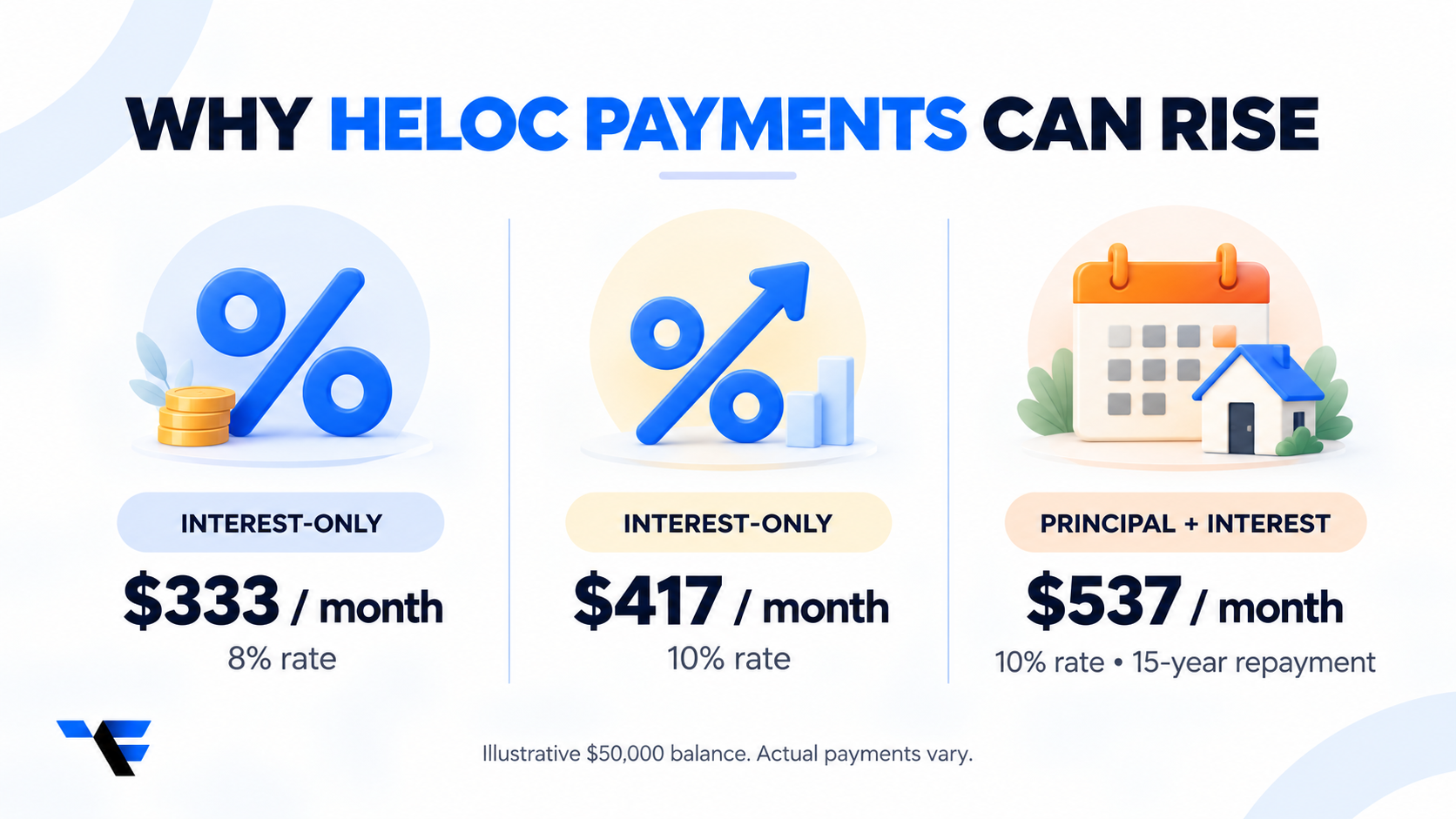
The effect can be significant if the amount borrowed is large. For example, a $50,000 balance at 8% would generate about $333 in monthly interest if the payment were interest-only. At 10%, the interest on that same balance would be about $417. You have not borrowed anything more, but the monthly interest has increased by roughly $84.
In your agreement, it should outline how often the rate can change and whether there's a cap on how far the rate can go. A rate cap limits how much the rate can change, but it doesn't guarantee that your monthly payment will remain affordable.
How to handle it
Don't base your borrowing decision on what the rate is today. Instead, try running calculations with a higher rate to see how a bigger rate change would affect your monthly payment. Can you easily afford the higher payment along with your mortgage, taxes, insurance, other debts and monthly expenses?
If your HELOC terms allow for converting some or all of your variable-rate balance to a fixed rate, ask your lender about how that works. Compare the rate, fees and the length of the repayment term to see if the fixed-rate conversion is worth it. Paying down the principal on a HELOC when you can also reduce the amount on which interest is charged.
2. Your payment can jump when the draw period ends
A monthly payment which seemed affordable during the draw period might not continue to be affordable when the draw period ends.
During the draw period, some HELOCs allow interest-only payments, which reduces the monthly payment significantly. Assuming you borrowed $50,000 and made interest-only payments, you are not reducing the $50,000 principal balance.
As the draw period ends and you enter the payback period, the terms of your HELOC might require you to start paying down the principal as well as the interest. That could make the payment jump, even if the interest rate remains the same.
Depending on how the HELOC is structured, you might also have to make a large final payment at the end of the payback period. The more important point for now is to realize that it might not be as simple as continuing to make the same monthly payment, especially if the draw period is still ongoing and you continue to borrow.
How to handle it
Find out when your draw period ends before borrowing. Ask your lender for an estimated payment during the payback period and how much principal you'll probably owe at that point. If you already have a HELOC and have failed to consider this issue, ask for the estimate now.
Making affordable principal payments during the draw period can reduce the amount which enters the payback period. If the forecast payment during the payback period seems unaffordable, refinancing might be an option to consider. That still requires making sure that you qualify for the new HELOC, and that the new terms, including any additional closing costs, are preferable given your repayment timeline and overall budget.
What could a $50,000 HELOC cost per month?
The two risks above can overlap, so it helps to compare the effect on actual numbers.
The following is a simple example. It isn't a formal quote and doesn't include other potential costs or additional borrowing.
| Scenario | Assumption | Approx Monthly Payment |
|---|---|---|
| Interest-Only | $50,000 at 8% | $333 |
| Interest-Only | $50,000 at 10% | $417 |
| Principal + Interest | $50,000 at 10% repaid over 15 years | $537 |
The first two rows reflect the impact of a rate increase when the payments are only for interest. The last row represents a case where the borrower is also paying down the $50,000 principal.
That makes a big difference. The increase from $417 to $537 isn't entirely due to the rate increase, but also due to the fact that the borrower is now paying down the $50,000 over 15 years.
The actual payment will depend on your lender's calculation, the balance, the interest rate and the HELOC terms. The point is that the payment today only reflects part of the affordability picture.
3. Missed payments can put your home at risk
This is the most serious risk to consider with a HELOC.
Your HELOC is a secured loan against your home. If you don't make the payments, the lender has the right to foreclose on your home. This is true even if you're current with the payments on your first mortgage, since a HELOC creates a separate obligation.
Selecting a fixed-rate HELOC, if available, can make the payments more predictable. But it doesn't change the fact that your home secures the debt.
This is why the amount for which you're approved shouldn't dictate the amount which you borrow. If you're approved for $100,000, you should still determine whether the HELOC fits within your personal budget.
Compare the HELOC payment with your existing mortgage, including the property taxes and insurance, other debts and regular monthly expenses. Budget for the possibility of unanticipated expenses as well.
If you're already having difficulty paying your bills, don't wait until you've missed several payments to ask for assistance. Contact your servicer and ask about hardship options for your situation.
You might also want to speak with a HUD-approved housing counselor. A housing counselor can help you evaluate your options and make a plan before the situation gets worse.
4. Fees can make a small or short-term HELOC more expensive
The interest rate is important, but it isn't the only cost associated with a HELOC.
Depending on the lender and the terms of the HELOC, there could be closing costs, appraisal or title-related costs, annual fees, inactivity fees, fees to convert to a fixed rate or to close the HELOC early.
These costs can be more of a concern if you expect to use only a small portion of the HELOC or if you expect to close the HELOC relatively soon.
For example, a lender might waive some of the upfront costs as long as you keep the HELOC open for a certain period. Paying those costs back when you close the HELOC early could increase your effective cost.
Also consider the difference between paying down the balance and closing the HELOC. Based on the terms of the HELOC, it might be possible to pay the balance to zero and leave the line of credit open.
Ask for a full list of any fees associated with the HELOC and consider the length of time for which you expect to keep the line open. HELOC closing costs can vary depending on the lender and the terms of the HELOC.
5. The lender may freeze or reduce your unused credit
Having an approved HELOC limit invites you to spend, but not all at once.
Under some conditions, a lender may be able to restrict or freeze your unused HELOC credit. This is possible, for example, if the value of your home falls significantly or if the borrower's financial situation changes in a way which causes the lender to believe the borrower may not be able to repay the HELOC.
A restriction on unused HELOC credit doesn't affect the balance which you've already borrowed. You still owe that amount and you'll still need to repay it.
How to handle it
Don't assume that the unused portion of your HELOC is a savings account. If possible, keep a cash savings account to cover unexpected expenses. Having $30,000 of unused HELOC credit is not the same as having $30,000 in savings.
If your line is restricted, read the lender's notice carefully. Ask for an explanation and inquire whether you can continue to make the payments which you're currently making and what, if anything, you need to do in order to restore access to the line.
6. Easy access to credit can lead to more debt
A HELOC has a draw period during which you can borrow and repay as needed. That flexibility comes at a price: the temptation to keep borrowing when you should be paying down the balance.
The risk is especially great if your HELOC is being used to consolidate debt.
The interest rate on your credit cards is probably higher than the interest rate on your HELOC. On that basis, it makes sense to pay down the credit card balances and use the HELOC to cover those expenses. But that ignores the fact that a HELOC is secured against your home, while credit card debt is unsecured.
There's another reason to avoid using a HELOC to pay off credit card balances and then maxing the cards again. You might find that the HELOC has a lower monthly payment, but that it's over a longer period. You could end up paying more interest overall on the new credit card balances than you would have on the HELOC balance.
How to handle it
Before borrowing, decide what the money is for and how much you're going to use.
If using home equity to pay off or consolidate debt, compare the overall cost, not just the monthly payment. Make a payoff plan for the HELOC and consider what needs to change in order to keep the credit card balances from simply growing again.
7. Borrowing against your equity can limit your options later
The equity in your home isn't cash in a checking account. It's the amount by which the value of your home exceeds the amount of the debts secured against it.
For example, if your home is worth $500,000 and you owe $300,000 on your first mortgage, you have roughly $200,000 in gross equity before selling costs and other considerations.
If you add a $50,000 HELOC balance, the debt secured against the property becomes $350,000. Your gross equity falls to roughly $150,000.
That can be a concern if you're planning to sell the home in the future. When you sell the property, the debts secured against it generally need to be paid off with the sale proceeds before you receive the remaining amount, after selling costs and other obligations.
A drop in the value of your home during this time would further reduce your gross equity.
How to handle it
If you're planning to move or to refinance within the next few years, that should affect your borrowing decision.
You don't necessarily need to avoid borrowing against your home equity, but it helps to leave some equity rather than borrowing up against the full amount.
A future increase in the value of your home isn't a repayment plan.
8. The HELOC may not be the best fit for the expense
Sometimes the biggest concern with a HELOC is that it's the wrong type of loan for the situation.
A HELOC provides easy access to funds and the flexibility to repay and borrow again during the draw period, but those advantages aren't available in every situation. If you know how much you need and want a fixed-rate payment, a home equity loan might be preferable. If you need a smaller amount and want to avoid putting your home up as collateral, a personal loan might be a better choice.
| Option | Payment structure | Home secures the debt? | May make sense when |
|---|---|---|---|
| HELOC | Usually variable, with flexible draws | Yes | You need access to money over time |
| Home equity loan | Usually fixed | Yes | You know the exact lump sum you need |
| Cash-out refinance | Replaces the existing mortgage | Yes | Replacing the current mortgage also makes financial sense |
| Personal loan | Usually fixed | No | You need a smaller amount without using your home as a collateral |
| Save and delay | No loan payment | No | The expense is optional and can wait |
A home equity loan might be easier to budget for if you know the exact amount and want predictable payments.
A personal loan avoids putting your home up as collateral, although the interest rate might be higher.
A cash-out refinance is appropriate only if replacing your existing mortgage makes financial sense. Refinancing your mortgage simply to access additional cash could end up being more expensive if the rate on your existing mortgage is favorable and you have several years left on the loan term. Compare the rate, remaining term, closing costs and total interest on the new mortgage.
Comparing a refinance with a HELOC can help you see the pros and cons.
And sometimes the best choice is to wait. If the expense is optional and a HELOC would make your monthly payments too large, avoiding the expense until you can afford it might be the most sensible choice.
How to compare your options with Truss Financial Group
You don't need to know which loan product you want before you visit a lender.
It's more useful to know how much you need, what you're going to use it for and what monthly payment you can afford.
Bring your current mortgage statement, if you have a HELOC, your estimate of the value of your home and the amount you're considering borrowing. If you're consolidating debt, having the balances, rates and payments for the debts you're considering paying off can help your comparison.
Lenders might consider income, credit, existing debts, home value and available equity and other factors. You can also review what lenders check before approving a HELOC before you apply.
If documentation or property valuation is a concern for you, Truss Financial Group also has options such as a No Tax Return HELOC and a No-Appraisal HELOC, subject to borrower, property and program eligibility.
These features might affect the application process for some borrowers, but they don't change the need to repay the HELOC or the fact that your home secures the HELOC.
Three numbers to check before you borrow
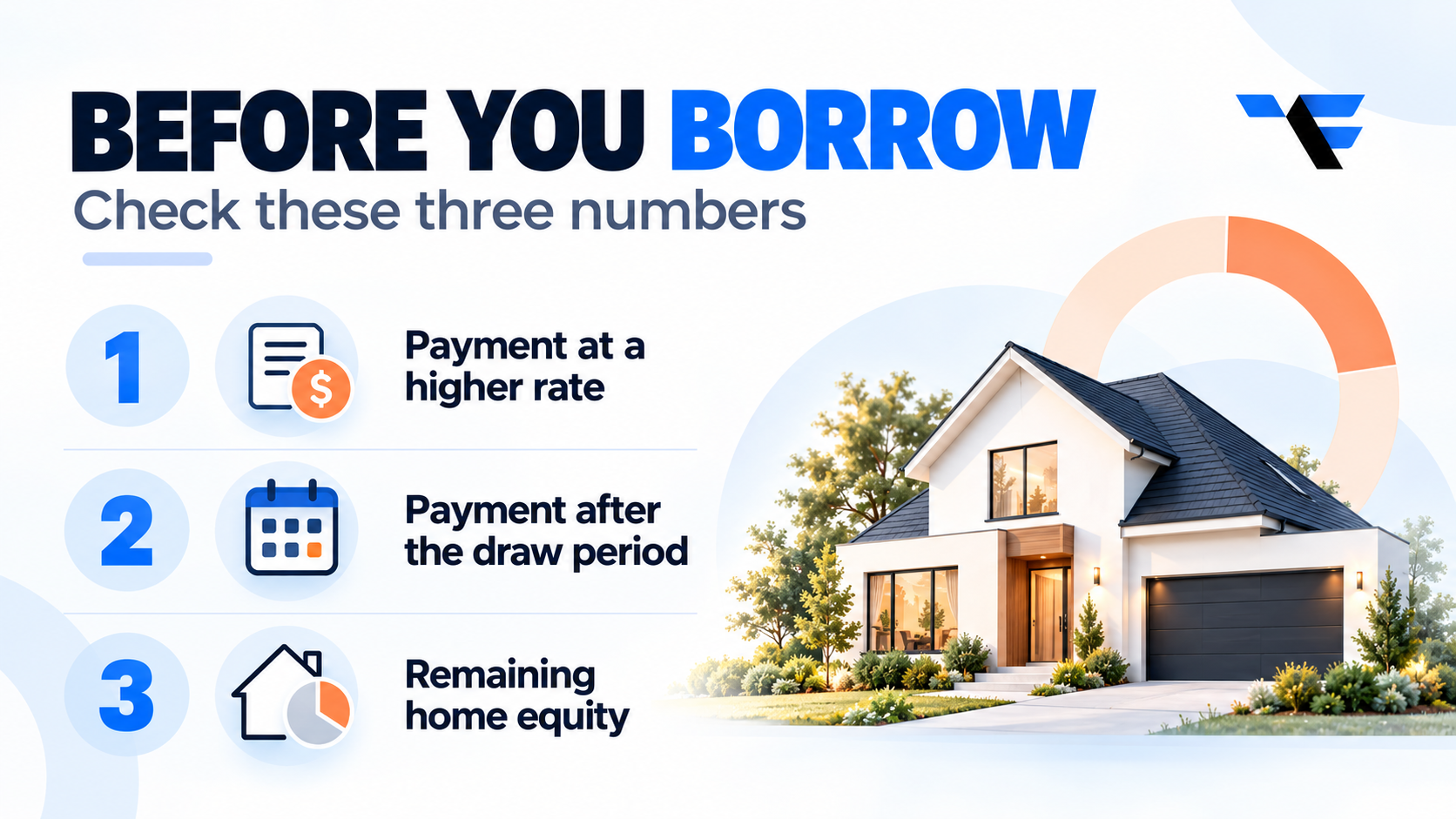
Before deciding that a HELOC would be affordable, "stress-test" these three numbers:
1. Your payment at a higher rate
Avoid basing your borrowing decision solely on a HELOC rate today. Instead, consider what the rate might be in the future and what that would do to your monthly payment.
2. Your payment after the draw period
Determine what you might owe and what your payments might be when the draw period is over and you have to start paying down the principal.
3. Your remaining equity
Calculate your existing mortgage, the HELOC you're considering and a reasonable estimate of the value of your home. Leave some cushion rather than counting on an increase in home value.
If the numbers still look good with some additional cushion, a HELOC might be appropriate for your situation. If the numbers only work if rates stay low, your income doesn't change and your home value steadily increases, that's a reason to reconsider.
Frequently Asked Questions
1. What is the biggest downside of a HELOC?
The biggest concern with a HELOC is that it combines variable-rate payments with secured debt. Your rate can change, your payment can increase when the draw period ends, and your failure to make the payments can result in losing your home.
2. How much would a $50,000 HELOC cost per month?
It depends on the rate, the balance and the payment structure. At 8%, $50,000 would generate about $333 in monthly interest if the payment were interest-only. At 10%, that would increase to about $417. A payment which also covered principal would be higher.
3. Is a HELOC a good idea for debt consolidation?
It can depend on the situation, but in general, not necessarily. Using a HELOC to pay off high-interest credit card debt makes sense on paper, but the credit card debt is unsecured while a HELOC is secured by your home.
4. Can I pay off a HELOC early without closing it?
It often can be done, but it depends on the terms of your HELOC. Paying the balance to zero doesn't necessarily close the line of credit. Check the agreement for any annual, inactivity or early closure fees before deciding whether to keep the line open.
5. What is a better option than a HELOC?
There's no single better option for every homeowner, but a home equity loan may be preferable if you need a lump sum and want predictable payments. A personal loan avoids putting your home up as collateral, as does delaying the purchase until you can afford it. A cash-out refinance might make sense if replacing your existing mortgage also makes financial sense.

.svg)

Discuss your unique requirements
Get direct answers and a roadmap for your future.
.png?width=202&height=202&name=image%20588255187%20(1).png)

.png?width=389&height=221&name=Blog%20covers%20(1).png)
%20(1)-1.png?width=40&height=40&name=image%20(65)%20(1)-1.png)


.png?width=389&height=221&name=Blog%20covers%20(10).png)


.svg)

.svg)
.svg)