View all states

10 mins

In this blog
Black Friday is the day shoppers score TVs at steep discounts. So when a builder banner or a listing flyer promises Black Friday real estate deals, it's fair to wonder whether a house works the same way. Sometimes it does, but not like electronics. A home isn't a standard product, so the only way to tell whether you're looking at an opportunity or an overpriced trap is to judge the property against comparable sales and the full cost of financing, not the size of the advertised markdown.
This guide is for buyers weighing holiday offers on new builds or resale homes, including self-employed buyers who need their income records in order, and investors checking the numbers. Black Friday falls on Nov. 27, 2026, and the holiday season brings real opportunities alongside real pressure, so offers you see this month can expire fast. Lenders like Truss Financial Group help buyers compare financing before they commit, so here's how to separate a genuine deal from holiday marketing.
Do Black Friday Deals Really Exist in the Housing Market?
Yes, in a quieter, more negotiated form. Real estate doesn't behave like traditional retail, and you shouldn't expect electronics-style discounts. What you'll typically see are local builder promotions and individually negotiated concessions on resale homes, such as closing cost contributions or a rate buydown.
The timing does tilt the housing market a little toward buyers. NAR Research found that existing-home sales average 11,380 per day in the winter months, compared with more than 18,000 per day in June. The same study reports the typical home is about 16% more expensive in June than in December through February, and that median days on market run 41 in October and November and 49 in the winter months. NAR notes that buyers have more negotiating power as homes stay on the market longer.
A second NAR analysis points in the same direction. Homes sold in December are often ones that were listed a while ago, since new listings slow sharply, and many sellers wait until spring. Fewer buyers means less competition from other buyers for the listings that remain, which is why Nov. and Dec. listings deserve a second look.
One caution: those figures describe the whole market, not a discount on any one home. A lower seasonal median price doesn't mean the house you love is on sale.
How to Find Black Friday Deals and Motivated Sellers
The best deals usually come from motivated sellers, not from banners. When most buyers are distracted by the holidays, the people still shopping for a home face less competition, and sellers who list in late fall often have a reason to move. Job relocations, a divorce, an estate, or a purchase already underway can all create urgency.
A few tips to guide your search and help you find Black Friday deals:
- Check listing history: A property that has sat for a couple of months, one that was previously listed and pulled, or one with several price cuts, may signal a seller ready to negotiate. Treat 60 days as a rule of thumb to investigate, not proof.
- Scan listings for urgency language such as "must sell," "relocation," or "bring all offers."
- Ask agents: A local agent often knows which sellers have a deadline, and which builders or developers are offering year-end incentives in your cities.
- Look at off-season inventory, including land, new construction, and foreclosures, but verify each one carefully.
Foreclosures can sell below market value, though they often need repairs and follow different purchase rules. If you're considering one, start with these guides on buying a foreclosure with an FHA loan and Fannie Mae HomePath properties.
What Is the Offer Actually Giving You?
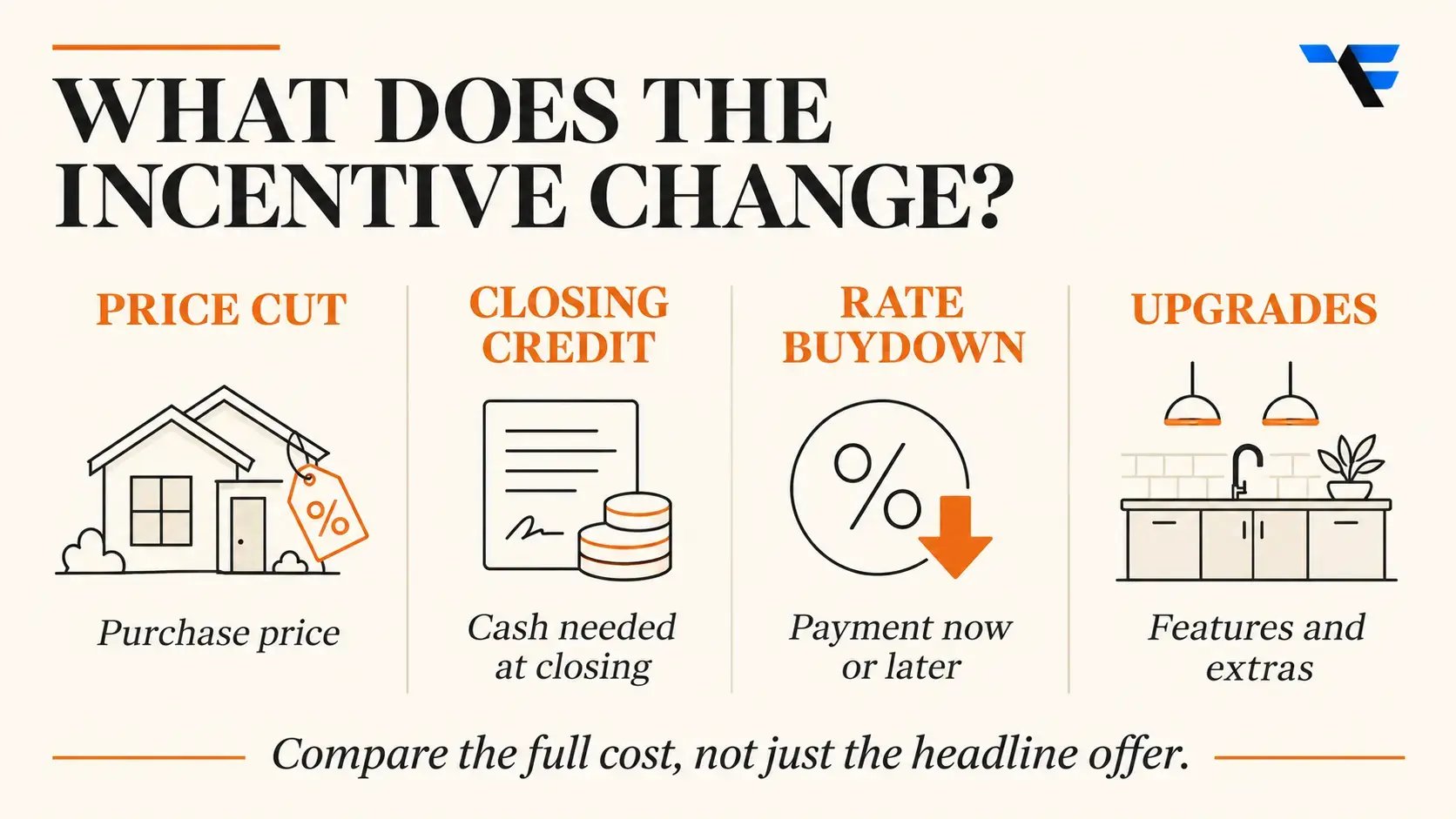
Holiday promotions come in four main shapes. Before you get excited, ask what each one changes: the price you pay, the cash needed at closing, your monthly payment later, or just the extras.
| Incentive | What it changes | What to check |
|---|---|---|
| Price reductions | The purchase price | Compare the final price with recent comparable sales and the home's own price history, not the size of the markdown. |
| Closing cost contributions | Cash needed at closing | Know the permitted uses and limits. Unused credits are not cash back. |
| Rate buydowns | Monthly payment, now or later | Separate a permanent rate discount (paid with points) from a temporary payment subsidy. |
| Upgrades and extras | Features, not the price | Retail value isn't appraised value or cash savings. Disclose everything to your lender. |
The rules matter. Under the Fannie Mae Selling Guide, seller and builder contributions are capped at 3% of the price for loans over 90% loan-to-value, 6% from 75.01% to 90%, and 9% at 75% or less, with a 2% cap on investment properties. The same guide says these contributions can't be used for your down payment or reserves, and they must be disclosed to the appraiser.
Temporary buydowns work differently. Fannie Mae requires lenders to qualify you at the full note rate, not the bought-down rate, and its guide lists investor properties as ineligible for them.
How to Check Whether the Home Is Overpriced
An artificially high asking price can make a modest cut look like a bargain, so strip away the holiday marketing and test the price yourself.
- Pull comparable sales: Compare the home with at least three similar properties that sold recently nearby, adjusted for size, condition, and features.
- Review the price history: A cut from an inflated asking price doesn't establish value.
- Inspect rigorously: Cold-weather months can hide roof, drainage, or heating problems, and a thorough inspection brings them out.
- Negotiate repairs: Ask your agent to negotiate on your behalf for repair credits or fixes, which can save more money than a headline discount.
- Plan for the appraisal: If the appraised value comes in below the price, you may need extra funds at closing.
Time on market alone proves neither a bargain nor a defect. Use it as one signal, then let the comps decide.
Compare Builder Financing With an Outside Quote to Get the Best Price
Many holiday promotions are tied to the builder's preferred lender, so the best price on the house may come with a pricier loan.
- Ask for one labeled comparison of three scenarios: a price cut, the builder's financing incentive, and an outside lender's offer.
- Use written Loan Estimates with the same loan type, term, and down payment, same-day quotes and matching lock periods.
- Compare points and fees, credits, cash to close, and the full payment, including taxes, insurance, mortgage insurance, and HOA charges.
The CFPB says homebuyers can potentially save $600 to $1,200 per year by getting offers from multiple lenders, and credit inquiries made within a 45-day window are recorded as a single inquiry. A Federal Reserve Bank of Philadelphia study found that borrowers' out-of-pocket costs for a purchase mortgage rose nearly 33% from 2021 to 2023, to almost $6,500, driven mainly by discount points.
If you want a second opinion, compare purchase financing with lenders like Truss Financial Group, start with our conventional purchase financing options, or browse our other financing services. Keep one more point in mind: an ARM reset is a separate event from a temporary buydown ending, and you shouldn't count on refinancing later to rescue the payment.
Read the Fine Print Before the Deadline
Black Friday promotions create urgency, and urgency pushes buyers into quick decisions. Slow down long enough to read the conditions:
- Which homes and locations qualify, and what borrower requirements apply.
- Whether you must use the builder's lender to get the incentive.
- The difference between the signing deadline and the closing date.
- Deposit and refund terms, and what happens if construction or financing is delayed.
Always confirm that a promotion is still active. Offers expire, and an expired promotion shouldn't drive your decision. Keep your inspection, appraisal, and title review rights intact, whatever the deadline says.
Get Pre-Approved Before You Commit
Being pre-approved gives you an advantage with sellers and builders, because it shows you can close. Talking with a lender early also tells you what you can afford before a deadline starts pushing you. Our guide to pre-approval versus pre-qualification explains the difference. Lining up your income records, down payment, closing funds, and reserves, and making sure you can access them, ahead of the week you find a home saves time when the clock is ticking.
Self-employed buyers can prepare early too. Bank statement loans may let eligible buyers qualify using deposits rather than tax returns. Run your numbers with the mortgage calculator and the affordability calculator before you shop.
One warning: new credit, large financed purchases, or reduced cash reserves can affect underwriting, and holiday spending counts. Hold off on big purchases until you close.
Investors should also check rent, vacancies, repairs, and financing costs, and remember that owner-occupant incentives may not apply. Our guides on rental property calculations and DSCR loans are good places to start.
When to Buy, Negotiate or Walk Away
Run every offer through a short checklist:
- The price is supported by comparable sales.
- The property's condition is acceptable, with repairs priced in.
- Payments stay affordable after any promotion ends.
- You have enough cash for closing and reserves.
- The contract terms work for you.
If one item is unclear, ask for a price adjustment, a repair credit, or an outside quote. If a cost or deadline can't be resolved, walking away is a legitimate choice. The best deals are the ones you can still afford after the holiday glow fades.
Review Your Financing With Us Today!
Black Friday real estate deals can be a real opportunity or an overpriced trap, and the difference comes down to the home, the price, and the full financing together. Before you sign, bring the listing, the written incentive, your financing quote, the deadline, and your budget to mortgage brokers like Truss Financial Group to help you compare suitable options. Leave valuation and legal contract advice to the right professionals.
Frequently Asked Questions
1. Is Black Friday the cheapest time to buy a house?
Not necessarily. Seasonal prices tend to run lower in late fall and winter, but that doesn't mean a specific home is discounted. See our guide to affordable mortgage programs.
2. Are builder incentives better than a price reduction?
It depends on what each changes. A price cut lowers the purchase price, while credits and buydowns mainly change closing cash or early payments. Estimate your monthly payment under each scenario.
3. Can I use my own lender and still get a builder incentive?
Sometimes, but some offers require the builder's lender. Check the terms, then compare written quotes before deciding.
4. Can seller credits cover my down payment?
On Fannie Mae-backed loans, no. The Selling Guide does not permit interested party contributions to be used for the down payment.
5. Can Black Friday credit-card purchases affect mortgage approval?
They can. New credit and lower reserves may change your underwriting picture. Read our mortgage underwriting guide.
6. How should investors evaluate a Black Friday rental deal?
Check price, rents, vacancies, repairs, and financing costs, and don't assume owner-occupant incentives apply. Use our rental property calculations guide.


Discuss your unique requirements
Get direct answers and a roadmap for your future.