.svg)



%20(1).svg)
%20(2).svg)
.png?width=480&height=420&name=Img%20(1).png)
%20(3).svg)
%20(4).svg)

%20(5).svg)


 View all states

11 mins
In this blog
Buying a home when you own a business can feel more complicated than buying one with a traditional W-2 paycheck. A mortgage for business owners often involves more documentation because income must be analyzed through the business as well as the household. A mortgage for entrepreneurs is not based simply on how much the company sells. The lender needs to determine how much income is stable, documented, and available for a mortgage for business owners.
For a primary residence, underwriters generally review qualifying income, business stability, credit, monthly debts, available funds, and the property. They also want records that explain how the business generates the money you use personally. Truss Financial Group can help with mortgage requirements for small business owners and compare documentation routes, including self-employed mortgage options, before they settle on a home budget.
When a Business Owner is Considered Self-Employed
Understanding the process starts with ownership, business structure, and the way income is reported.
Under Fannie Mae's guidelines, a person with a 25% or greater ownership interest in a business is considered self-employed. That means receiving a W-2 from a company you own does not automatically make the application identical to that of a traditional salaried employee.
The exact paperwork depends on the business structure. These mortgage requirements for small business owners can vary based on ownership percentage and tax treatment. A sole proprietor generally reports business activity on Schedule C. Partnerships, S corporations, and some LLCs can generate Schedule K-1 income and business tax returns. An LLC's tax treatment matters because it helps determine which records the lender needs to review.
This is where mortgage requirements for small business owners can differ from a standard employee's application. The lender is checking the business records as well as the borrower's personal finances. That helps answer what do mortgage lenders look for beyond a pay stub. These mortgage requirements for small business owners are designed to establish whether the income is dependable.
Income That Can Support a Mortgage for Business Owners
Business Revenue Versus Qualifying Income
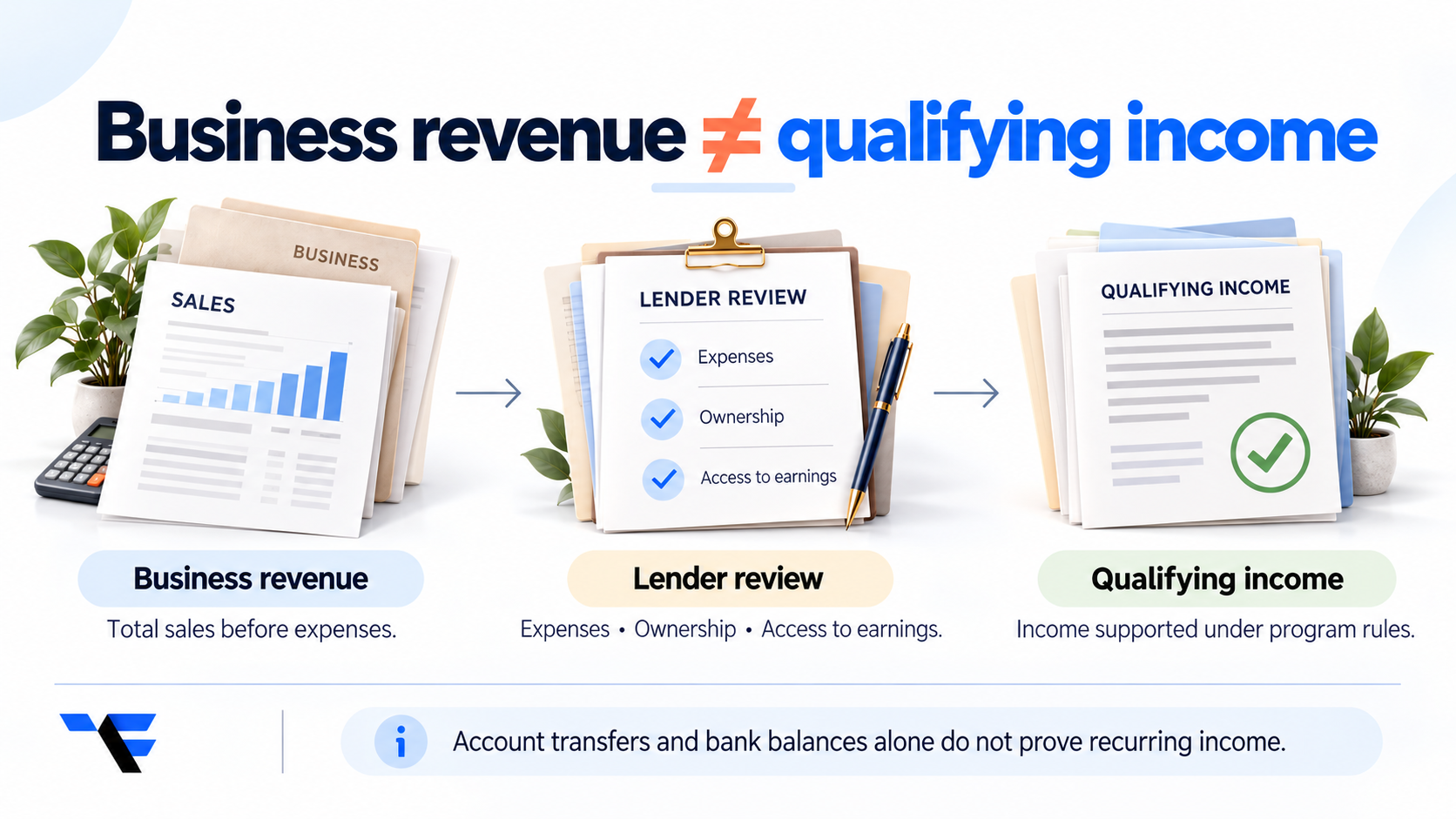
One of the biggest misunderstandings about a mortgage for entrepreneurs is assuming that business revenue equals personal qualifying income. It does not. That distinction matters in underwriting.
Imagine a company generates $400,000 in annual sales. That figure says very little about how much the owner can safely use for a mortgage. The business may have payroll, rent, inventory, insurance, taxes, equipment costs, and other expenses. The lender generally works from the income that can be supported under the applicable underwriting rules, not the company's top-line sales.
Transfers from a business account to a personal account do not automatically turn those transfers into qualifying income either. A large personal bank balance also does not, by itself, prove recurring income.
If you are unsure about self-employed mortgage requirements or whether a lender is using gross or net income, ask how the lender is calculating your qualifying income under its self-employed mortgage requirements. The explanation of whether mortgage lenders use gross or net income for self-employed borrowers can help clarify the basic distinction.
Ownership Share and Access to Business Earnings
Salary, owner distributions, and K-1 income can all appear in a business owner's financial picture, but the same earnings cannot simply be counted twice.
For partnerships, S corporations, and similar structures, reported profit may not equal money that was actually distributed to the owner. Fannie Mae notes that business income reported on an individual return may not necessarily have been distributed, so underwriting can involve an analysis of whether earnings can be relied upon while the business remains viable.
Business History and Current Financial Health
Lenders also look at the trend. They may compare prior earnings with current activity and investigate seasonal changes, declining income, business losses, or a recent ownership change.
Fannie Mae generally calls for a two-year history of prior earnings for self-employed borrowers. There is, however, a shorter-history pathway in its guidelines when the most recent signed personal and business tax returns show a full 12 months of income from the current business and the borrower can document prior income at the same or greater level from comparable work.
So, can someone with less than two years in business qualify? Sometimes. Meeting self-employed mortgage requirements is ultimately a documentation and underwriting question. It depends on the loan program, the documentation, the borrower's prior work, and the lender's underwriting.
A current profit and loss statement, balance sheet, or other evidence that the business remains active may also be requested. If recent performance differs sharply from filed returns, expect the underwriter to ask questions.
If your business is relatively new, the self-employed mortgage requirements can be more detailed, so our guide on self-employed mortgage with less than one year covers the issue in more detail.
Thinking about buying soon? Truss Financial Group can review your business income, documentation, and potential loan options so you can build a realistic purchase budget before making an offer. Explore Self-Employed Mortgage Options to see what may fit your situation.
What Do Mortgage Lenders Look For in Personal Finances?
When borrowers ask what do mortgage lenders look for, the short answer is consistency: credit history, monthly obligations, documented income, and funds that can be traced to an acceptable source.
Credit history is still part of the picture, and it is another area covered by self-employed mortgage requirements. Underwriters review payment history, existing balances, recent borrowing, and the monthly obligations that will remain after the new mortgage is added.
For a mortgage for business owners, your debt-to-income ratio, or DTI, compares monthly debt payments with qualifying monthly income. The CFPB notes that DTI limits vary by loan product and lender.
This is another area where mortgage applications for business owners can get tricky. A business loan may appear on your personal credit report even though the business makes the payments. Under Fannie Mae's rules, the payment may be excluded from personal DTI only when the lender has acceptable evidence that the business paid the obligation, the account does not have a delinquency history, and the payment is reflected in the business cash-flow analysis.
Down Payment Funds and Money Left After Closing
Another answer to what do mortgage lenders look for is a clean paper trail for the money used to close. That paper trail is part of what do mortgage lenders look for in a self-employed file. The down payment is only one part of the funds a lender may review. Closing costs and required reserves can matter too.
The lender needs to establish where your funds came from and whether you have access to them. Large deposits or transfers may need an explanation. The CFPB advises borrowers to document the source of down payment funds and notes that lenders may request documentation for large deposits.
Business funds require another layer of analysis. If you are using self-employed income to qualify and also plan to use business assets for the down payment, closing costs, or reserves, Fannie Mae requires a business cash-flow analysis to determine whether the withdrawal could negatively affect the business.
Documents That Help a Lender Understand the Business
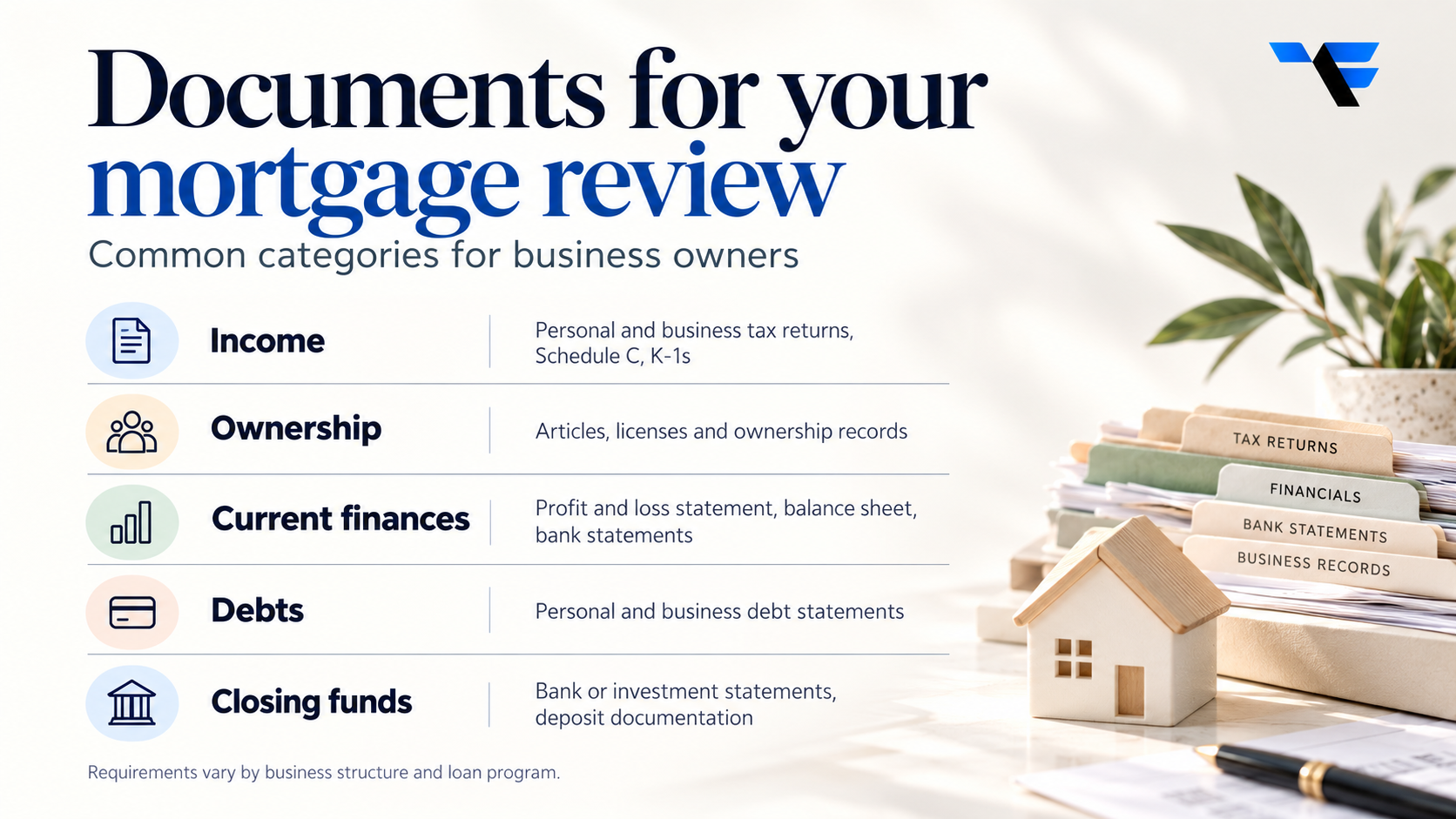
The exact list varies by business structure and loan program, but these are common categories. Good self-employed mortgage documents make it easier to explain income and ownership:
|
What the Lender Checks |
Documents They May Request |
What Those Records Show |
|---|---|---|
|
Income |
Personal tax returns, Schedule C, K-1s, business returns |
Reported earnings and business income |
|
Ownership and business activity |
Articles, licenses, ownership records, business information |
Who owns the business and how it operates |
|
Current financial health |
Profit and loss statement, balance sheet, business bank statements |
Recent performance and cash flow |
|
Debts |
Personal and business debt statements |
Monthly obligations and payment history |
|
Funds for closing |
Bank or investment statements, deposit documentation |
Available funds and source of money |
The CFPB recommends preparing financial information before shopping for a mortgage, a useful habit for anyone navigating mortgage requirements for small business owners and notes that self-employed or irregular-income borrowers may need additional documentation.
Your self-employed mortgage documents should tell one consistent story – where your income comes from, how stable it is, and what obligations the business carries. Complete self-employed mortgage documents are easier to evaluate when ownership, income, and cash flow reconcile. Keeping self-employed mortgage documents current also helps when the lender requests updated records.
When Bank Statements May Offer Another Way to Qualify
For a mortgage for business owners, tax returns do not always show the full picture. Some owners legitimately report substantial deductions, which is a common concern for a mortgage for entrepreneurs and can reduce the income visible on tax returns even when the business has strong deposits.
In those situations, a bank statement mortgage may be worth discussing if you meet the program's eligibility requirements. This is one option that can broaden the conversation around a mortgage for entrepreneurs. It can be especially relevant when a mortgage for entrepreneurs applicant has strong deposits but lower taxable income.
Instead of relying primarily on traditional tax-return income calculations, the lender may analyze business or personal bank statements, qualifying deposits, expenses, ownership, and the consistency of cash flow.
For borrowers exploring a mortgage for entrepreneurs and comparing self-employed mortgage requirements, bank statement loans can be a useful route to discuss when conventional income documentation does not tell the whole story.
Getting Ready for a Mortgage Review
Before applying, make the financial story easy to follow.
- Bring your bookkeeping up to date and make sure your tax records are complete.
- Gather personal and business returns, K-1s, bank statements, and current financial statements that apply to your situation.
- Document unusual deposits, transfers, or major changes in income before the underwriter asks.
- Make a list of personal and business debts, including obligations that may not be obvious from an account review.
- Identify the money available for your down payment, closing costs, and reserves.
- Ask for an income review before setting your home-shopping budget.
Your Next Step as an Entrepreneur
For a small business owner, getting approved for a mortgage for business owners is less about proving that your company is successful and more about showing that your income is stable, documented, and sustainable.
The most important parts of a mortgage for business owners review are usually qualifying income, business history, credit, debt obligations, ownership, and funds available for the transaction. Strong preparation can make the process much easier because the underwriter has a clear record of how the business supports your household.
If you're planning to buy a primary residence, Truss Financial Group can help you evaluate the documentation route that makes the most sense for your situation. Bring your business history, income records, self-employed mortgage documents, and target purchase budget to the conversation so you can understand your options before you start making offers.
FAQs (Frequently Asked Questions)
1. Can I get a mortgage if I pay myself a salary from my business?
Yes. A mortgage for business owners can still work when you pay yourself a W-2 salary. Paying yourself a W-2 salary does not automatically prevent you from qualifying. If you own 25% or more of the business, you are generally treated as self-employed under Fannie Mae's rules, so the lender may need to evaluate the business and your income history rather than treating the salary like a standard employee's paycheck.
2. Does owning an LLC affect my mortgage application?
For a mortgage for business owners, the LLC itself is not necessarily the issue; its tax treatment and your ownership percentage determine what income and business records may need to be reviewed. Depending on the structure, the lender may examine Schedule C, Schedule K-1, business returns, or other financial records.
3. Can I qualify with less than two years in business?
Possibly. A mortgage for business owners can sometimes be available with less than two years in business. Some conventional underwriting rules allow income with less than two years of self-employment when the current business shows a full 12 months of income, and the borrower can document comparable prior income or experience. Other loan programs may use different rules, so the exact file matters.
4. Does business debt count toward my mortgage DTI?
It may. If a business debt is also your personal obligation, the lender generally needs evidence before excluding its payment from your DTI. Fannie Mae allows an exclusion in certain cases when the business has paid the debt, there is no delinquency history, and the payment is accounted for in business cash-flow analysis.
5. Can I use business funds for my down payment?
Yes, depending on the loan program and your circumstances. When business assets are being used while self-employed income is also used to qualify, the lender may need to determine that withdrawing the funds will not hurt the business's cash flow. Additional statements or a balance sheet may be requested.

.svg)

Discuss your unique requirements
Get direct answers and a roadmap for your future.
.png?width=202&height=202&name=image%20588255187%20(1).png)

.png?width=389&height=221&name=Blog%20covers%20(55).png)




.svg)

.svg)
.svg)