.svg)



%20(1).svg)
%20(2).svg)
.png?width=480&height=420&name=Img%20(1).png)
%20(3).svg)
%20(4).svg)

%20(5).svg)


 View all states
Fannie Mae Student Loan Guidelines for Mortgages | TFG

15 mins

In this blog
Student loans can complicate the mortgage purchase process, but they do not necessarily preclude Fannie Mae student loan mortgage eligibility. What Fannie Mae student loan guidelines care about is the share of your monthly student loan obligation. The amount of this liability depends on whether you are making regular payments, using an income-driven repayment plan, or temporarily in deferment or forbearance. This and many other questions are discussed below.
Truss Financial Group can help you analyze the interaction between your student loan obligations and mortgage financing. We will take a closer look at your current situation rather than provide a broad online estimate.
What Fannie Mae Actually Does in a Mortgage Application
Fannie Mae does not fund most mortgages. Instead, the company purchases qualifying loans from approved lenders. Fannie Mae student loan guidelines publish minimum standards that these lenders must use when evaluating borrower applications.
Your mortgage lender is responsible for analyzing your application, verifying the information you submit, and determining whether you meet the requirements. In practice, these lenders tend to implement additional, more stringent conditions called overlays.
One of these overlays is Desktop Underwriter (DU), an automated loan evaluation tool. When you apply for a mortgage, your lender will use DU to estimate the likelihood of your approval based on your submitted income, debts, credit, and proposed mortgage. This is not a guarantee of funding, as the lender must still review your application and collect the necessary documents.
How Student Loans Factor Into Your DTI
Your back-end debt-to-income (DTI) ratio represents the ratio of your total qualifying monthly debt payments to your gross monthly income.
Student loans factor into this equation based on the monthly payment that the lender uses for your DTI calculations. In general, the outstanding student loan balance does not add directly to your monthly debt payments. The outstanding loan balance does affect the calculation, however, if no documented monthly payment is available.
Student loans also affect DTI in other ways:
- Credit report: Late or unpaid payments can adversely affect your credit history.
- Available savings: Paying off a student loan with savings reduces the amount of money you have for a down payment, closing costs, and other reserves.
- Monthly budget: Larger student loan payments reduce the amount of money available for other monthly expenses.
If you would like to learn more about the student loan payment DTI calculation, understand debt-to-income ratio requirements for mortgages.
What Payment Does the Lender Use for Student Loans?
The lender determines the payment based on your repayment status at the time of application and the documents available. Fannie Mae's Selling Guide has a detailed chapter on Fannie Mae student loans, including the qualifications for the following scenarios:
| Student Loan Situation | Fannie Mae Treatment | Supporting documentation |
|---|---|---|
| Payment appears on credit report | The lender may use the reported monthly payment. | Current credit report |
| Reported payment is inaccurate | The lender may use the amount on the most recent student loan statement. | Recent statement showing the correct payment |
| Documented IDR payment is $0 | The lender may use $0 when documentation establishes the actual $0 IDR payment. | Current statement or servicer documentation |
| Deferred or in forbearance; no usable payment | Use 1% of the outstanding balance or a fully amortizing payment based on documented terms. | Balance, rate, and repayment-term documentation |
| Another party makes the payments | Possible exclusion if the separate “paid-by-others” rule is fully documented. | Most recent 12 months of proof, with no delinquency |
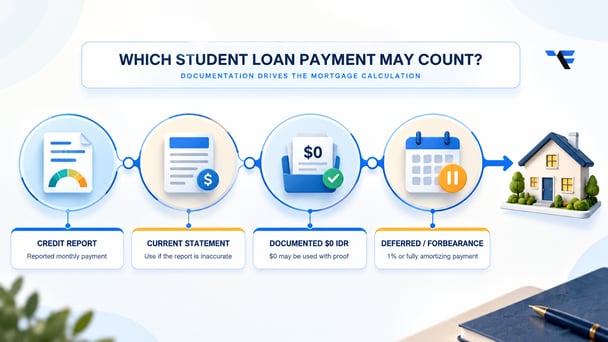
Reported Payment vs. Incorrect Payment vs. Current Statement
Before submitting your application, compare the student loan payment on your credit report with your latest statement from the loan servicer. Credit reports can have outdated information, and the payment on your report may not reflect your current monthly payment. Furthermore, an income-driven repayment plan or loan consolidation may change the terms in ways that affect your mortgage qualification.
If the credit report does not show the correct amount, Fannie Mae student loan guidelines permit the lender to use the latest statement. It is not enough, however, to show a generic screenshot from your phone. The lender must obtain documentation from you that confirms the payment amount.
When student loans have been recently consolidated or refinanced, special attention should be paid to the documents provided. Updated records can help the lender determine which liabilities to consider and which conventional loan student debt has already been satisfied.
A preapproval review with Truss Financial Group can help you identify discrepancies and inconsistencies in your application.
Income-Driven Repayment Mortgage and a Documented $0
Fannie Mae allows the lender to use a $0 student loan payment when documentation verifies that the borrower is actually required to pay $0 if the borrower's income-driven repayment plan shows that the monthly payment is $0. The critical point is in the word “actual.”
A credit report that shows a $0 payment does not automatically establish that the borrower has a documented $0 income-driven repayment mortgage payment. The lender may need to see your current statement or servicer documentation confirming the repayment arrangement and the required payment.
A blank field, temporary administrative pause, deferment, or forbearance should not be treated as a $0 income-driven repayment payment. Each of these situations may involve a separate calculation.
Federal repayment plans and terminology change from time to time. To ensure that the lender uses the correct information, consult Federal Student Aid rather than your memory when discussing income-driven repayment plans.
Deferred or Forbearance Student Loans
Temporary deferment or forbearance of student loans can stop or reduce monthly payments. At the same time, these arrangements rarely lower the student loan debt that qualifies for a mortgage.
If your deferred student loans or loan in forbearance does not have a qualifying payment, Fannie Mae permits the lender to use either 1% of the outstanding balance or a fully amortizing payment based on the loan terms.
Either way, the lender needs an acceptable documentation package to support the payment calculation. That is why a current statement or repayment terms might make a difference.
If you are thinking about getting preapproved for a mortgage, examine your student loan statements and collect necessary documents in advance. It is better to fix a minor documentation problem before you submit your application or accept an offer.
When Another Person Pays the Student Loan
Borrowers sometimes do not benefit from their own student loan payments, as parents, spouses, or other persons pay off the debt on a regular basis. In such cases, Fannie Mae student loan guidelines have a debts-paid-by-others rule that permits the lender to ignore this obligation when determining the borrower's monthly debt payments. The rule is not a blanket exemption; however, the lender must confirm certain conditions.
In general, the lender must receive the most recent 12 months of statements from the person making the payments. Additionally, the debtor must not have any delinquencies during this period. The rule also does not apply to the interests of a party to the transaction, e.g., a seller or real estate agent.
Loans paid by family members, employers, or other persons should therefore be examined carefully. The lender can analyze the situation using the appropriate requirements. The key point is for the borrower to provide the lender with sufficient information early in the process.
If someone pays your student loan, speak with your lender and compile the necessary papers. Do not assume that these obligations will simply disappear because the payments come from another source.
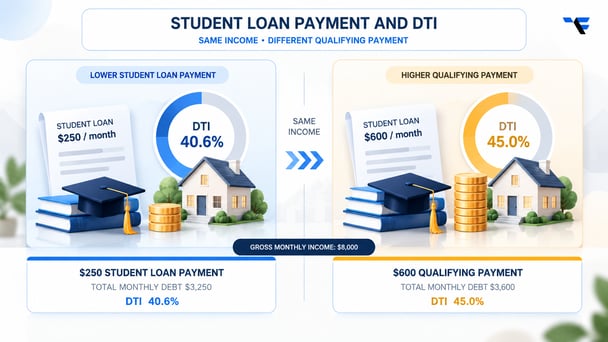
Student Loan Payment DTI: A Simple Example
Let us suppose that a borrower has the following income and debt:
Gross monthly income: $8,000
Proposed housing payment and other monthly debts: $3,000
Student loan payment: $250
The borrower's total monthly debt is $3,250.
DTI = 3,250/8,000*100 = 40.6%
Now let us assume that the borrower has deferred student loans with a $60,000 outstanding balance and no usable documented monthly payment. If the lender uses the 1% method, the qualifying student loan payment would be $600.
The borrower's monthly debt increases to $3,600.
DTI = 3,600/8,000*100 = 45.0%
The difference between these two scenarios is 4.4 percentage points. On the surface, the difference in documentation appears to dictate the outcome. In practice, however, each application is reviewed on a case-by-case basis. A lender analyzes the borrower's entire financial profile, including debt, income, down payment, and credit history, before reaching a decision.
Fannie Mae DTI Limits: Desktop Underwriter vs. Manual Underwriting
Student loan payment DTI limits are a rough indicator of a borrower's qualifications. They are not a substitute for a comprehensive review of the borrower's financial and credit profile. For manually underwritten Fannie Mae loans, the DTI limit is 36%, with an increase to 45% when certain credit score and reserves requirements are met. For DU loans, the maximum DTI is 50%.
Each of these limits should be taken into consideration:
- The manual underwriting and DU use different requirements.
- The lender must approve the application based on the overall risk profile, not the DTI.
- Other types of transactions may have different limits.
- The lender may impose additional requirements ("overlays").
A borrower with a 50% DTI is not automatically approved for a mortgage simply because the DU program allows it. An automated approval still considers the borrower's credit profile and documentation, as well as the lender's overlays.
If your student loan payment affects your DTI, a lender can determine whether the correct payment calculation is used. For a detailed discussion of DTI and its effect on mortgage qualification, understand Fannie Mae DTI limits.
Documents to Assemble Prior to Mortgage Preapproval: Student Loan Mortgage Eligibility
Preapproval is not the final stage in the mortgage application process. At the same time, it is a good opportunity to make sure that the lender has all the necessary documents. You should also take this opportunity to review your own paper trail, which the lender will examine more closely during the underwriting process.
- Current credit report: The lender will order the credit report for you. However, it is helpful to have a copy of the report to see what the lender sees.
- Latest student loan statements: Provide a statement for each student loan account.
- Repayment details: Have the current payment amount, outstanding balance, interest rate, remaining term, and repayment status available if needed.
- $0 student loan payment documentation: If your income-driven repayment plan actually requires $0 per month, provide current servicer documentation that confirms this.
- Payment records from another person: If someone else makes the payments, have the 12 months of required documentation available.
- Changes to the account: Include any recent changes, such as consolidation, payoff, forgiveness, discharge, or employer contributions if applicable.
A future event is not the same as an actual change to the account. If you are considering consolidation or employer contributions, find out what documentation you will need to provide before the underwriter reviews your application.
Common Underwriting Challenges
- A credit report shows $0, but there is no documentation establishing an actual $0 income-driven repayment mortgage payment.
- The credit report does not reflect the most recent student loan statement.
- Consolidated loans appear along with old accounts, causing confusion about which liabilities to consider.
- The borrower expects deferment or forbearance to reduce the payment.
- The borrower takes on new obligations shortly before closing, changing the DTI.
- The lender receives incomplete information about the deferment or forbearance.
In each of these scenarios, the lender should review the situation carefully to make sure that the correct payment is used. The discussion with the lender helps you identify the documents that you may need to provide.
If you are considering a mortgage with Truss Financial Group, we encourage you to bring the actual student loan records rather than the information from a credit-monitoring service.
Should I Pay Off Student Loans Before Buying a Home?
Paying off student loans before buying a home reduces monthly debt obligations. At the same time, a substantial payment may adversely affect your DTI when buying a home. Consider the trade-off between the reduction in monthly payments and the decrease in available savings. Paying off a student loan with a large chunk of your savings reduces the amount of money that you can use for:
- Down payment and closing costs
- Reserves required by the lender
- Cash for repairs, furniture, and other home furnishings
Student Loan Cash-Out Refinance: Another Option
Fannie Mae student loan guidelines have a student loan cash-out refinance option for borrowers who want to use home equity to pay off some or all of their student loan debt. This is a separate transaction with its own requirements. At a minimum, one student loan must be paid in full with the proceeds of the refinance, and the payment must be made directly to the student loan servicer at closing. Paying off only a portion of the debt does not qualify for the cash-out refinance feature.
The choice to cash-out refinance a student loan depends on several factors, including the interest rate on the mortgage and student loan, the length of the mortgage loan, and the closing costs for the refinance. Each of these considerations has a material impact on the profitability of the exchange.
The borrower should also realize that a cash-out refinance converts unsecured student loan debt into a secured mortgage liability. Paying off a student loan with a cash-out refinance also eliminates some or all of the borrower's federal student loan benefits, depending on the type of loan.
Frequently Asked Questions
Can you get a Fannie Mae mortgage with student loans?
Yes. student loan debt does not automatically disqualify you for a mortgage. The lender will determine the appropriate monthly student loan payment and analyze your application.
Does Fannie Mae use the loan balance or the monthly payment?
The lender will generally use the qualifying monthly payment. The outstanding loan balance may be used to determine a substitute payment if no qualifying monthly payment is documented.
Can a documented $0 income-driven payment be used as $0?
Yes, when documentation confirms that the actual required payment under an income-driven repayment plan is $3,000 and your gross monthly income is $0. 0 alone does not establish this.
How are deferred or forbearance loans counted?
When no qualifying payment is available, the lender may use 1% of the outstanding balance or a fully amortizing payment based on documented loan terms.
What if the credit-report payment is wrong?
The lender may use the monthly payment from your latest student loan statement if the credit report does not reflect the correct amount.
Can the payment be excluded when someone else pays it?
Possibly. Fannie Mae's debts-paid-by-others rule allows the lender to ignore this obligation, but specific requirements must be met. In particular, the lender must obtain the most recent 12 months of payment documentation and confirm that no delinquencies are present.
Does expected Public Service Loan Forgiveness remove the debt from DTI?
Not necessarily. An expected event is not the same as an actual occurrence. Ask the lender what documentation is required to establish that the debt has been discharged or the payment obligation has changed.
What is the maximum DTI for a Fannie Mae loan?
The general manual-underwriting maximum is 36%, with an increase to 45% when applicable credit score and reserves requirements are met. DU's maximum allowable DTI is 50%. These are limitations, not guarantees of approval.
Should I pay off student loans before applying for a mortgage?
It depends on your situation. You should analyze the trade-off between the reduction in monthly payments and the impact on your DTI, savings, and other reserves.
Can different lenders arrive at different results?
Yes. Different documentation, underwriting findings, and lender overlays can affect the outcome. Always ask to review the same current documentation when comparing offers from different lenders.
Know Your Student Loan Payment
Student loans are not an absolute barrier to obtaining a mortgage. The crucial point is to make sure that the lender uses the correct monthly payment when calculating your DTI and reviewing your application.
A documented $0 income-driven repayment mortgage payment, an accurate statement, or a properly supported debt-paid-by-others arrangement may affect the outcome. On the other hand, deferment and forbearance may require the lender to use a substitute payment.
Are you ready to purchase a home? Contact Truss Financial Group to discuss your current student loan statements, repayment status, and other relevant matters.

.svg)

Discuss your unique requirements
Get direct answers and a roadmap for your future.
.png?width=202&height=202&name=image%20588255187%20(1).png)




.png?width=389&height=221&name=Blog%20covers%20(53).png)


.svg)

.svg)
.svg)