.svg)



%20(1).svg)
%20(2).svg)
.png?width=480&height=420&name=Img%20(1).png)
%20(3).svg)
%20(4).svg)

%20(5).svg)


 View all states

16 mins
In this blog
Qualifying for a mortgage when you're self-employed isn't about proving your business is successful; it's about proving your income is stable, documented, and calculable under a specific framework. As of December 2025, an estimated 16.63 million Americans were self-employed, yet income verification issues remain one of the leading causes of mortgage application problems, and self-employed borrowers bear a disproportionate share of that burden.
Freddie Mac guidelines define exactly how lenders evaluate self-employment income, what documentation is required, and how underwriters arrive at a qualifying number. This guide covers the mechanics, the documentation requirements, and what you can do to strengthen your position before you apply.
Mortgage brokers like Truss Financial Group work with self-employed borrowers every day and can help you understand exactly where you stand before a formal application is ever submitted.
Who Counts as Self-Employed Under Freddie Mac Guidelines?
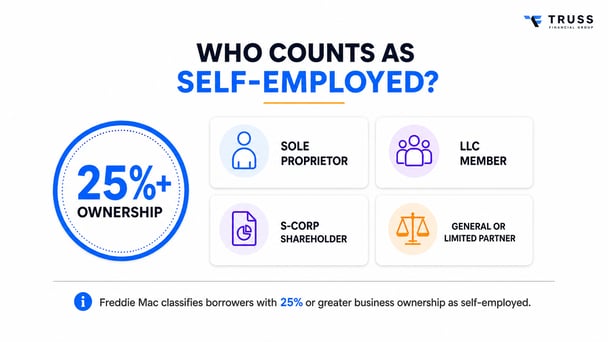
The answer catches more borrowers off guard than you might expect. Under Freddie Mac's framework, any borrower with a 25% or greater ownership interest in a business is classified as self-employed for mortgage qualification purposes, regardless of whether they think of themselves that way.
|
Business Structure |
Counts as Self-Employed? |
|---|---|
|
Sole proprietor |
Yes |
|
LLC member |
Yes, if ownership ≥ 25% |
|
S-corporation shareholder |
Yes, if ownership ≥ 25% |
|
General or limited partner |
Yes, if ownership ≥ 25% |
|
Business owner drawing a W-2 from their own company |
Yes, if ownership ≥ 25% |
|
Employee with no ownership stake |
No |
The classification matters because it changes the entire income verification process. A salaried borrower presents a pay stub and a W-2, and the income picture is largely settled. For a self-employed borrower, lenders must instead determine how much of the income reported on the federal income tax return is actually stable, continuous, and likely to continue, which requires a written cash flow analysis drawn from multiple years of tax data.
The question the underwriter is asking is not "how much did this borrower earn?" but "how much of what they earned can reliably be expected to continue?" That distinction shapes every documentation and income calculation decision that follows.
How Many Years of Self-Employment Do You Need to Qualify?
The standard Freddie Mac requirement is a two-year history of self-employment in the same or similar occupation or industry. Most borrowers have heard this. What fewer know is that the framework includes two meaningful exceptions that can open the door for borrowers with shorter histories, along with a separate rule for business structure changes.
|
Pathway |
Requirement |
Key Condition |
|---|---|---|
|
Standard |
2 years self-employment |
Same or similar occupation or industry |
|
LPA One-Year Exception |
1 year self-employment |
Business in existence 5+ years; LPA feedback certificate must specifically support it, not lender discretion |
|
Bulletin 2024-10 Exception (effective Nov 8, 2024) |
Less than 2 years self-employment |
Combined 2-year history from current self-employment + prior W-2 in same/closely related occupation; qualifying income is the lesser of the two; written analysis required in mortgage file |
|
Business Structure Change |
Existing clock preserved |
Ownership interest percentage must remain unchanged; no negative impact on revenue or expenses; otherwise treated as a new business |
What Are the Documentation Requirements for Self-Employed Borrowers?
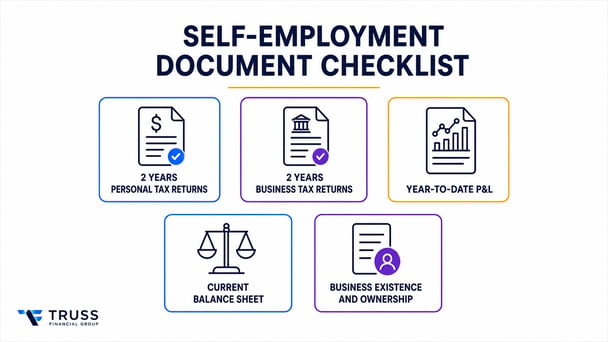
Documentation for self-employed borrowers follows a two-track logic: what the loan type requires under Freddie Mac's Selling Guide, and what LPA's specific findings specify. For most borrowers under the standard two-year requirement, the core documentation package includes:
- Two years of signed personal federal income tax returns (Form 1040 with all applicable schedules)
- Two years of business tax returns (Schedule C for sole proprietors, Form 1065 for partnerships, Form 1120S for S-corporations) with all applicable schedules, including K-1s
- A year-to-date profit and loss statement
- A current balance sheet
- Documentation verifying the current existence of the borrower's business and confirming ownership, typically a business license, articles of incorporation, or IRS EIN confirmation letter
Business tax returns may be waived when LPA returns a one-year finding, and the business has operated for five or more years, or when the borrower has been in the same business for five-plus years, uses personal funds only for down payment and reserves, and personal returns show rising income over both years. IRS income transcripts are an acceptable substitute for borrower-provided copies, provided they contain sufficient detail for the cash flow analysis.
Freddie Mac's own data shows that loans using automated income assessment are four times less likely to produce defects, with income verification issues accounting for nearly one-third of all purchase transaction defects. Supplemental documentation such as a CPA statement or client letters is not always required but can strengthen the file when income has fluctuated.
How Do Lenders Calculate Self-Employment Income for Mortgage Qualification?
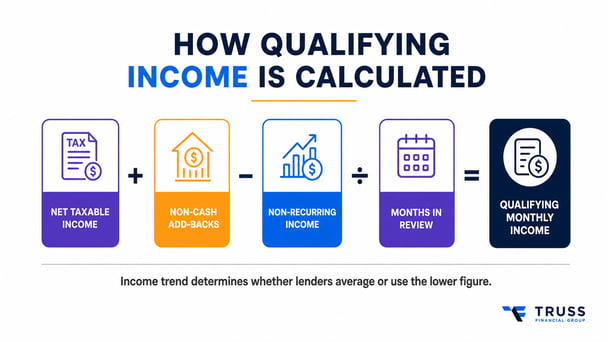
This is where the gap between what a borrower earns and what a lender can use often becomes most apparent, and most surprising.
- Gross revenue and bank deposits are not used: Lenders start with net income reported on the individual income tax return, then apply a series of add-backs and exclusions to arrive at an appropriate qualifying income figure.
- Add-backs restore non-cash deductions: Depreciation, depletion, amortization, business use of home, and non-cash mileage are added back to net income because they reduced taxable income without representing actual cash leaving the business.
- Non-recurring income is excluded: One-time gains, insurance settlements, and income that appears in only one of the two filing years cannot be relied upon to continue and are removed from the calculation.
- The result is divided by months: The adjusted income figure is divided by the number of months in the filing period to produce a stable monthly income number, the figure that gets applied to the debt-to-income ratio.
- A written income analysis is required: Freddie Mac requires this calculation to be documented and retained in the mortgage file. Lenders may use Freddie Mac's own income calculator or a comparable tool such as Form 91. It is not discretionary.
- Year-over-year trend drives the final number: If income rose from year one to year two, lenders generally average the two. If it declined, they must use the lower figure, or produce a written analysis justifying why the decline is an isolated anomaly rather than a continuing trend.
What Does "Stable Self-Employment Income" Mean: How Do Underwriters Assess It?
Income stability under Freddie Mac's guidelines is not just a number; it is a judgment that underwriters are required to make, document in writing, and support with evidence. Freddie Mac's Section 5304.1 directs lenders to evaluate the nature and location of the borrower's business, the demand for its products or services, the business's financial strength, and whether it is capable of continuing to generate income sufficient to support the mortgage obligation.
How Does Income Trend Factor Into the Stability Assessment?
Rising income over two years is the clearest signal of stability; flat income is generally acceptable. Declining income, even when the two-year average is technically usable, requires a written analysis in the loan file assessing whether the drop is a pattern or an anomaly. A decline of 25% or more year over year will typically trigger additional scrutiny of business liquidity.
Underwriters also watch for layering of risk. A new business, declining income, and a high DTI compound each other, while strong reserves, a long-established business, and a stable industry can offset individual risk factors when properly documented.
What Happens When Self-Employment Income Has Declined or Fluctuated?
Declining income does not automatically disqualify a borrower, but it does materially change how the income calculation works and what additional documentation the lender will require.
- Lenders cannot average a declining income: If the most recent year's income is lower than the prior year, they must use the lower figure as qualifying income, or produce a written analysis justifying why the decline is not a continuing trend.
- A significant drop triggers additional documentation: Lenders will typically request a current profit and loss statement and a current balance sheet to assess whether the decline is stabilizing.
- A CPA explanation may be required: If the drop is material, underwriters often ask for a written explanation addressing what drove the change and whether it is expected to persist.
For borrowers with seasonal businesses or project-based revenue, lenders look at the full two-year picture rather than penalizing a single low quarter. But they will not accept a two-year average that obscures what is clearly a downward pattern in the borrower's income.
Per Freddie Mac Bulletin 2024-10, the written analysis justifying the income stability determination is not optional; it is a required component of the mortgage file regardless of whether the income is rising, flat, or declining.
How Does the Business Tax Deduction Strategy Affect Qualifying Income?
The most common blind spot for self-employed borrowers preparing to apply is the gap between what they earn and what appears on the income tax return after deductions. Maximizing business deductions is sound tax strategy, but those same deductions directly reduce the income figure a lender can use, because lenders work from net taxable income, not gross receipts or business revenue. Here is how that plays out in practice:
- Deductions reduce qualifying income directly: A borrower with $150,000 in annual business revenue who deducts $60,000 in legitimate business expenses may have a qualifying income figure significantly lower than their actual take-home, even if the business is healthy.
- Some deductions are added back: Depreciation, amortization, depletion, business use of home, and non-cash mileage are standard add-backs in the lender's cash flow analysis. They reduce the tax bill without representing real cash outflow, so lenders restore them to income.
- Others are not recovered: Contractor payments, equipment purchases, travel, and advertising expenses are not added back. They reduce qualifying income permanently for mortgage purposes.
The practical implication is that borrowers planning to apply within the next one to two years should review their tax strategy with a CPA with that goal explicitly in mind before filing. The decision of what to deduct has a direct downstream effect on what a lender will calculate as their stable monthly earned income.
How Can Self-Employed Borrowers Strengthen Their Mortgage Application?
Research analyzing over 30 million mortgage applications from 2018 to 2024 using Home Mortgage Disclosure Act data found that DTI-related issues were the single largest driver of application denials, a finding that hits self-employed borrowers especially hard, given how business deductions can compress qualifying income. Here's what moves the needle before you apply:
- Know your qualifying income number first: Work backward from the last two years of personal and business tax returns: applying standard add-backs, removing non-recurring income, then averaging or flooring based on the income trend. Borrowers who walk in with that number already calculated are far better positioned to pick the right loan amount and avoid surprises at underwriting.
- Keep personal and business finances cleanly separated: Co-mingled accounts make the cash flow analysis harder and can raise questions about business liquidity that slow down or complicate the file.
- Build adequate reserves: Strong cash reserves reduce perceived risk, particularly when income has fluctuated year over year.
- Avoid major business expenditures or structural changes in the one to two years before applying: New equipment purchases, entity conversions, or significant expense increases can compress qualifying income or trigger additional documentation requirements in the underwriting review.
- Review your tax deduction strategy with a CPA before your next filing: Deductions that reduce your tax bill also reduce the income a lender can use; knowing the tradeoff in advance gives you time to make an informed decision.
Lenders like Truss Financial Group work with self-employed borrowers regularly and can run the income calculation before a formal application is submitted, so you know exactly what your qualifying income looks like under Freddie Mac's Section 5304.1 framework before anything is put on paper.
Frequently Asked Questions
How many years of tax returns do I need for a self-employed mortgage?
Most lenders following Freddie Mac guidelines require two years of personal and business tax returns. One-year exceptions exist when LPA returns a one-year finding, and the business has been operating for five or more consecutive years. The 2024 guideline update also allows a combined two-year history for borrowers who have transitioned from W-2 employment in the same field.
Does Freddie Mac allow one year of tax returns for self-employed borrowers?
Yes, in specific circumstances. When LPA issues a one-year income finding, and the business has been in existence for five or more years with the borrower holding at least 25% ownership throughout, lenders may work with a single year of returns. This is not available to every borrower; it depends on what LPA returns and the lender's overlays.
What does "less than two years of self-employment" mean under Freddie Mac guidelines?
Under Freddie Mac Bulletin 2024-10, borrowers with less than two years of current self-employment may qualify if they can demonstrate a combined two-year history of self-employment plus prior W-2 employment in the same or closely related occupation. Qualifying income is the lesser of the two income levels, and a written analysis must be included in the loan file.
Does Freddie Mac require a two-year employment history for self-employed borrowers?
Two years of self-employment history in the same or similar occupation is the standard requirement, but it is not an absolute cutoff. The 2024 guideline update allows borrowers to combine self-employment with prior W-2 work in the same field. The five-year LPA exception is another pathway. Borrowers with genuinely new businesses and no comparable prior employment face the highest bar.
What documents do I need to prove self-employment income for a mortgage?
The standard package includes two years of personal federal income tax returns with all applicable schedules, two years of business tax returns depending on entity type, a year-to-date profit and loss statement, a current balance sheet, and documentation confirming business existence and ownership. Business returns may be waived in specific circumstances. IRS income transcripts are an acceptable alternative to borrower-provided copies.
How do lenders calculate self-employment income for mortgage qualification?
Lenders start with net taxable income from the IRS form filings, add back non-cash deductions such as depreciation, amortization, home office, and mileage, remove non-recurring income, and divide the adjusted figure by the number of months covered to arrive at a stable monthly income figure. A written cash flow analysis is required in every file.
Can you get a mortgage with less than two years of self-employment?
Yes: through either the LPA one-year exception requiring a five-year business history, or the 2024 Freddie Mac guideline update allowing borrowers to combine self-employment with prior W-2 income in the same occupation. Neither pathway is automatic; both require documented analysis and lender approval.
Does Freddie Mac allow a mortgage to close in an LLC?
Freddie Mac conventional loans are made to individual borrowers, not business entities. A borrower whose business is structured as an LLC is still treated as an individual obligor; the LLC is relevant for income documentation through business tax returns, not as the party to the loan. Borrowers should confirm with their lender how their specific business structure affects the application.
Does being self-employed mean I'll pay a higher mortgage rate?
Self-employment status alone does not trigger a rate premium. Rates are determined by credit score, loan-to-value ratio, loan type, and market conditions. The documentation requirements are more involved, but the loan product is the same conventional mortgage available to any qualified borrower.
What if my business changed structure recently?
Business structure changes, for example, from a sole proprietorship to an S-corporation, do not automatically restart the two-year clock, provided the borrower's ownership interest percentage did not change, and there is no indication the change had a negative impact on revenue or expenses. If those conditions are not met, the prior business structure is treated as a different business and the two-year clock resets.
Do I need a profit and loss statement even if I already filed taxes?
Yes, in most cases. A year-to-date P&L is typically required in addition to the federal income tax returns because the returns reflect the prior year; lenders need visibility into current business income, particularly when several months have passed since the most recent filing. The P&L must be signed by the borrower and consistent with the tax returns on file.
Ready to Find Out What You Actually Qualify For?
Qualifying for a mortgage as a self-employed borrower comes down to documentation, income calculation, and understanding how Freddie Mac's guidelines translate what you earn into what a lender can use as appropriate qualifying income. The mechanics are learnable, the documentation is gatherable, and the process is navigable, but only if you know the numbers before you apply, not after.
Mortgage brokers like Truss Financial Group specialize in exactly this kind of file. Before a formal application is submitted, the team can review your tax returns, run the income calculation under Freddie Mac's Section 5304.1 framework, and tell you where you stand, so there are no surprises when it counts.

.svg)

Discuss your unique requirements
Get direct answers and a roadmap for your future.
.png?width=202&height=202&name=image%20588255187%20(1).png)





%20(2)-1.png?width=389&height=221&name=Blog%20covers%20(1)%20(2)-1.png)



.svg)

.svg)
.svg)