.svg)



%20(1).svg)
%20(2).svg)
.png?width=480&height=420&name=Img%20(1).png)
%20(3).svg)
%20(4).svg)

%20(5).svg)


 View all states
Reverse Mortgage Calculators for Retirement Planning

11 mins

In this blog
Key Takeaways
- A reverse mortgage calculator estimates how much home equity you could convert into retirement income, and shows how your loan balance and remaining equity change over time, based on your age, home value, interest rate, and payout choice.
- The output is a planning estimate, not a guarantee. Inputs like home appreciation and interest rates are assumptions, and the real numbers get confirmed when you sit down with a lender.
- These calculators are most useful once you already have a sense of your retirement income gap and want to model whether home equity can help close it, which is exactly what this guide walks you through.
If you own your home and you're 62 or older, or getting close, a reverse mortgage calculator can show you something most retirement tools can't: how much of your home's equity could become usable income, and what that decision costs you over time. This guide is built for homeowners who've already heard the term "reverse mortgage" and want a clear-eyed answer to a specific question: is the calculator estimate I'm looking at actually trustworthy, and what should I do with it?
Lenders like Truss Financial Group help homeowners turn that estimate into a real number once the planning stage is done. We'll cover how these calculators work mechanically, what inputs actually move the output, how to read what you get back, where the numbers fall short, and how to take the next step with confidence.
What Does a Reverse Mortgage Calculator Actually Tell You?
A reverse mortgage calculator shows two things:
- An estimate of how much you could receive from your home equity, based on your age, your home's value, and current interest rates
- A projection of how your loan balance grows and how much equity remains in your home at future points, typically 10, 15, and 20 years out; this is the part that matters most for retirement planning
That second output is what makes these tools genuinely useful. It lets you weigh the cost of accessing equity now against what you'd be giving up later. According to the U.S. Department of Housing and Urban Development, which insures the Home Equity Conversion Mortgage (HECM) program, borrowers can remain in their home indefinitely as long as they keep up with property taxes and homeowners insurance; the loan itself doesn't require monthly repayment.
That structure is exactly why the calculator's long-term equity projection matters more than any single "amount available" figure. Treat the calculator as a starting point, not a finish line. A reverse mortgage conversation with a lender is what turns an estimate into a real number.
What Information Do You Need to Use a Reverse Mortgage Calculator?
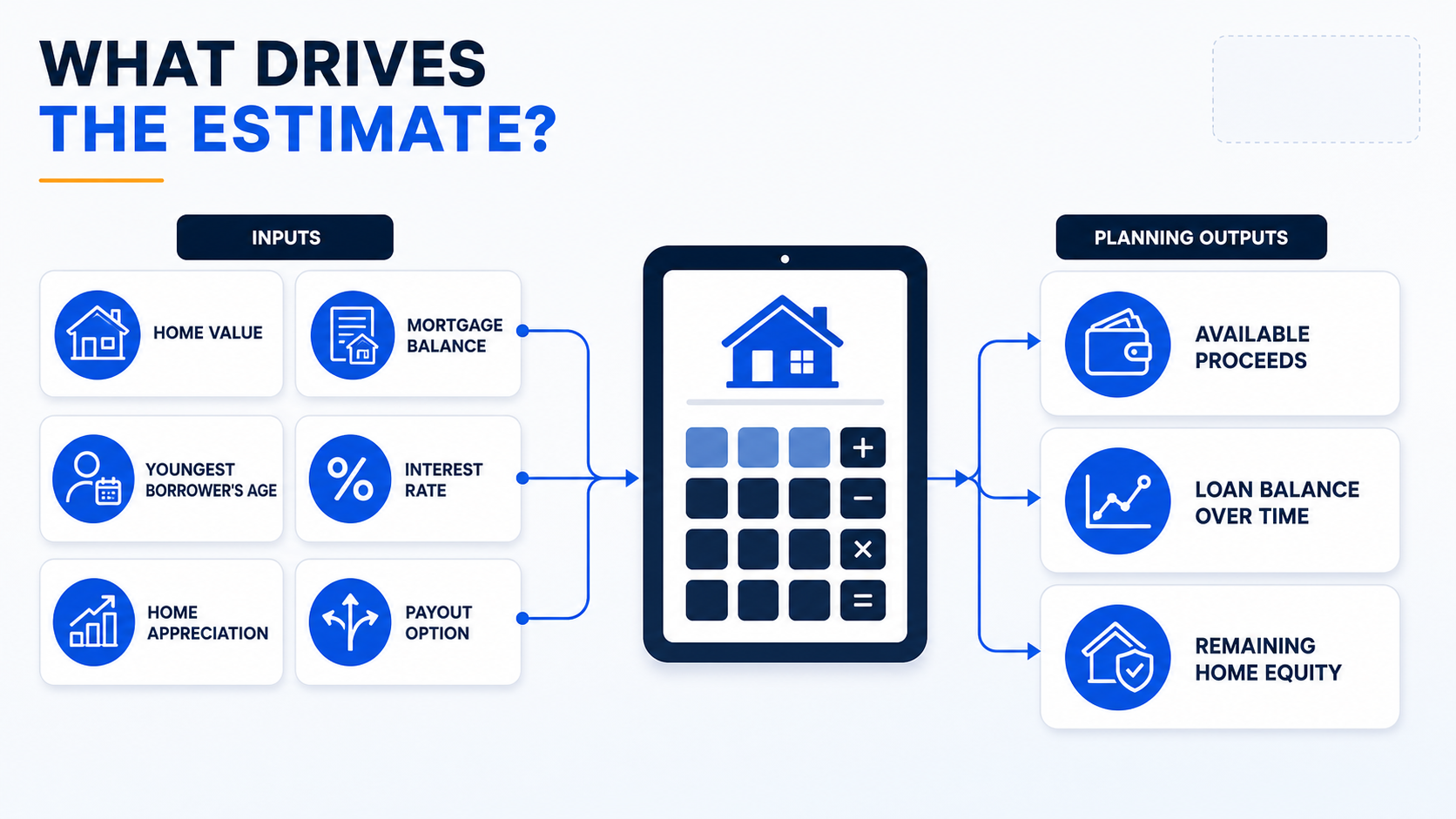
Most calculators ask for the same handful of inputs, and the quality of your output depends entirely on how accurate those inputs are:
- Home value: use a current market estimate, not your purchase price or tax assessment. Higher value means a larger potential loan.
- Current mortgage balance: any existing mortgage gets paid off at closing using reverse mortgage proceeds, which reduces the net amount available to you. If your home is paid off, this is zero.
- Age of the youngest borrower: HECMs require borrowers to be at least 62. The older you are, the larger your principal limit tends to be, since the loan is expected to run for a shorter period.
- Expected interest rate: a higher rate assumption means your loan balance grows faster and your remaining equity shrinks more quickly.
- Home appreciation rate: this is the assumed annual growth in your home's value. Since real home prices don't rise consistently every year, a conservative estimate gives you a more reliable picture.
- Payout option: lump sum, line of credit, monthly payments, or a combination. Each produces a very different balance trajectory.
These inputs produce an estimate. The real figure gets confirmed by a lender after a formal appraisal.
How Do Reverse Mortgage Calculators Factor Payout Options Into the Estimate?
The payout structure you choose has a real effect on how your loan balance grows over time. A good calculator lets you model each scenario separately before you commit to anything.
| Payout Option | How the Balance Grows | Best Fit For |
|---|---|---|
| Lump sum | Full amount accrues interest from day one | Paying off an existing mortgage or covering a large, immediate expense |
| Line of credit | Unused portion grows over time at the interest rate | Flexibility, and maximizing what's available later by drawing less now |
| Tenure payments | Balance climbs steadily with each monthly payment, for life | Predictable income for as long as you stay in the home |
| Term payments | Balance climbs steadily with each monthly payment, for a set period | Bridging an income gap for a fixed number of years |
| Combination | Depends on the mix: lump sum grows immediately, credit line grows on the unused portion | Covering an upfront need while keeping ongoing flexibility |
How Accurate Are Reverse Mortgage Calculators for Retirement Planning?
Be honest with yourself here: these are planning tools, not quotes. A few key limitations to keep in mind:
- Interest rates fluctuate over time, but calculators assume a constant rate, which can understate or overstate how fast your balance actually grows
- Home values don't always rise, either; they can decline in the short term, and an aggressive appreciation assumption paints a rosier picture than reality might deliver
- There is real protection built in, though. HECMs carry a no negative equity guarantee, which means you'll never owe more than your home is worth at the time of sale, regardless of what the loan balance shows on paper; a meaningful safety net, but it doesn't make the underlying estimate more precise
The practical move is to run the calculator with a conservative appreciation rate and a rate assumption toward the higher end of the current range.
Can a Reverse Mortgage Calculator Help You Estimate Retirement Income?
Close the Retirement Income Gap
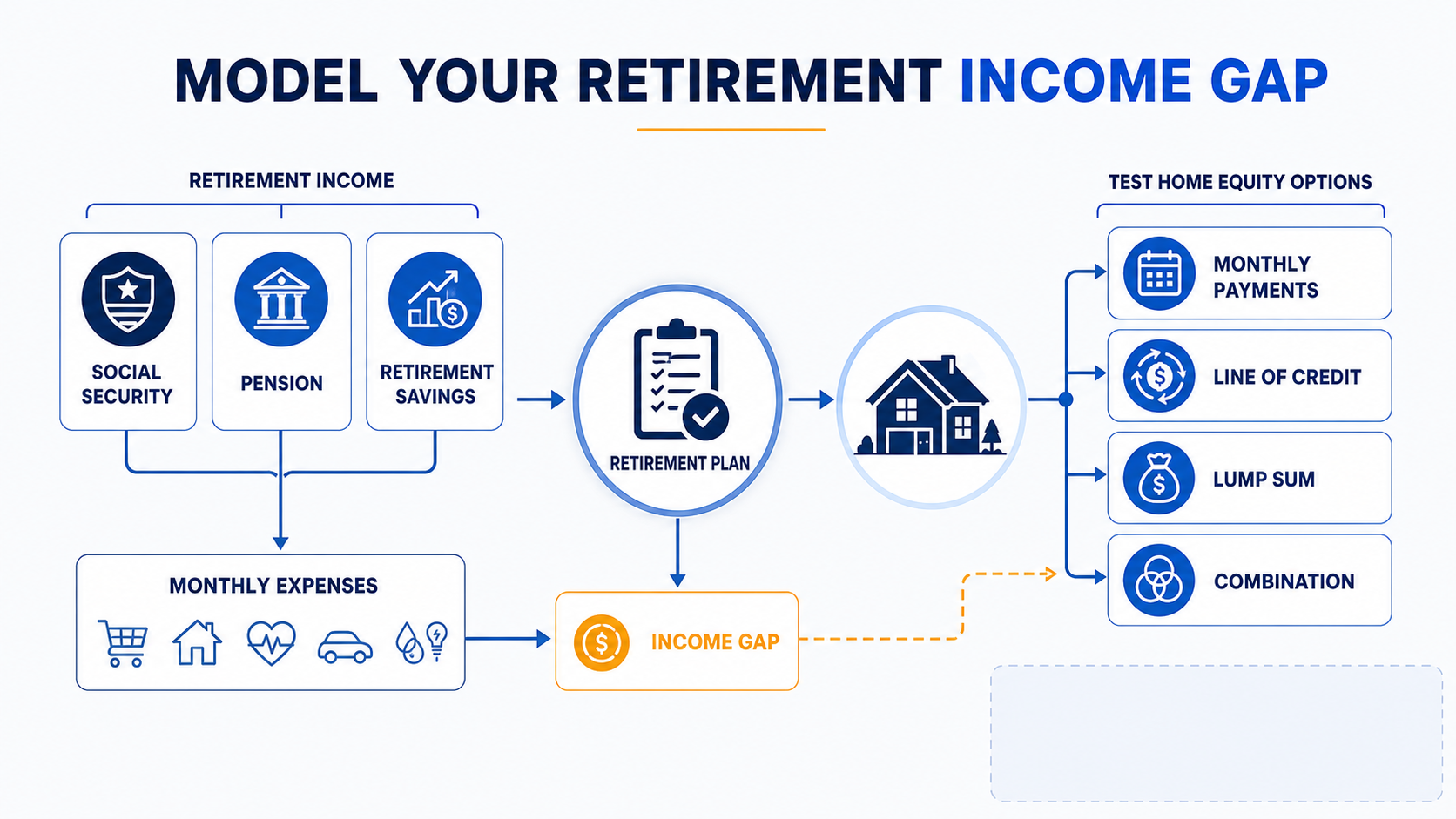
Most people approaching retirement are working against a retirement income gap: the difference between what fixed income sources (Social Security, a pension, IRA or 401(k) withdrawals) cover and what they actually need. A reverse mortgage calculator helps you model whether home equity can help close that gap, and in what form.
Use a Line of Credit as a Buffer
Say the calculator shows a $180,000 line of credit. You might draw on it monthly to supplement income, tap it as healthcare costs come up, or hold it in reserve as a buffer against a market downturn early in retirement: a real risk known as sequence-of-returns risk, where a bad few years right after you stop working can force withdrawals from a portfolio that hasn't had time to recover.
The Social Security Bridge Strategy
One specific strategy worth knowing about: some borrowers use term payments from a reverse mortgage to cover living expenses while they delay claiming Social Security. According to the Social Security Administration, waiting past your full retirement age increases your monthly benefit by roughly 8% per year, up until age 70.
That said, the Consumer Financial Protection Bureau studied this exact bridge strategy and found that, for a typical borrower starting at 62, the cost of the reverse mortgage by age 69 can run about 60% of the amount borrowed, often exceeding the lifetime Social Security gain by a few thousand dollars.
Why Home Equity Matters More Than You Think
Home equity also tends to matter more to retirement security than people expect. The Federal Reserve's Survey of Consumer Finances consistently shows that for many households nearing or in retirement, home equity represents one of the largest components of household wealth, often larger than retirement account balances. That's exactly why modeling it carefully, rather than guessing, is worth the ten minutes a calculator takes.
Who Should (and Shouldn't) Use a Reverse Mortgage Calculator Right Now?
Running the numbers makes the most sense for a few specific situations:
- Homeowners 62 or older with significant equity and a low or paid-off mortgage who want to understand what that equity could generate
- Pre-retirees approaching 62 who are stress-testing their retirement plan before they get there
- Recent home sellers weighing a HECM for Purchase: using proceeds to buy a new property without taking on a monthly mortgage payment
- Homeowners with an existing mortgage who want to eliminate the remaining balance and free up monthly cash flow without touching their investment accounts
A calculator alone falls short in a few cases, too:
- You have a spouse who isn't yet 62: their age affects the loan amount and needs lender-level modeling
- You're concerned about Medicaid eligibility: how proceeds might interact with it is outside any calculator's scope
- Your primary goal is estate planning: understanding what your heirs will actually receive needs a lender and, often, an estate attorney at the table
This is exactly where a real lender conversation earns its place. The best reverse mortgage brokers like Truss Financial Group look at your actual numbers, including your equity, your goals, and your timeline, rather than pushing a product, and tell you plainly whether a reverse mortgage fits, or whether a HELOC or something else makes more sense for your situation.
What Does a Reverse Mortgage Calculator Cost to Use, and What Comes Next?
The calculator itself is free. No application, no credit check, nothing required to run an estimate. The real costs show up if you move forward with an actual loan, and most of these get financed into the loan rather than paid out of pocket:
| Cost | Typical Amount |
|---|---|
| Origination fee | Capped at $6,000 for HECMs |
| Upfront mortgage insurance premium | 2% of the loan amount |
| Annual mortgage insurance | 0.5% of the outstanding balance |
| Closing costs | Third-party fees, e.g., appraisal and title |
| Servicing fees | Ongoing, set by the lender |
Before a HECM can close, HUD requires a counseling session with an approved HECM counselor; an independent step designed to make sure you understand what you're signing up for before you commit. The calculator is the right first step. Counseling and a lender conversation are the right second and third.
Frequently Asked Questions
What is the minimum age to use a reverse mortgage calculator?
Most calculators allow entry from age 62, the minimum federal borrowing age for a HECM. The age of the youngest borrower, or an eligible non-borrowing spouse, directly affects how much you may qualify for.
How do reverse mortgage calculators factor in home appreciation?
Calculators apply a constant annual growth rate to your home's current value. Since real appreciation isn't guaranteed year to year, using a conservative estimate, such as 2 to 3% or even zero, gives a more dependable baseline.
Can I use a reverse mortgage calculator if I still have a mortgage?
Yes. The calculator subtracts your existing balance from available proceeds, since that loan must be paid off at closing with reverse mortgage funds. Entering the correct balance gives you a realistic picture of what's actually accessible.
Does using a reverse mortgage calculator affect my credit score?
No. Running one requires no personal identifying information and no credit inquiry of any kind.
Can I use a reverse mortgage calculator for a HECM for Purchase?
Some lenders offer a dedicated calculator for this scenario, estimating how much you might receive toward a new home purchase and what down payment would be required. It's a distinct tool worth using separately if buying, not staying, is the plan.
Will a reverse mortgage calculator show me what my heirs will receive?
Only partially. It projects remaining equity at future points, but the actual amount heirs receive depends on when the loan is repaid, what the home sells for, and settlement costs at that time. For estate planning specifics, a lender and an estate professional are the right people to ask.
Ready to Run the Real Numbers on Your Loan?
A reverse mortgage calculator is one of the most useful free tools available for figuring out whether home equity belongs in your retirement plan, but the estimate is only as good as the assumptions behind it, and the real conversation happens with a lender who can look at your actual loan. The question isn't whether a reverse mortgage works in theory. It's whether it works for your specific home, age, equity position, and retirement goals.
Lenders like Truss Financial Group can model your real numbers and tell you plainly whether a reverse mortgage, a different equity strategy, or something else entirely is the right move.

.svg)

Discuss your unique requirements
Get direct answers and a roadmap for your future.
.png?width=202&height=202&name=image%20588255187%20(1).png)



.png?width=389&height=221&name=Blog%20covers%20(1).png)




.svg)

.svg)
.svg)