.svg)



%20(1).svg)
%20(2).svg)
.png?width=480&height=420&name=Img%20(1).png)
%20(3).svg)
%20(4).svg)

%20(5).svg)


 View all states
Rental Calculation: Ultimate Guide for Real Estate Investors

12 mins
In this blog
Key Takeaways:
- A rental calculation is valuable only with reasonable assumptions about the rent, vacancy, expenses, financing, and cash investment.
- Begin calculations by deriving the effective gross income from scheduled rent, in that order.
- Keep operating performance, financing, taxes, and sale expectations separate.
- Principal and interest are not entered in the NOI calculation.
- Use cap rate, cash-on-cash return, and DSCR for different purposes.
Purchasing a rental property involves more than comparing its monthly rent against its mortgage payment. A useful rental calculation takes the expected income, minus vacancies and operating costs, with cash-investment and financing assumptions to arrive at a set of numbers an investor can analyze. The result is seldom a guarantee.
For buy-and-hold opportunities, it is generally most useful to calculate NOI, financing, and rental property ROI in that order. This keeps property performance separate from leverage and cash requirements, and makes variations in financing easier to compare.
What a Rental Property Calculator Can and Cannot Tell You
A rental property calculator is a preliminary underwriting tool, and the results can vary significantly from one calculator to the next. They may represent differing sets of assumptions or formulas. No single tool can account for due diligence, an appraisal, inspection, lease analysis, income and expense audit, tax analysis, or loan application.
One calculator may assume a 5% vacancy, another 8%. Calculators will handle reserves, management fees, lender costs, and other expenses differently. They may also handle debt differently and apply variations for appreciation, sale costs, and coverage conventions. Compare the inputs before reviewing the outputs.
Start With the Property and Purchase Assumptions
Estimates for purchase price, property type, unit count, location, and expected holding period form the foundation. Add the estimate for closing costs and any work needed before the property can be rented, or furnishings necessary for the intended purpose of the rental or its strategy.
Maintenance costs should be separated from capital expenditures. A portion of reserves or a line item in the budget should reflect ongoing replacements like systems, appliances, and components. A larger reserve or repair account may be needed if significant work is planned for the acquisition.
The down payment, loan amount, interest rate, amortization schedule, points, and lender costs should be identified separately to keep the financing separate from the property itself and facilitate the later stages of the analysis.
Estimate Rent, Vacancy and Other Property Income
A rental income calculator should begin with the market rent or the scheduled rent in a lease, whichever is lower. Research recent comparable rentals, current rental income, and the advice of a property manager. Vacancy rates should be estimated with reference to similar units in the same price range and local area.
Vacant units represent a loss of potential income. The vacancy rate should be expressed as a decimal and multiplied by the scheduled rent, and the result subtracted from total scheduled rent. The number should reflect realities in the local market. A national average is not necessarily applicable to a particular property. This step produces the effective gross income.
Other regular income from the property may include parking, storage, laundry, or pet rent, if those charges are typically made and allowed by the landlord. Refundable security deposits cannot be counted as income. Short-term or seasonal rental income requires a different rental income calculator that considers occupancy rates and platform costs, if any.
Build a Complete Operating-Expense Estimate
The operating budget should include regular expenses related to the property – taxes, insurance, homeowners association or condominium fees, utilities paid by the owner, property management fees, normal maintenance, leasing costs, and any other regularly incurred costs. Nonrecurring items should be annualized to avoid the appearance of an artificially low monthly budget that ignores upcoming large expenses.
Repairs and replacements should be separated from normal maintenance. An itemized maintenance budget should be established that reflects ongoing system upkeep, while a separate reserve or repair budget estimates the cost of system replacements within the next few years. The IRS provides guidance on itemizing expenses, classifying them for tax purposes, and taking depreciation. Publication 527 describes some of the more common deductions for landlords of different classes of property.
Enter Financing and Total Cash Invested
Loan amount is derived from the purchase price and the down payment estimate. Interest rate, amortization, periodic payment, and any lender costs should be listed to keep property taxes, insurance, and other costs separate from the servicing of debt.
Total cash invested should be defined consistently. It may include the down payment, buyer-paid closing costs, points, lender fees, any pre-rental repair costs, and other items included in the analysis. Some items that appear in this budget might be financed, reducing cash investment and increasing debt and interest.
Calculation Order and Core Formulas
Follow one simple sequence: start with gross, subtract to reach the effective gross income, subtract to get to NOI, then subtract to reach the rental property cash flow. There are other approaches, but consistency is important.
| Calculation | Formula | Note |
|---|---|---|
| Effective gross income | Scheduled rent + recurring other income − vacancy and credit loss | Keep the period consistent. |
| NOI | Effective gross income − operating expenses | Exclude debt service, income taxes, depreciation, and capital purchases. |
| Pre-tax cash flow | NOI − annual debt service | State how reserves and owner-specific costs are treated. |
| Cap rate | Annual NOI ÷ purchase price or current value | Name the denominator; this is an unlevered property measure. |
| Cash-on-cash return | Annual pre-tax cash flow ÷ total cash invested | Define all cash included. |
| DSCR | Property income measure ÷ debt obligation measure | Use the lender or program's exact convention. |
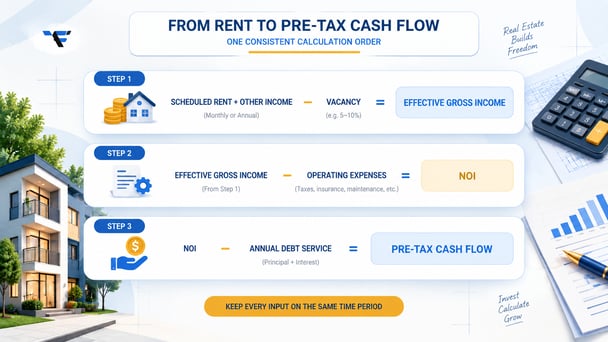
Denominator choice is important; a cap rate based on purchase price provides a different perspective than one that uses the current market value, just as a cash-on-cash return based on the total cash invested, including the down payment, points, fees, and initial repair costs, may be significantly different than one that uses only the down payment. A DSCR calculation uses income and debt-service definitions that may differ from the net operating income and debt service in the earlier calculations.
How to Read the Main Metrics
Each metric describes a slightly different perspective:
NOI
NOI represents the performance of the property without regard for financing or leverage. Cap rate, in turn, measures the performance of that NOI in relation to the value of the property or the purchase price. NOI and cap rate are both metrics for the performance of the property itself, without regard for leverage.
Cash Flow
The cash flow provides a view of the same metrics with the addition of financing costs and the impact on cash. Cash-on-cash return brings the perspective back to the cash invested in the deal. Positive cash flow is valuable but should be analyzed. A higher cap rate, in turn, does not always translate to higher cash flow with financing, especially when the payments exceed the cash available from the property.
Cash-on-Cash Return
The cash-on-cash return depends on the mix of financing, including the portion that represents interest. In some cases, a higher interest rate may increase the cash-on-cash return if it increases cash flow, but that scenario typically involves increased leverage, where additional cash flow from the additional NOI is greater than the additional interest expense.
DSCR
DSCR varies by convention, but the measurement may be applied differently by a lender calculating the qualifying income in a different way than the investor. TFG or another lender may calculate eligible rent and debt obligations differently from the investor's spreadsheet.
Advanced analysis of the cash distribution on a property-level basis can include appreciation, paydown of the mortgage, tax implications, and internal rate of return. These calculations all depend on the holding period assumptions and exit assumptions.
Worked Rental Calculation Example
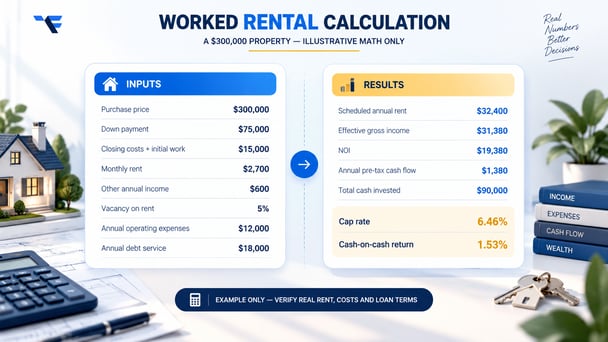
Assume the purchase price is $300,000. The investor puts $75,000 down and spends another $15,000 on closing costs and initial work. Monthly rent is $2,700, with $600 in additional annual income. Assume 5% vacancy on rent, $12,000 in annual operating expenses, and $18,000 in annual debt service.
First, calculate the scheduled annual rent: $2,700*12 = $32,400
Add the other annual income: $32,400 + $600 = $33,000
Five percent vacancy on the $32,400 rent equals $1,620.
That leaves:
$33,000 − $1,620 = $31,380 effective gross income
Now subtract the $12,000 in operating expenses:
$31,380 − $12,000 = $19,380 NOI
Next comes debt service:
$19,380 − $18,000 = $1,380 annual pre-tax cash flow
Using the $300,000 purchase price, the cap rate is approximately 6.46%.
Total cash invested is $90,000: the $75,000 down payment plus $15,000 in closing costs and initial work.
So:
$1,380 ÷ $90,000 = approximately 1.53% cash-on-cash return
Don’t treat these figures as a suggestion. The example is only meant to show the math. For a real property, you still have to check the real rent, taxes, insurance, vacancy rate, repairs, the loan terms, and any upfront costs.
One more issue can come up too. A lender may not compute DSCR as a straight NOI number divided by the yearly debt payment.
Rules of Thumb: Useful Screen, Not Final Analysis
The 1% rule and 50% rule are examples of rules of thumb – inexpensive approximations that can identify an implausible offer. A rule of thumb may help to filter a large list, but local conditions, age of the building, and other factors can render the 1% or 50% rule completely impractical.
A full rental calculation is always needed, however. Begin with a rule of thumb or another approximation, then move to a more detailed analysis with more realistic figures.
Due Diligence the Calculator Cannot Do
A spreadsheet will not visit the property for a physical inspection. The report on the property should be reviewed, including current tenants' leases, rent roll, title, zoning, permits, rental rules, and physical condition. Quotes on insurance and current tax bills should be obtained rather than accepted figures from the seller.
Tax calculations can differ considerably when the nature of the rental changes, with deductions allowed or disallowed due to length of use, repairs, capital improvements, or other factors. IRS Publication 527 discusses some of the more common considerations affecting deductions and depreciation for different classes of rental property. A qualified tax preparer can address questions about a specific property.
Common Calculation Mistakes
Most errors fall into a small number of categories:
- Asking rent used in the place of supportable market rent, scheduled rent, or an analysis including available local rent rolls or lease income
- Failure to account for vacancy and credit loss
- Failure to consider self-managed costs when comparing offers
- Owner-financed costs included in the operating budget
- Using the seller's old tax or insurance figures without verification
- Mortgage principal and interest included inside the NOI
- Comparison of offers using different inputs, reserve assumptions, or financing
- Monthly figures misapplied to an annual budget without identification or vice versa
FAQs (Frequently Asked Questions)
What is the basic formula for rental-property cash flow?
The effective gross income minus operating expenses equals the NOI; the NOI minus annual debt service equals the pre-tax cash flow.
Does a mortgage payment count as an operating expense or part of NOI?
No: NOI is income minus operating expenses; principal and interest are not included in the operating expenses and are subtracted second to calculate cash flow.
How do I estimate vacancy?
Vacancy depends on local conditions and similar available units. Vacancy should be estimated based on comparable local units, history of the property and its manager, and should always be stress-tested.
What expenses belong in a rental calculation?
Taxes, insurance, HOA fees, utilities, management and maintenance fees, leasing costs, license or professional fees, and other regularly incurred costs. Capital expenditures should be listed separately.
What is the difference between cap rate and cash-on-cash return?
Both are ratios, but cap rate reflects the NOI and is an unleveraged percentage of the value of the property. Cash-on-cash return reflects the annual pre-tax cash flow from the investment and is therefore affected by leverage and financed cash flow.
What is a good cap rate or cash-on-cash return?
It depends on the property and the market. Consider comparable properties and the same criteria.
How does financing change returns?
Financing changes the amount of additional cash needed to close, as well as the subsequent cash flow. Leverage can impact the cash-on-cash return without changing the NOI.
How is DSCR different from investor cash flow?
Investor cash flow is the cash distribution after expenses and debt service. DSCR is a coverage ratio that uses definitions from a lender; it may vary by program and have different definitions for qualifying income and expenses.
Can the 1% or 50% rule replace a full analysis?
No. The 1% or 50% rule is a screening tool only and cannot account for tax implications, insurance costs, maintenance, management, local conditions, or other factors.
How accurate is a rental property calculator?
It is only as accurate as its inputs and assumptions. A rental income calculator cannot predict rent, vacancies, operating costs, repairs, financing, or sale proceeds.
Next Step!
A strong analysis makes the assumptions clear, verifies the income stream, identifies operating expenses, and separates financing. If you have specific questions about a particular property or opportunity, Truss Financial Group can help you understand how the proposed rent, property type, and loan structure may be evaluated for available investor or DSCR financing. The result of a rental property calculator informs that conversation; it is not approval for financing.

.svg)

Discuss your unique requirements
Get direct answers and a roadmap for your future.
.png?width=202&height=202&name=image%20588255187%20(1).png)

.png?width=389&height=221&name=Blog%20covers%20(12).png)





.svg)

.svg)
.svg)