

 View all states

12 mins

In this blog
When people ask if a reverse mortgage is a good idea, the honest answer is that it depends. For some homeowners, yes. Upfront costs can make a reverse mortgage an expensive way to borrow if you expect to move soon or only need a small amount. Mortgage brokers like Truss Financial Group help homeowners compare reverse mortgages with other ways to access home equity.
This guide focuses on FHA-insured HECMs, which are available to eligible homeowners age 62 and older. Some private reverse mortgage programs accept borrowers starting at age 55, depending on the lender and state. Below: how it works, when it makes sense, what it costs, and what else you can do with your equity.
What Should You Know About How Reverse Mortgages Work and Who Qualifies?
Here is how a reverse mortgage works, and who can get one.
What you should know:
- You borrow against your home equity and receive the money instead of paying a lender every month.
- The most common type is the Home Equity Conversion Mortgage (HECM), which is insured by the Federal Housing Administration.
- A fixed-rate HECM pays a single lump sum payment at closing. An adjustable-rate HECM can offer a line of credit, monthly advances, or a combination of the two. FHA limits how much you can access in the first year.
- For a HECM on a home you already own, the borrowing limit depends on the age of the youngest borrower or eligible non-borrowing spouse, the expected interest rate, and the lower of the home's appraised value or FHA's national cap, which is $1,249,125 for 2026. Financed closing costs, any mortgage payoff funded by the loan, and required set-asides reduce the proceeds available to you.
- The catch is the direction of the math: as fees accrue, the loan balance increases. Interest is added to the loan balance each month, so the balance grows rather than shrinks.
- A HECM generally comes due when you sell the home, when it stops being a borrower's primary residence, or when the last borrower dies. An eligible non-borrowing spouse may qualify to defer repayment after the last borrower dies or spends more than 12 consecutive months in a healthcare facility. A default on the loan obligations can also trigger repayment.
Who qualifies:
According to the Consumer Financial Protection Bureau and HUD's HECM overview, these are the main reverse mortgage requirements:
- You are 62 or older, because HECMs are available only to homeowners in that age group.
- You complete counseling with a HUD-approved agency first.
- The home is your primary residence.
- You must own the home outright or be able to pay off the existing mortgage at closing with reverse mortgage proceeds, your own funds, or both. The property must meet FHA eligibility and condition standards.
- You are not behind on federal debt.
- The lender assesses your financial ability to meet ongoing loan obligations. Depending on the assessment, the lender may require part of the loan proceeds to be set aside for property taxes and insurance.
What Are the Reverse Mortgage Pros That Make It Worth Considering?
The reverse mortgage pros are real, and they matter most to a specific kind of homeowner.
No Monthly Mortgage Payments
The headline benefit is that a HECM lets you defer making monthly mortgage payments of principal and interest until repayment is due. You remain responsible for property taxes, homeowners insurance, and upkeep, and you must keep the home as your primary residence.
Money upfront can cover living expenses without touching savings. If you are on a fixed income and a large share of it goes to a traditional mortgage, deferring that payment can change your monthly cash flow overnight. A reverse mortgage can also pay off your existing mortgage first, which frees up what you used to send the lender.
Flexible Payout Options
A fixed-rate HECM pays a single lump sum payment at closing, which suits a one-time need such as home repairs. An adjustable-rate HECM can offer a line of credit, monthly advances, or a combination of the two. A line of credit lets you draw only what you need, and monthly advances work like monthly payments to you that can supplement retirement income for years.
You Keep Title and Stay in Your Home
You keep title and can stay in your home as long as you meet the loan obligations. For many seniors, that is the point: stay near family and friends without selling.
No Federal Income Tax on Proceeds
Reverse mortgage proceeds are excluded from federal taxable income because the IRS treats them as loan proceeds, not income.
Who Benefits Most?
Weigh the mortgage pros and cons together, and the profile that benefits most looks like this: significant equity, limited savings, a long runway in the same house, and no strong need to leave the home to heirs.
When Is a Reverse Mortgage Not a Good Idea?
The same features that help one borrower can hurt another. A reverse mortgage is usually the wrong move in these situations:
- You may move within a few years: Upfront costs are spread over a short time, and leaving the home permanently makes the loan due. A stay of more than 12 consecutive months in a healthcare facility can trigger repayment if no co-borrower still lives in the home and no eligible non-borrowing spouse qualifies for a deferral.
- Taxes, insurance, and upkeep are already a stretch: You must keep paying property taxes and homeowners insurance and maintain the house; if you cannot pay property taxes on time, the loan can become due. Falling behind on these ongoing obligations is a loan default, and it can lead to foreclosure even though you never missed a loan payment.
- You want a debt-free inheritance: Because the loan balance grows, there is less equity left for your family.
- A younger spouse is not on the loan: Protections for a non-borrowing spouse depend on when the loan was made and whether they meet HUD's rules.
- You rely on needs-based benefits such as SSI or Medicaid: If you receive SSI or Medicaid, check how unspent proceeds could affect your eligibility before choosing a payout.
A reverse mortgage is not dangerous by design. It is unforgiving when it does not match your plans.

What Does a Reverse Mortgage Loan Really Cost?
Cost is where most people are surprised. You defer principal and interest payments, but the fees do not go away. Here are the main charges on a HECM, based on HUD's HECM overview and the CFPB's cost guide:
| Cost | What it is | How it is charged |
|---|---|---|
| Initial mortgage insurance premiums | FHA mortgage insurance paid at closing | 2% of the FHA maximum claim amount at closing. For a HECM on an existing home, that amount is the lower of the appraised value or FHA's national cap |
| Annual mortgage insurance premiums | Ongoing FHA mortgage insurance | 0.5% of the outstanding loan balance each year |
| Origination fees | Lender's fee for making the loan | The fee limit is the greater of $2,500 or 2% of the first $200,000 of the maximum claim amount plus 1% of the amount above $200,000, subject to a $6,000 overall cap. The lender may charge less |
| Servicing fees | Fee for statements and account upkeep | If charged separately, up to $30 per month for fixed-rate or annually adjusting HECMs, or $35 per month for monthly adjusting HECMs |
| Interest | Cost of borrowing | Interest accrues on the outstanding balance and is generally added to the balance each month |
| Other closing costs | Appraisal, title insurance, title search, credit checks, recording fees | Third-party charges that vary |
You can finance eligible upfront costs with the loan. Doing so reduces the cash available to you and increases the balance on which interest accrues. The Federal Trade Commission warns that a reverse mortgage can be an expensive way to borrow, with fees and other costs that can be higher than a home equity loan or HELOC.
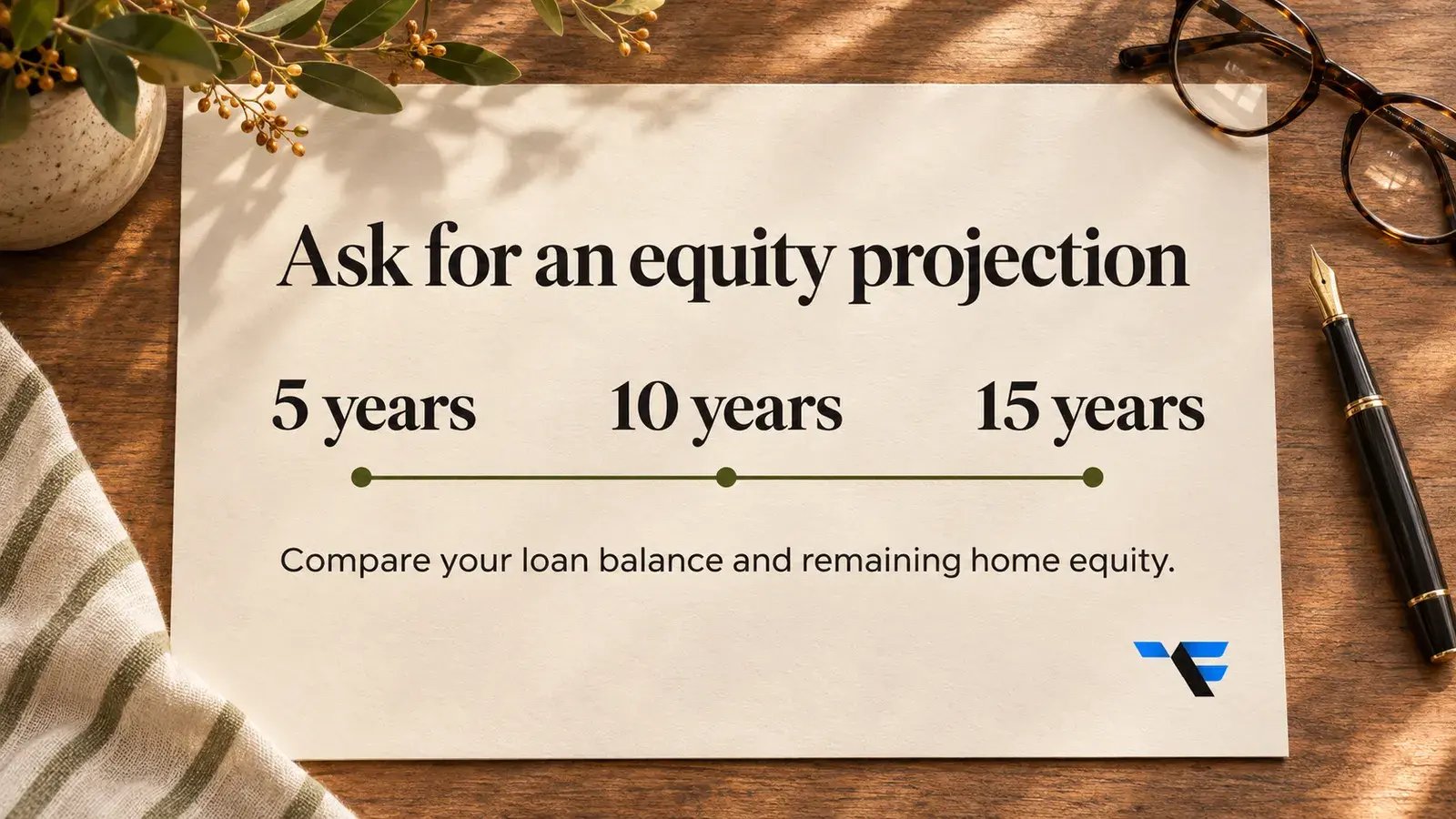
Mortgage insurance premiums alone can add up over a long loan. Before you sign, ask for a projection of your loan balance and remaining equity at 5, 10, and 15 years. Seeing the numbers exposes unexpected costs early.
How Does a Reverse Mortgage Affect Social Security, Taxes and Your Heirs?
Three questions come up again and again, so here are direct answers.
Social Security and other benefits
HECM proceeds leave Social Security retirement benefits and standard Medicare eligibility unchanged. For Supplemental Security Income (SSI), unspent proceeds can count toward the resource limit starting the following month. They can also affect eligibility for some Medicaid programs, depending on the state and eligibility category, according to AARP's policy summary. If you receive either, talk with a benefits counselor before choosing a payout.
Taxes
Any federal mortgage interest deduction depends on whether you itemize, how you used the funds, and whether you actually paid the interest. Accrued interest generally is not deductible until it is paid, and state rules vary, so speak with a tax professional.
Heirs
HECMs are non-recourse loans. The lender can collect the debt from the home, and heirs are protected from personal liability for a shortfall. Once the loan is due, heirs can sell the home and keep any sale proceeds left after the loan payoff and selling costs. If the loan balance exceeds the home's value, a qualifying sale for at least 95% of the current appraised value can satisfy the debt. Heirs who want to keep the home should ask the servicer for a written payoff amount.
If you are weighing these tradeoffs against other ways to use your equity, mortgage brokers like Truss Financial Group can lay the options side by side with you before you commit to anything.
How Does a Reverse Mortgage Compare With a Home Equity Loan or Line of Credit?
A reverse mortgage is not your only way to tap equity. The CFPB's guide to using home equity walks through the main options, and the tradeoffs are fairly consistent:
- Home equity loan: a lump sum that you repay in installments. The interest rate can be fixed or adjustable, and there is no age minimum. You need income to carry the payments.
- Home equity line of credit (HELOC): a revolving credit line where you pay interest on what you draw. A HELOC can cost less than a reverse mortgage, depending on the rate, fees, amount borrowed, and how long you keep the loan, but payments are required, and rates can change. Compare the two in reverse mortgage vs. HELOC, or look at a senior HELOC.
- Cash-out refinance: replaces your existing mortgage with a larger loan. It can lower your monthly mortgage payments if rates and terms work out, but you keep making payments.
- Downsizing: Downsizing may free up equity if your net sale proceeds exceed the cost of a new primary residence and the move. Whether you need a new mortgage depends on the purchase price and the funds available.
A home equity loan or HELOC can cost less, depending on the rate, fees, amount borrowed, and how long you keep the loan. Compare actual quotes and the monthly payments each option would require. Which tradeoff wins depends on your income and how long you plan to stay.
Does a Reverse Mortgage Work Differently If You Are Self-Employed?
Sometimes, yes. Lenders review your overall financial situation for every HECM, and self-employed homeowners document their income differently. If you use self-employment income to qualify for a HECM, expect to provide two years of personal and business tax returns or acceptable IRS transcripts. A year-to-date profit-and-loss statement and, when applicable, a balance sheet can also be required. The lender evaluates this income as part of the same financial assessment used for other HECM borrowers. Private reverse mortgage programs set their own documentation rules.
What Should You Ask Before You Decide?
Bring this list to your counselor, and to a financial advisor if you have one, and to any lender you talk to:
- What will this cost me in total over 5, 10, and 15 years?
- What happens if I move, get sick, or outlive my funds?
- Is my spouse protected if I die first?
- How do my heirs feel about this?
- Is a simpler option available for what I need?
HUD-approved counselors can answer these. You can reach HUD's counselor line at (800) 569-4287.
Frequently Asked Questions
1. Is a reverse mortgage a good idea for seniors?
It can be, if you have substantial equity, plan to stay in the home long term, and are comfortable leaving less to heirs. It tends to be a poor fit for people who may move soon, or who want long-term financial security through a larger inheritance.
2. Can I lose my home with a reverse mortgage?
You keep the title, but you can lose the home if you stop paying property taxes and insurance, stop maintaining it, or stop living there as your primary residence.
3. Does a reverse mortgage affect Social Security and Medicare?
HECM proceeds leave Social Security retirement benefits and standard Medicare eligibility unchanged. For Supplemental Security Income (SSI), unspent proceeds can count toward the resource limit starting the following month. They can also affect eligibility for some Medicaid programs, depending on the state and eligibility category.
4. How much money can I get from a reverse mortgage?
For a HECM on a home you already own, the borrowing limit depends on the age of the youngest borrower or eligible non-borrowing spouse, the expected interest rate, and the lower of the home's appraised value or FHA's national cap. Financed closing costs, any mortgage payoff funded by the loan, and required set-asides reduce the proceeds available to you.
Ready to Compare Your Home Equity Options?
A reverse mortgage is a good idea for the right homeowner and an expensive one for the wrong one. The question is not whether it is good in general. It is whether it is good for your plans, your spouse, and your family. Mortgage brokers like Truss Financial Group can walk you through your options, from home equity loans to refinancing, so you can decide with confidence.


Discuss your unique requirements
Get direct answers and a roadmap for your future.