View all states

9 mins
In this blog
Reverse mortgage requirements are set by federal guidelines for the Home Equity Conversion Mortgage (HECM), which is insured by the FHA. Proprietary options have their own requirements. If you are 62 or older and own your home, you may be able to access some of your equity under a HECM without making required monthly principal and interest payments. Approval depends on your age, equity, property, income, and documentation. Truss Financial Group can review your circumstances and compare HECM and eligible proprietary options.
What Are the Main Requirements for a Reverse Mortgage?
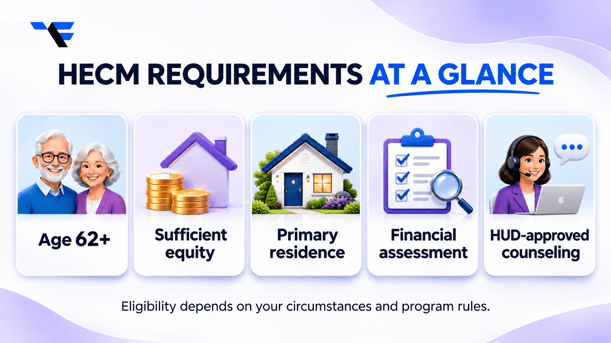
Reverse mortgage requirements start with HECM requirements, which are the baseline for most reverse mortgage lenders. Proprietary options are often similar, but they may have their own rules.
Reverse Mortgage Age Requirements
HECM age requirements are strict: all borrowers must be 62 or older. A co-borrower signs the loan and shares responsibility for it. An eligible non-borrowing spouse is not named on the loan but may have protections if they meet HUD criteria. The age of the youngest borrower or eligible non-borrowing spouse affects how much you can access.
Homeownership and Existing Mortgage
Among the reverse mortgage requirements, you must own your property outright, or have enough equity to pay off any outstanding mortgage at closing. Loan proceeds, or funds you are permitted to use, can pay off that mortgage. If the payoff exceeds the available funds, you may have to pay the difference in cash, so speak with us early to understand how this applies to you.
Principal Residence
The property must be your main home, meaning you live there for most of the year. Meeting this rule is one of the core reverse mortgage requirements. It can be a single-family home or an owner-occupied two-to-four-unit property. It cannot be a vacation home or an investment property.
Income, Assets and Credit Review
The FHA does not set a minimum credit score for a HECM, but lenders still review your payment history. Income requirements are determined by a financial assessment. The lender reviews your income, assets, monthly outgoings, and history of paying property costs such as taxes and insurance. It then calculates your residual income, which is the income you have left after paying your obligations.
If your residual income is low, the lender may require a Life Expectancy Set-Aside (LESA), which holds back part of your proceeds to pay property costs. A LESA reduces the cash available to you, so ask how it would affect your numbers.
Federal Debt and Program Eligibility
Outstanding federal debt, such as certain federal student loans, may prevent approval until it is settled or an acceptable repayment plan is in place. Identity and residency rules also apply, and these have been updated recently. Confirm the current HUD guidelines and the evidence your lender will require. Meeting HECM requirements depends on confirming these rules before you apply.
Independent Counseling
Counseling is one of the reverse mortgage requirements you must complete before you apply. You must complete a counseling session with a HUD-approved counselor. The session explains the costs, risks, and alternatives, and you receive a certificate when it is complete. This counseling is separate from your consultation with Truss. Timing and state requirements vary.
How Much Equity Do You Need for a Reverse Mortgage?
Reverse mortgage equity requirements have no fixed threshold. The equity you need depends on your age, current interest rates, the property's appraised value, FHA limits, and any existing debt. Generally, older borrowers can access more, and lower expected interest rates increase the amount available.
The amount you can take out is called the principal limit, but it is not all cash you receive. Closing costs, the mortgage insurance premium, any mortgage payoff, and any LESA are deducted from your proceeds. Speak with us to see what you may be eligible for based on your circumstances. Our guide to reverse mortgage estimates explains how these figures work.
What Property Types and Conditions Qualify?
You can qualify for a reverse mortgage on a single-family home, a HUD-approved condominium, an owner-occupied two-to-four-unit property, or a manufactured home. Your lender will arrange an FHA appraisal and review the property's condition and safety. Any necessary repairs must be completed before closing.
Condos must meet HUD requirements to be approved, and those requirements can change. Speak with Truss early to understand the current status of your project. Requirements also vary by program, so confirm what is needed with your loan advisor.
What Documents Do You Need to Apply?
Meeting reverse mortgage requirements starts with having the right documents ready. Speak with us early to understand which documents you will need. Your lender will confirm the final list, but it will generally include:
- Proof of identity and age
- Proof of residency under current HUD rules
- Deed and mortgage or lien details
- Income and asset statements
- Property tax, homeowners insurance, and any association documents
- Your HECM counseling certificate
You may also need spouse documents, trust documents, or condo association documents.
Do Proprietary and Jumbo Reverse Mortgages Have Different Requirements?
Yes, these can differ. Proprietary reverse mortgages are not insured by the FHA and have their own requirements. Some proprietary reverse mortgages may have a lower minimum age, starting at 55, depending on the lender and state. They may also accept different property values. Jumbo reverse mortgages are typically proprietary loans, and their financial assessment, counseling, and availability can vary by state.
Consider these differences carefully, and speak with your Truss loan advisor to understand what is available. Proprietary and jumbo options vary by state and program.
What Are the Ongoing Reverse Mortgage Requirements?
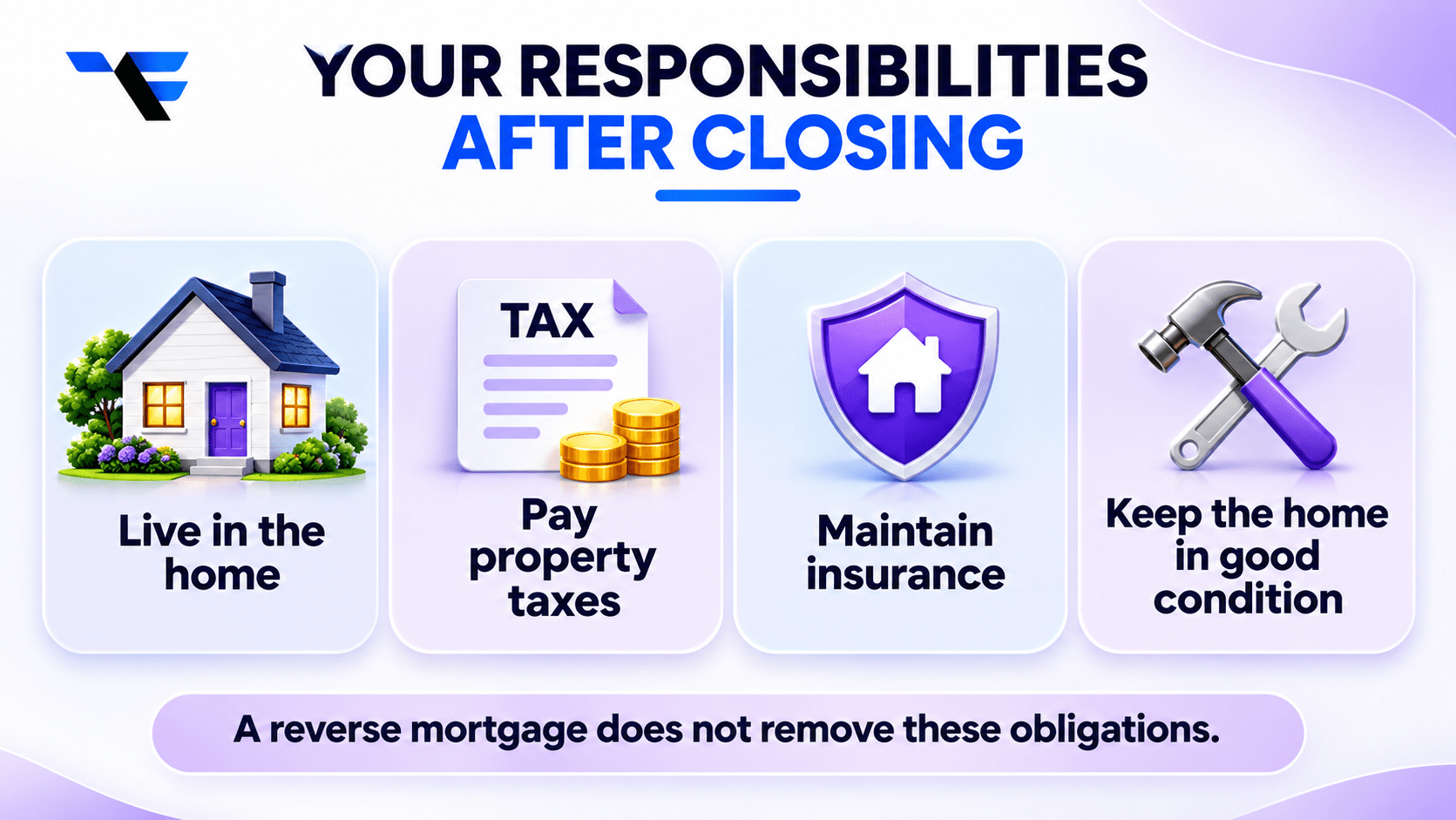
A HECM does not require monthly principal and interest payments, but you still have obligations. You must continue to live in the property as your main home, certify occupancy every year, and pay property taxes and homeowners insurance, including flood insurance where required. You must also pay any association fees and keep the property in good condition. Failing to meet these obligations may result in default.
Under HECM rules, the loan generally becomes due once the last borrower moves out permanently or passes away. Eligible non-borrowing spouses may be protected and allowed to remain in the property, depending on specific criteria and current HUD rules. Reverse mortgages are non-recourse, so you or your heirs will never owe more than the home’s value at sale. Speak with your loan advisor to understand the rules. The CFPB's reverse mortgage guide explains what borrowers need to do.
How Do You Apply and Compare Your Options?
Start by speaking with us to see whether you may be eligible. Then complete your independent counseling, gather your documents, and move through the appraisal and underwriting. Finally, review the final costs and net funds. If the requirements or costs do not suit you, compare your options.
A Home Equity Line of Credit (HELOC) may suit you if you have a regular income and want to keep your first mortgage. If your home no longer fits your needs or budget, downsizing may be an option. Your loan advisor can explain how these options compare with a reverse mortgage.
Review Eligibility With Truss Financial Group
Tell us your age, your spouse's age, the property type, its approximate value, your current mortgage balance, and your retirement budget, so we can review your reverse mortgage requirements. A loan advisor can help you understand which HECM or proprietary options you may be eligible for, and explain the costs and net funds for each.
FAQs (Frequently Asked Questions)
1. What can disqualify you from getting a reverse mortgage?
Common reasons include being under 62 for a HECM, the property not being your main home, outstanding federal debt, insufficient residual income, and missed property tax or insurance payments. Review eligibility with Truss to understand what applies to you.
2. Can I get a reverse mortgage if I still owe money on my home?
In many cases, yes. Any outstanding mortgage must be paid off at closing using the loan proceeds or funds you are allowed to use. Find out more about HECM reverse mortgage eligibility.
3. What credit score and income do I need for a reverse mortgage?
The FHA does not require a minimum credit score for a HECM. Income requirements are determined by a financial assessment that reviews your income, assets, outgoings, and history of paying property costs. Start by understanding HECM eligibility.
4. Can I qualify if my spouse is younger than 62?
Possibly. They may qualify as an eligible non-borrowing spouse. However, the age of the youngest borrower or eligible non-borrowing spouse affects how much you can access. Speak with TFG to understand whether you are eligible.
5. Can I get a reverse mortgage at age 55?
Not for a HECM, where the minimum age is 62. Some proprietary options start at 55, subject to lender and state rules. Find out about reverse mortgage options for those aged 55 and over.
6. Can I get a reverse mortgage on a condo?
Possibly. Condos must meet HUD requirements at the time of application, and those requirements can change. Find out about reverse mortgage rules for condos.
7. How do I estimate how much money I could receive?
The estimate is based on your age, the current interest rate, the property value, and any deductions. It is only an estimate, not a guarantee. Find out how reverse mortgage calculator estimates work.
8. Is a HELOC a better option if I do not qualify for a reverse mortgage?
That depends on your income, your current mortgage, and whether you want to keep your first mortgage. A HELOC requires you to qualify based on income and involves monthly payments. Compare a reverse mortgage and a HELOC to see which fits your situation.


Discuss your unique requirements
Get direct answers and a roadmap for your future.