.svg)



%20(1).svg)
%20(2).svg)
.png?width=480&height=420&name=Img%20(1).png)
%20(3).svg)
%20(4).svg)

%20(5).svg)


 View all states

12 mins
.png)
In this blog
Key takeaways
- Fannie Mae doesn't lend directly to homeowners: it sets the guidelines lenders follow when underwriting a HELOC, which shapes how much you can borrow, how much equity you can access, and whether you qualify at all.
- Your combined loan-to-value ratio (CLTV) and home equity combined loan-to-value ratio (HCLTV), not just your credit score, are what actually determine your borrowing ceiling under Fannie Mae standards.
- A HELOC and a cash-out refinance both unlock home equity, but they work differently under Fannie Mae's guidelines; knowing which one fits your situation could save you thousands in unnecessary closing costs or interest.
American homeowners are sitting on record home equity, and more of them are finally tapping it. According to the Federal Reserve Bank of New York's Q1 2026 Household Debt and Credit Report, outstanding HELOC balances have climbed to $446 billion, $129 billion above the low point reached in early 2022, and the report's sixteenth consecutive quarterly increase.
If you're one of the homeowners considering a home equity line of credit, you've probably run into the name "Fannie Mae" somewhere in your research. What you may not know is what Fannie Mae actually does, and why its guidelines quietly shape how much you can borrow, what your lender checks, and whether you qualify at all.
This guide breaks down what Fannie Mae's HELOC guidelines actually require, how they set your borrowing limits, and how a HELOC stacks up against a cash-out refinance under those same standards. Mortgage brokers like Truss Financial Group help borrowers make sense of these rules and work with over 90 lenders to match borrowers with the right home equity solution.
Does Fannie Mae Directly Offer HELOCs to Borrowers?
No, and this is the single most misunderstood part of the whole topic. Fannie Mae doesn't originate loans or lend money to homeowners directly. It operates in the secondary mortgage market, buying and securitizing loans that lenders originate. That means any lender planning to sell a loan into the secondary market has to underwrite it according to Fannie Mae's Selling Guide.
Most borrowers will never interact with Fannie Mae directly. But when a lender underwrites a HELOC, or a first mortgage on a home that already has a HELOC attached, Fannie Mae's guidelines shape what that lender is required to check:
- Borrower eligibility
- Income verification
- Credit assessment
- How the HELOC interacts with the rest of the borrower's debt
The Consumer Financial Protection Bureau describes a HELOC in the plainest terms as an "open-end" line of credit that lets a homeowner borrow repeatedly against their equity, but it's the underwriting standards layered on top of that basic structure that determine who actually gets approved. Fannie Mae's own consumer guidance frames the tradeoff the same way: a HELOC works a bit like a credit card, but because your home secures it, missed payments carry the risk of foreclosure.
In short: these aren't arbitrary lender preferences. They're structural requirements that flow from how the loan will eventually be sold.
How Do Fannie Mae HELOC Policies Impact Borrowing Limits for Homeowners?
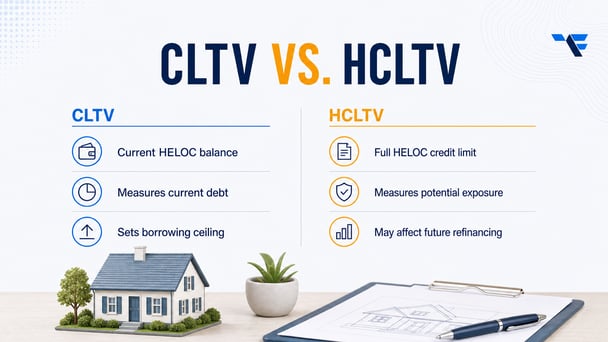
Fannie Mae uses two ratios to evaluate loans with subordinate financing like a HELOC attached.
- The combined loan-to-value ratio (CLTV) measures your total mortgage debt against your home's value: your first mortgage balance plus your HELOC balance.
- The home equity combined loan-to-value ratio (HCLTV) goes further: it uses your HELOC's full credit limit, not just what you've drawn.
That distinction matters. Even if you only plan to draw $50,000 from a $150,000 HELOC, your lender evaluates the transaction as if the entire $150,000 could be borrowed, which is why a large, mostly-unused credit line can still restrict your options down the road.
For example: a $500,000 home with a $250,000 first mortgage leaves $250,000 in equity. At an 85% CLTV ceiling, maximum total debt is $425,000, so the HELOC could theoretically reach $175,000. But HCLTV counts the full credit line, so applying for that $175,000 line means the lender treats your property as carrying the full $425,000 in exposure, whether you draw on it or not, which can affect a future refinance.
| CLTV | HCLTV | |
|---|---|---|
| What it measures | First mortgage + HELOC balance outstanding | First mortgage + full HELOC credit limit |
| Why lenders use it | Assesses current debt against home value | Assesses maximum potential exposure |
| Impact on borrower | Sets your current borrowing ceiling | Can restrict future refinancing options |
This is one reason record home equity hasn't translated into proportionally record HELOC balances at the bank level. FDIC data shows home equity lines held on bank balance sheets have been rising steadily, up to roughly $300 billion by the end of 2025, but that growth has been measured rather than explosive, reflecting how conservatively lenders size credit lines against these exposure limits.
What Are the Key Borrower Requirements Under Fannie Mae HELOC Standards?
Getting approved comes down to two tracks: you have to qualify, and the property has to qualify.
On the borrower side, lenders underwriting to Fannie Mae's general borrower eligibility standards generally assess four things:
- Credit profile. Fannie Mae doesn't publish a standalone minimum credit score specifically for HELOCs, but lenders typically set their own floors in the 620–680+ range depending on your overall risk profile, LTV, and other compensating factors.
- Income and employment. Your income needs to be stable, documented, and expected to continue. Self-employed borrowers often face additional documentation requirements: something some lenders specialize in through their bank statement and self-employed loan programs.
- Debt-to-income ratio (DTI). Fannie Mae's general threshold for conforming loans caps DTI at 45%, though Desktop Underwriter (DU) can approve higher ratios with compensating factors.
- Equity. You need sufficient equity remaining after the HELOC is factored in, typically subject to CLTV or HCLTV limits of 80–90%, depending on the lender.
On the property side, eligible homes generally include one- to four-unit residences, whether primary, second home, or investment, subject to varying LTV constraints depending on occupancy. Housing costs remain the largest single expense for most American families, which is exactly why lenders weigh these equity and income checks so carefully before extending additional credit against a home.
How Does a HELOC Payment Affect Your DTI Under Fannie Mae Rules?
This is a question worth asking before you draw a dollar. Fannie Mae's Selling Guide is specific here about how a HELOC payment factors into your debt-to-income ratio:
- If your HELOC has an outstanding balance and requires a monthly payment of principal and interest, or interest only, that payment counts against your DTI.
- If the HELOC has no outstanding balance and no required payment, the lender isn't required to include an equivalent payment amount at all.
- A borrower carrying a large HELOC balance with a required payment may find their DTI is higher than expected when they go to refinance their first mortgage, which can affect approval or the rate offered.
How Do Fannie Mae's Guidelines Compare a HELOC to a Cash-Out Refinance?
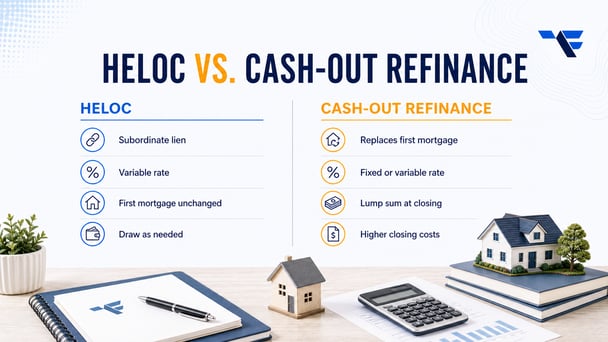
Both options unlock home equity, but they work very differently under Fannie Mae's framework, and the right one depends on what you're actually trying to solve for.
- A cash-out refinance replaces your existing first mortgage with a new, larger loan. Fannie Mae's cash-out refinance standards cap LTV at roughly 80% for primary residences and require a full underwriting process: income and credit verification, appraisal, and closing costs.
- A related option, the limited cash-out refinance, can be used specifically to pay off an existing HELOC that's in first-lien position, and allows only minor cash back to the borrower.
- A HELOC, by contrast, sits as a subordinate lien. It doesn't touch your first mortgage. You get revolving access rather than a lump sum, a variable rate rather than a fixed one, and a lighter closing process, though your lender still verifies credit, income, and equity.
| HELOC | Cash-Out Refinance | |
|---|---|---|
| Structure | Subordinate lien (revolving) | Replaces first mortgage (lump sum) |
| Interest rate | Variable | Fixed or variable (new loan) |
| Closing costs | Lower | Higher (typically 2–5% of loan) |
| First mortgage | Unchanged | Replaced entirely |
| Access to funds | Draw as needed during draw period | Full amount disbursed at closing |
| Best for | Preserving your existing rate | Restructuring rate or term |
The math behind this decision has shifted in recent years. A large share of outstanding mortgages still carry rates locked in well below where new loans price today, which is a major reason more homeowners are choosing to leave their first mortgage untouched and access equity through a HELOC instead.
If you want a side-by-side look at how the refinance route specifically works under Fannie Mae's rules, see Fannie Mae Cash-Out Refinance: Guide & Eligibility Rules.
Is a HELOC Under Fannie Mae Guidelines Right for Your Situation?
A HELOC tends to make the most sense if:
- You locked in a low rate on your first mortgage and don't want to give it up through a refinance.
- You have ongoing or phased needs, such as a renovation where costs come in stages, where revolving access beats a lump sum.
- Your CLTV and HCLTV comfortably support the credit line you want, with a DTI that stays within Fannie Mae's qualifying thresholds even with the HELOC payment included.
It's usually not the right move if:
- Your equity position can't support the line size you want once CLTV and HCLTV constraints are applied.
- Your DTI would breach qualifying limits with the HELOC payment factored in.
- You'd prefer a fixed and predictable payment over variable rate exposure.
- Your real need is a large one-time lump sum that a cash-out refinance would serve more efficiently.
This is exactly the kind of judgment call worth getting a second opinion on. Lenders like Truss Financial Group look at your actual loan, equity position, and financial profile and tell you upfront whether a HELOC, a cash-out refinance, or something else genuinely fits your situation, rather than steering you toward a single product.
Frequently Asked Questions
How does Fannie Mae count a HELOC in my debt-to-income ratio?
If your HELOC requires a monthly payment, principal and interest or interest only, that payment is included in your recurring monthly debt obligations for DTI purposes. If no payment is required because there's no outstanding balance, the lender isn't required to include one.
What credit score is generally needed for a Fannie Mae-compliant HELOC?
Fannie Mae doesn't publish a standalone minimum credit score for HELOCs specifically. Lenders underwriting to its standards typically set their own floors, often in the 620–680+ range, based on your overall risk profile, LTV, and DTI.
What's the difference between CLTV and HCLTV, and why does it matter for a HELOC?
CLTV measures your outstanding mortgage debt against your home's value. HCLTV uses your HELOC's full credit limit rather than just what's drawn, giving lenders a more conservative view of your total potential exposure, which can limit your options on a future refinance even if your line is mostly unused.
Can I use a cash-out refinance to pay off my HELOC under Fannie Mae guidelines?
Yes, through a limited cash-out refinance, if the HELOC is in first-lien position. If your HELOC is subordinate and not being paid off, it needs to remain clearly subordinate to your new first mortgage.
Does having a HELOC affect my ability to refinance my first mortgage?
Yes. A HELOC with an outstanding balance and required payment counts toward your DTI on the new loan, and it factors into your CLTV and HCLTV calculations, which can affect your LTV eligibility. If you're planning to refinance and currently carry a HELOC, it's worth modeling both numbers before you apply. If your line ever gets frozen or reduced mid-process, this guide on HELOC freezes and how to respond walks through your options.
What property types are eligible for a HELOC under Fannie Mae standards?
Generally, one- to four-unit residences, whether primary, second home, or investment, subject to the LTV and underwriting requirements tied to each occupancy type. Specifics vary by lender, so it's worth confirming directly before you apply.
Ready to See How Fannie Mae's Guidelines Apply to Your Loan?
Understanding Fannie Mae's HELOC guidelines isn't really about learning regulatory language: it's about knowing what your lender is actually evaluating when they decide how much equity you can access and whether you qualify at all. The real question was never whether a HELOC works in theory. It's whether it works for your specific loan, your equity position, your DTI, and what you're actually trying to accomplish.
That's a conversation worth having with a lender who will run the actual numbers rather than push a single product. Lenders like Truss Financial Group work with more than 90 banks and can tell you plainly whether a HELOC, a cash-out refinance, or another option is the right move for your loan.

.svg)

Discuss your unique requirements
Get direct answers and a roadmap for your future.
.png?width=202&height=202&name=image%20588255187%20(1).png)


%20(1).png?width=389&height=221&name=Blog%20covers%20(2)%20(1).png)



.svg)

.svg)
.svg)