


 View all states

13 mins

In this blog
Two investors. Same 3-bedroom property in Nashville. One has a traditional year-long lease at $2,600/month. The other runs a furnished mid-term rental at $3,400/month, occupied by a traveling nurse on a corporate housing contract. Same asset, nearly $800 more per month, and a tenant with a housing stipend backing the lease.
That difference is the mid-term rental strategy: furnished properties leased for 30 days to 12 months, commanding a premium that traditional long-term rentals cannot match. Specialized lenders like Truss Financial Group help real estate investors structure the right financing to capture it. This guide covers everything you need to decide if MTR belongs in your real estate portfolio.
What Is a Mid-Term Rental?
A mid-term rental, sometimes called a medium-term rental, is a furnished property leased on a monthly basis, typically for one to six months, with three-month terms being most common. Unlike short-term housing priced by the night or traditional long-term leases locking tenants in for a year, the mid-term model is built around flexible rental agreements that give both sides room to adapt.
Medium-term rentals occupy a practical middle ground. Vacation renters want nights; long-term tenants want a year-long commitment.
Mid-term renters want a few months, with the stability of a proper lease agreement and the convenience of a furnished, move-in-ready space. That is precisely what justifies the income potential over unfurnished rentals in the same market.
|
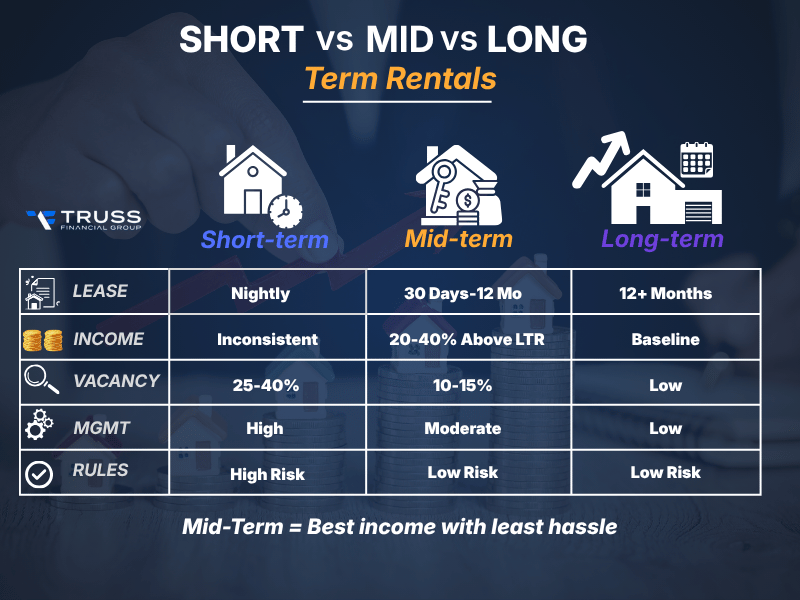
Feature |
Short-Term Rental |
Mid-Term Rental |
Long-Term Rental |
|
Lease length |
Nightly / weekly |
30 days – 12 months |
12+ months |
|
Furnished? |
Yes |
Yes |
Rarely |
|
Pricing model |
Dynamic (nightly) |
Monthly premium |
Fixed annual |
|
Management intensity |
High |
Moderate |
Low |
|
Vacancy risk |
High (seasonal) |
Low–moderate |
Low |
|
Regulatory exposure |
High |
Low–moderate |
Low |
|
Monthly income vs. LTR |
Inconsistent |
20–40% above LTR |
Baseline |
Who Rents Mid-Term Properties?
Understanding tenant demographics before acquisition is the single biggest driver of occupancy in the mid-term rental market. Demand is not random. It concentrates around specific industries and life events, and property owners who align their investment strategy with those demand anchors consistently outperform those who don't.
- Traveling nurses and healthcare professionals are the most reliable mid-term tenants. They book 13-week assignments through staffing agencies, often arrive with housing stipends, and generate year-round demand that does not track economic cycles. Properties within 3–5 miles of major hospitals consistently capture this segment.
- Corporate employees and business travelers need temporary housing during project assignments, office relocations, or training programs. Corporate tenants frequently carry employer backing, reducing default risk compared to individual signers. Tech hubs and cities with Fortune 500 headquarters density generate the most consistent demand from this group. Direct relationships with corporate housing platforms and HR relocation departments can eliminate platform fees entirely for repeat volume.
- Remote workers and digital nomads seek flexible housing options, fast internet, and walkable neighborhoods over proximity to any single employer. This segment has grown substantially since 2020 and fills calendar gaps between primary tenant types well.
- Families relocating need three to six months of furnished housing during home purchases, sales, or major remodels. They typically require larger properties, book with urgency, and pay above-market rates because furnished rentals at the family scale are scarce.
- Insurance-displaced tenants, households displaced after fires, floods, or other covered losses, represent the highest-rate segment. Insurance companies pay premium rates for immediately furnished accommodations, and occupancy is effectively guaranteed for the claim period.
|
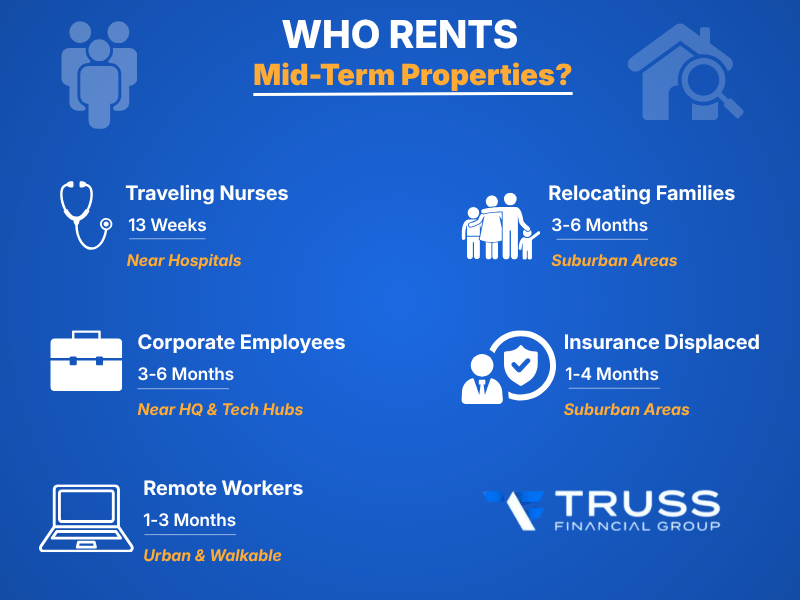
Tenant Type |
Typical Stay |
Best Location |
|
Traveling nurses |
13 weeks |
Within 5 miles of major hospitals |
|
Corporate employees |
3–6 months |
Near Fortune 500 HQ, tech hubs |
|
Remote workers |
1–3 months |
Walkable urban neighborhoods |
|
Relocating families |
3–6 months |
Suburban markets near good schools |
|
Insurance displacement |
1–4 months |
Any market; insurance-backed rates |
Are Mid-Term Rentals Profitable?
The income advantage is real, but it needs to be modeled against actual costs before it becomes a decision. Many mid-term rentals offer more consistent income than short-term housing precisely because tenants stay for extended periods rather than a few nights at a time.
Mid-term rentals provide 20–40% higher monthly rent than comparable unfurnished long-term rentals. A 3-bedroom property leasing at $2,800/month on a traditional lease can command $3,360–$3,920/month as a furnished rental.
Part of that premium offsets utilities and internet, which the landlord typically covers, but the net gain after those costs still produces more consistent income, running 10–20% above traditional long-term rental net income.
Vacancy rate is where the medium-term rental strategy pulls further ahead of short-term properties. Short-term vacation rentals average 25–40% annual vacancy due to seasonal demand fluctuations. Mid-term rentals fall in the 10–15% range because tenants are booking for extended periods, not nights.
Sample monthly cash flow, 3-bedroom MTR, mid-size market:
|
Line Item |
Monthly Amount |
|
Gross rental income |
$3,500 |
|
Vacancy reserve (12%) |
–$420 |
|
Effective gross income |
$3,080 |
|
Mortgage payment (DSCR loan) |
–$1,200 |
|
Property taxes + insurance |
–$250 |
|
Utilities |
–$200 |
|
Internet + streaming |
–$100 |
|
Cleaning between tenants |
–$100 |
|
Maintenance reserve (8% of gross) |
–$280 |
|
Net monthly cash flow |
$950 |
On a $50,000 down payment, that produces a 22.8% annualized cash-on-cash return and steady cash flow month over month. For comparison, a well-run long-term rental in the same market typically produces 8–10%. Furnishing costs of $8,000–$15,000 for a 3-bedroom are amortized over five years, adding roughly $130–$250/month to the true cost basis, which the model above can absorb without compressing the return materially.
Mid-Term Rental Financing: Matching the Structure to Your Portfolio
Mid-term rental financing follows the same framework as other investment property loans, but the right product depends on where you are in your real estate investing journey and how you document income.
|
Loan Type |
Qualifies On |
Best For |
Typical Down Payment |
|
DSCR loan |
Property rental income |
Scaling investors, self-employed |
20–25% |
|
Conventional mortgage |
Personal income + credit |
First property, strong W-2 |
15–25% |
|
Portfolio loan |
Lender relationship |
4+ properties, complex portfolios |
20–30% |
|
Hard money loan |
Asset value |
Acquisition + renovation bridge |
10–20% |
1. DSCR Loans
The lender qualifies the property on its rental income rather than the borrower's personal income, dividing projected monthly rent by total monthly debt service to calculate the debt service coverage ratio. Most lenders require a DSCR of 1.0–1.25. Because mid-term rentals generate a 20–40% premium over long-term lease rates, many properties clear that threshold more easily than comparable unfurnished units.
Example: a property generating $3,500/month in rental income against $2,600/month in debt service produces a DSCR of 1.35, comfortably above the standard ceiling, with no W-2s, tax returns, or DTI calculation required. Specialized lenders like Truss Financial Group offer DSCR products structured specifically for investment property income profiles like this, including options for borrowers with a DSCR below 1.0.
2. Conventional Mortgages
Conventional mortgages carry lower interest rates but require high personal income, credit scores of 680+, and full documentation. DTI, including the new mortgage, must stay under 43–45%. Best fit for property owners acquiring their first mid-term rental with a clean W-2 income profile.
3. Portfolio Loans
These are held by the lender rather than sold to the secondary market, allowing more flexible terms and the ability to roll multiple properties into a single loan structure. Best fit for investors with four or more properties or complex entity structures.
4. Hard Money Loans
Hard money loans serve one purpose: to acquire and renovate a property that cannot qualify for long-term financing at purchase. The path is to acquire with hard money, furnish and establish rental income, then refinance into a 30-year DSCR product. Not a hold strategy, purely an acquisition bridge.
How to Set Up and Operate a Mid-Term Rental?
Step 1: Choose Your Market and Property
Start with demand anchors. Target markets that combine at least two of the following:
- Major hospitals (3+ within 20 miles)
- Fortune 500 or regional corporate headquarters,
- University districts
- High relocation activity.
A single employer is not a sufficient thesis. Single-family homes command the highest premiums for families relocating and long-assignment corporate tenants; condos and townhomes work well in urban markets for nurses and consultants; multifamily units spread vacancy risk across multiple mid-term tenants simultaneously; ADUs offer the lowest entry cost for solo traveling professionals.
Step 2: Furnish and Prepare the Property
The property must be genuinely move-in ready, not staged, but actually livable. Essentials include:
- Proper bed and bedroom furniture
- Functional workspace (non-negotiable for remote workers)
- Full kitchen kit
- Washer/dryer in-unit
- High-speed internet at a minimum of 200 Mbps.
Budget $8,000–$15,000 for a 3-bedroom and buy durable mid-range pieces. Cheap flat-pack furniture degrades after two to three tenant cycles and becomes a recurring maintenance cost.
Step 3: List and Source Tenants
A multi-platform strategy maximizes occupancy. Furnished Finder drives the most consistent healthcare professional demand. Airbnb's monthly filter captures remote workers and digital nomads on 30–90 day stays. Corporate housing platforms target relocation tenants directly.
For high-volume markets, direct outreach to hospital staffing agencies and corporate HR departments eliminates platform fees and builds a repeatable pipeline. Property management software can help streamline listing updates, tenant communication, and rental period tracking across platforms simultaneously.
Step 4: Screen Tenants and Finalize the Lease
Follow the same standard as any investment property: background check, employment verification, and prior housing reference. For corporate and healthcare tenants, they require proof of assignment or an employer letter confirming duration. Use a custom mid-term lease that specifies the furnished inventory (attached as an itemized list), utilities included, security deposit terms, move-in/move-out standards, and early termination conditions.
Legal and financial considerations matter here: a well-drafted lease prevents security deposit disputes and protects against tenants claiming long-term tenant rights under local landlord-tenant laws. Consult a real estate attorney before finalizing.
A property manager experienced in furnished rentals can handle tenant sourcing, screening, and lease execution for investors who prefer a hands-off approach, though self-managing 1–3 properties is straightforward given that mid-term leases only turn over 4–6 times per year.
Risks and Costs of Mid-Term Rentals: The Honest Version
|
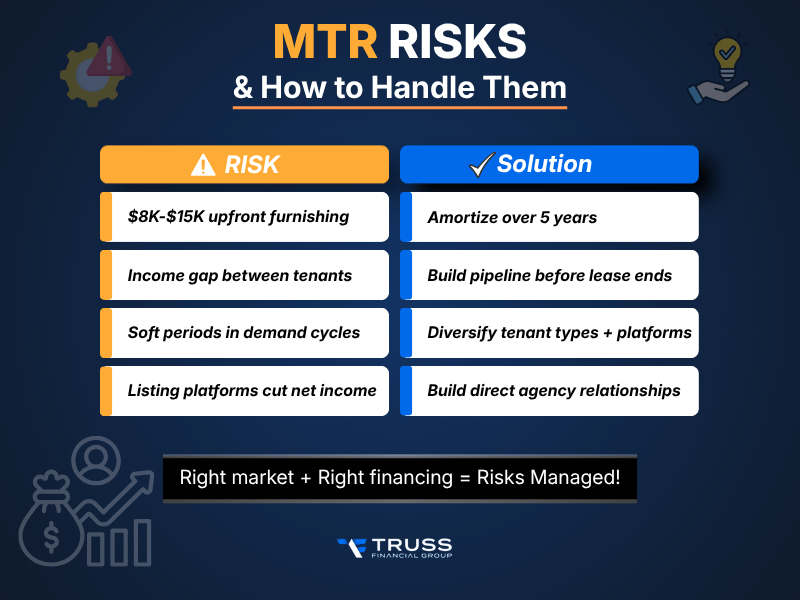
Risk / Cost |
Detail |
Mitigation |
|
Furnishing investment |
$8,000–$15,000 upfront for a 3-bedroom |
Amortize over 5 years; buy durable pieces |
|
Vacancy between tenants |
Each transition is a potential income gap |
Build a tenant pipeline before the current lease ends |
|
Seasonal demand fluctuations |
Healthcare and corporate cycles create soft periods |
Diversify tenant types across platforms |
|
Regulatory exposure |
Some municipalities may expand short-term rental restrictions to MTR |
Verify local regulations and HOA rules before acquiring |
|
Platform fees |
Listing platforms compress net income |
Build direct agency and HR relationships for repeat volume |
|
Property management fees |
MTR specialists charge 10–15% of the monthly rent |
Self-manage 1–3 properties; hire for 4+ or remote holdings |
Three situations where the strategy does not work: markets where the furnished premium does not clear 15% above LTR net after utilities and furnishing amortization; investors carrying high leverage who have not modeled the DSCR impact of additional operating costs; and small markets with no clear demand anchor. Proximity to a hospital, corporate campus, or university is not a nice-to-have; it is the entire investment thesis.
Frequently Asked Questions
What is a mid-term rental?
A furnished property leased for 30 days to 12 months on monthly rental agreements, targeting traveling professionals, remote workers, and relocating families who need more stability than short-term housing and more flexibility than year-long leases.
How profitable are mid-term rentals?
Well-positioned mid-term rentals generate 20–40% higher monthly income than comparable long-term rentals, with annual vacancy averaging 10–15% vs. 25–40% for short-term vacation rentals. Cash-on-cash returns in the range of 12–18% are achievable in strong demand markets.
What financing works best for mid-term rental properties?
DSCR loans are the primary option for scaling investors. They qualify on rental income, require no personal income documentation, and benefit directly from the MTR premium. Conventional mortgages suit first-property buyers with high W-2 income. Portfolio loans work best for investors managing four or more properties.
Do mid-term rentals need to be furnished?
Yes, without exception. Mid-term tenants are temporary professionals who arrive without household goods. Many mid-term rentals include utilities, internet, and streaming services in addition to furniture, and that all-inclusive setup is what justifies the monthly premium over unfurnished rentals in the same market.
What are the biggest risks?
Furnishing costs, vacancy between tenants, seasonal demand gaps, regulatory exposure in restrictive municipalities, and platform fees. The strategy underperforms in markets without a clear, overlapping demand anchor.
How do I screen mid-term tenants?
Background check, employment verification, and prior housing reference as a baseline. For corporate and healthcare mid-term renters, proof of assignment or an employer letter. Use a custom mid-term lease, never a standard residential lease template.
Is Mid-Term Rental Investing Right for Your Portfolio?
Those who explore mid-term rentals often find the income potential more compelling than they expected. The premium is real, the demand is structural rather than cyclical, and the mid-term rental business is more manageable than short-term housing by a significant margin.
But the investors who build a successful real estate portfolio around this strategy are not the ones who move fastest. They are the ones who validated their demand anchor before acquisition, ran the cash flow model honestly before signing, and matched their financing structure to the actual return profile, not an optimistic one.
Mortgage brokers like Truss Financial Group help real estate investors evaluate the mid-term rental opportunity from the financing side first, then structure the right DSCR or investment property loan around your specific market, portfolio stage, and timeline before anything goes to underwriting.


Discuss your unique requirements
Get direct answers and a roadmap for your future.