.svg)



%20(1).svg)
%20(2).svg)
.png?width=480&height=420&name=Img%20(1).png)
%20(3).svg)
%20(4).svg)

%20(5).svg)


 View all states
How to Get a Bank Statement: 5 Methods Explained

12 mins
In this blog
Getting a bank statement from your financial institution is usually a five-minute task once you know which method fits your situation, and for most people, that means logging into online banking or opening a mobile app. This guide is for anyone pulling a statement for a loan application, a rental application, a tax filing, or a routine records check.
Below, we walk through every retrieval method, including online, mobile, branch, phone, and ATM, how to download a statement as a PDF, what to do if your account is closed, and how to decide which route is fastest for your specific need. Mortgage lenders like Truss Financial Group work with borrowers on exactly these kinds of documentation questions every day.
What Is a Bank Statement, and What Is It Used For?
A bank statement is a record of every credit and debit to your account during a specific statement period, typically one month. It includes your name, account number, institution name, opening and closing balance, and a chronological list of transactions: deposits, withdrawals, debit card purchases, ATM activity, fees, and interest earned. Paper and electronic versions contain identical data; format is the only difference.
Bank statements come up most often for four reasons:
- Reviewing spending against a budget
- Spotting unauthorized transactions or fraud
- Providing proof of income for a loan or mortgage application
- Supporting a rental application or tax filing.
That last use case matters more than it used to: the Federal Trade Commission's Consumer Sentinel Network received reports of more than $12.5 billion in fraud losses in 2024, a 25% jump over the prior year, which is part of why regularly reviewing your statements for unfamiliar charges has become standard financial hygiene.
5 Methods to Get a Bank Statement from Your Financial Institution
Method 1: How Can I Access My Bank Statements Through Online Banking?
For most account holders, the online banking portal is the fastest way to get a statement. Log in to your bank's official website, then navigate to the section labeled "Statements," "e-Documents," "Account Activity," or "Document Center"; the exact wording varies by institution. From there, select the account, choose the statement period, and view or download.
- Log in to your bank's official website
- Go to the Statements, e-Documents, or Account Activity section
- Select the account you need
- Choose the statement period or date range
- View online or download as a PDF
Most portals allow direct PDF downloads from this screen. If you haven't yet enrolled in online banking, you'll need to register before statements become available this way. Availability also varies: most banks provide between two and seven years of statement history online, though exact retention practices differ by institution. Banks are required to maintain most deposit account records for a minimum of five years under federal recordkeeping rules, which is one reason online statement archives commonly extend that far back.
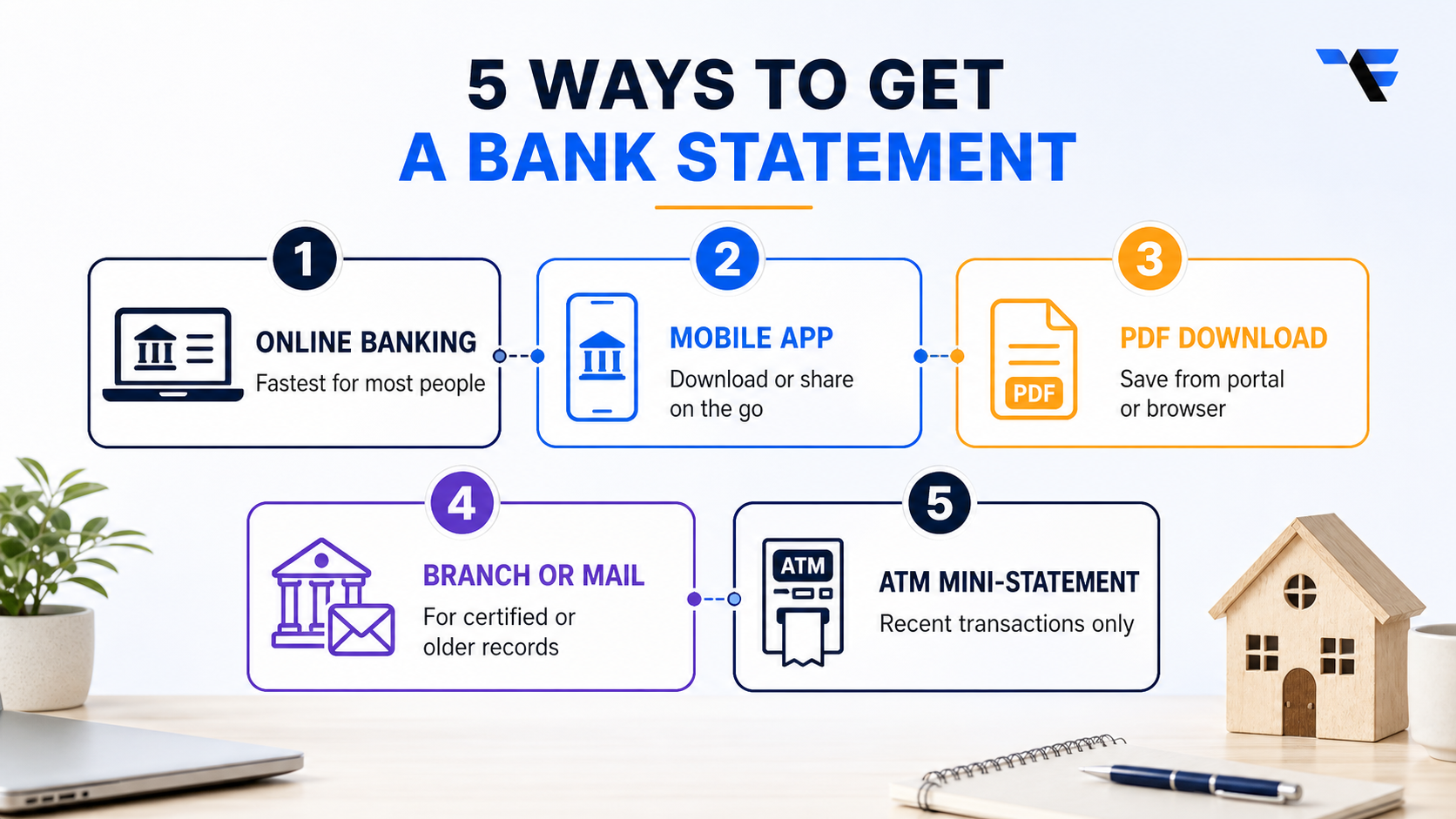
Method 2: Where Do I Find Bank Statements on My Mobile Banking App?
Most major bank apps support statement access, though navigation varies more than it does on the web. The general path:
- Open your bank's official mobile app
- Tap on the account you need
- Look for "Statements," "Documents," or "Account Details"
- Select the statement period
- Download, view, or share directly from the app
One practical advantage of the app is that many let you share a statement directly via email or save it to cloud storage without ever opening a browser, useful if you're pulling documents for a self-employed mortgage or bank statement loan application while away from your desk. One limitation worth knowing: statement history in the app is sometimes shorter than what's available through the web portal, so if you need an older statement, check the portal or consider a branch visit.
Method 3: How Do I Download Bank Statements in PDF Format?
Most online portals and apps save statements as PDFs automatically when downloaded. If a statement opens as a viewable page instead of downloading, use your browser's print function to save it:
- Open the statement in your browser
- Select "Print" from the browser menu
- Choose "Save as PDF" as the destination
- Save the file to a secure folder on your device
This works across all major browsers and operating systems. PDFs downloaded directly from your bank's official portal are generally accepted as official documents for loan applications, rental applications, and similar verification purposes. Because these files contain sensitive account details, store them somewhere secure, such as a password-protected folder or encrypted storage, rather than leaving them in a general downloads folder.
Method 4: How Do I Request a Paper Bank Statement by Mail or at a Branch?
A branch visit is the most reliable option when online access isn't available, when you need an older statement, or when a certified or official copy is required.
- Bring government-issued photo ID and your account number to a branch
- Ask a teller or personal banker for the statement period you need
- Request a printed copy on the spot, or ask them to start a mailed copy request
If a branch visit isn't convenient, you can request a statement by phone instead:
- Call the number on the back of your debit card or listed on your bank's official website
- Request the specific statement period you need
- Ask whether the representative can mail a paper copy or arrange secure email delivery
Processing time for mailed copies typically runs three to seven business days. Expect a fee for paper or mailed statements, commonly $1 to $5 per statement, with higher charges for archived records; always confirm the cost before submitting the request.
Method 5: Can I Get a Bank Statement from an ATM?
Yes, in a limited way. Some ATMs, particularly those owned by your bank, offer a mini-statement option that prints your last five to ten transactions. This is not a full monthly statement: it skips the opening and closing balance summary and the complete transaction history, and it isn't suitable for loan applications or other official documentation. It's useful only for a quick check of recent activity, and it isn't available at every ATM or for every account type.
Which Method Is Right for Your Situation?
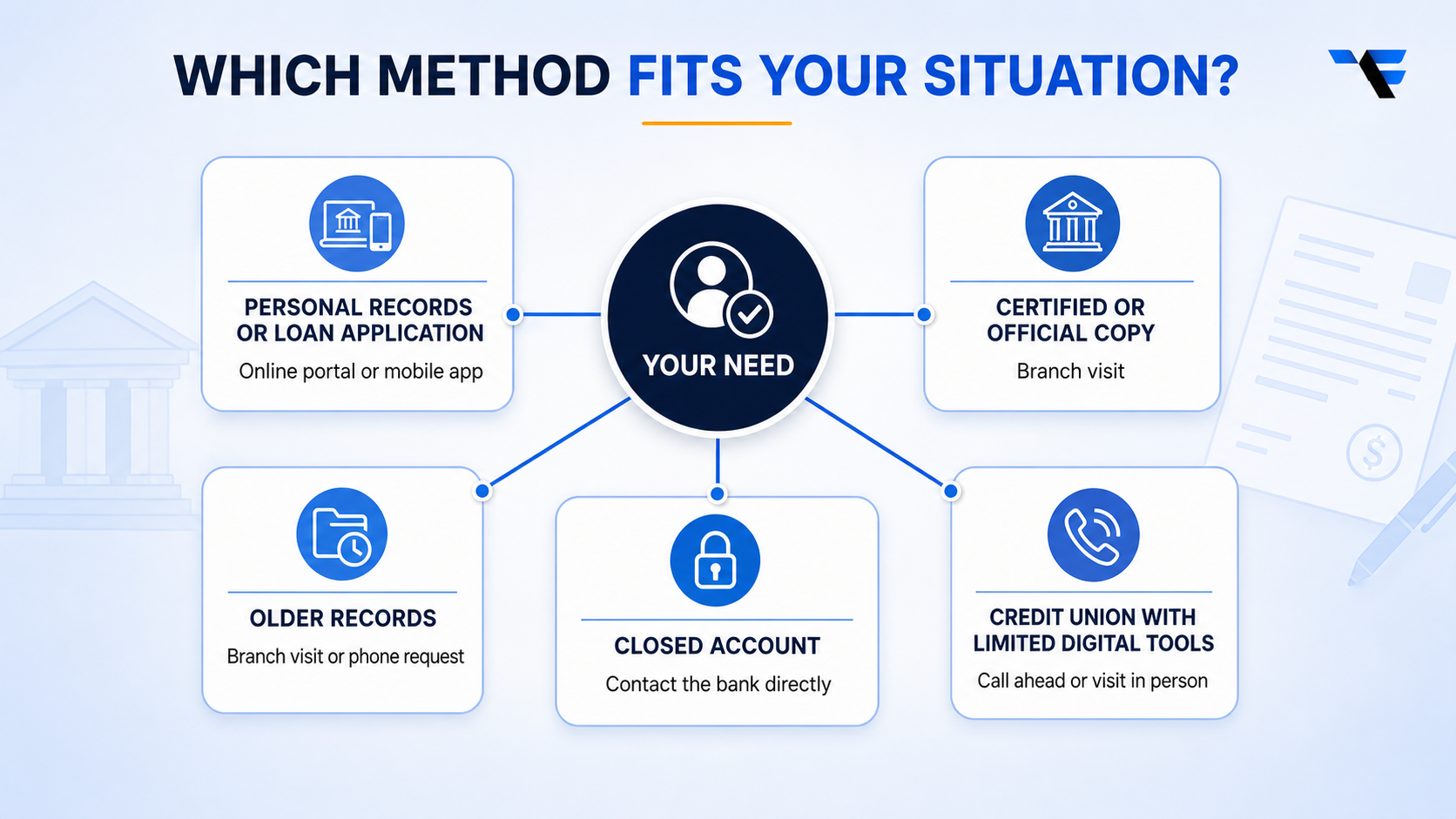
The right method depends on what the statement is for.
| Your Situation | Best Method |
|---|---|
| Standard download for personal records or a loan application | Online portal or mobile app |
| Certified or official copy for legal or international use | Branch visit |
| Records older than what's available online | Branch visit or phone request |
| Closed account | Direct contact with the bank |
| Credit union with limited digital tools | Call ahead or visit in person |
A Standard Download for Personal Records or a Loan Application
The online portal or mobile app is fastest for this: no branch visit or waiting period required.
A Certified or Official Copy for a Legal Matter or International Transaction
A branch visit is required. Certified statements can't be self-generated online.
Records Older Than What's Available Online
A branch visit or a phone request to the bank's records department is the path to take.
A Closed Account
You'll need to contact the bank directly and go through identity verification.
A Credit Union with Limited Digital Tools
Calling ahead or visiting in person tends to be more reliable than assuming the app covers everything.
If you're gathering statements specifically because a lender asked for them, whether for a conventional loan, a no doc loan, or a bank statement-based mortgage, it helps to work with a lender who tells you upfront exactly what's needed and in what format, rather than leaving you to guess and resubmit. Lenders like Truss Financial Group play that role for borrowers working through documentation for a home loan.
How Do I Get Bank Statements from a Credit Union Online?
The process at a credit union mirrors that of a commercial bank: online portal, mobile app, branch, or phone. The key difference is that credit unions vary more widely in their digital capabilities; smaller institutions may have more limited online statement access or less intuitive portals.
Before assuming your credit union's app supports PDF downloads, check directly. For older records or certified statements, contacting the credit union's member services team by phone or in person tends to be the most reliable path, and these teams are often more directly responsive than large bank call centers.
How Do I Get a Bank Statement for a Closed Account?
It's possible, but the process takes longer than for an active account.
- Contact the bank's records department or a branch manager directly
- Complete identity verification as requested
- Allow one to two weeks for processing
- Confirm the fee: one is likely for closed-account requests
If the bank itself has closed or merged with another institution, your records may now sit with the acquiring bank, or in some cases with a regulatory archive. The FDIC maintains resources specifically for tracking down records and unclaimed funds tied to failed banks, which is a useful starting point when a closed account's paper trail isn't obvious.
Not every record survives indefinitely, so the sooner you request statements after closing an account, the better your odds of getting them.
What Does It Cost to Get a Bank Statement?
| Method | Typical Cost |
|---|---|
| Online portal or mobile app (current statements) | Free |
| Mailed paper statement | $1–$5 per statement |
| Archived statement (2–3+ years old) | $5–$25 per statement |
| Certified statement | Separate fee, varies by institution |
Viewing and downloading statements online is free at virtually every institution, though many banks waive mailed statement fees entirely as well. Retrieving older or archived statements, generally anything beyond two to three years, tends to run higher.
Enrolling in electronic statements eliminates the recurring paper fee at most banks. This shift is also formally regulated: under the federal E-SIGN Act, a bank must get your affirmative consent before switching you to electronic-only delivery, and must clearly explain your right to request paper copies and any fees tied to that option. Certified statement requests are confirmed directly with the institution.
Frequently Asked Questions
How do I get a bank statement sent to my email?
Most banks don't email statements as direct attachments for security reasons. Enrolling in e-statements instead triggers an email notification when your statement is ready to view and download through the portal or app. Some banks offer secure email delivery on request through customer service.
How do I get a bank statement for a joint account online?
The process is the same as for a single-holder account. Either account holder can log in with their own credentials and access the full shared statement history.
How do I set up paperless bank statements?
Log in to online banking, go to account or document preferences, and select "Statement Delivery" or "Paperless." Some banks require email verification before the switch takes effect, and the change usually applies starting with the next statement cycle.
How far back can I access past bank statements digitally?
Most institutions offer two to seven years of statements through their online portal. For anything older, a formal request to the bank is required, and a fee may apply.
Does getting a bank statement affect my credit score?
No. Requesting or downloading a statement doesn't involve a credit inquiry and has no effect on your credit profile.
How do I obtain a certified bank statement?
A certified statement must be requested in person at a branch or through a formal written request; it can't be self-generated online. The bank stamps or signs it to confirm authenticity. It's typically required for legal proceedings, visa applications, or certain international transactions.
What is the best method to get a bank statement for a loan application?
A PDF downloaded directly from your bank's official portal or app is accepted by most lenders, since it carries the institution's own formatting and account details. If a lender specifically requires a certified copy, a branch visit is necessary: confirm the accepted format with your lender before retrieving the document.
Ready to Pull Your Statements and Move Forward?
Getting a bank statement is a straightforward task once you match the right method to your situation: online for speed, a branch for certification, phone or a records request for older or closed accounts. The bigger question for most people at this point isn't how to get the statement; it's what happens next once they have it. If that next step involves a home loan, lenders like Truss Financial Group will look at your actual documents and tell you exactly what you need and what comes next.

.svg)

Discuss your unique requirements
Get direct answers and a roadmap for your future.
.png?width=202&height=202&name=image%20588255187%20(1).png)







.svg)

.svg)
.svg)