.svg)



%20(1).svg)
%20(2).svg)
.png?width=480&height=420&name=Img%20(1).png)
%20(3).svg)
%20(4).svg)

%20(5).svg)


 View all states
Bank Statement FAQs: How to Get & Read Your Statement

12 mins
In this blog
Key Takeaways
- A bank statement is an official record of every transaction in your account over a set period, and you can access it instantly online, through your bank's mobile app, or by requesting a paper copy.
- Getting a bank statement costs nothing for electronic copies and is usually available within seconds through online banking or a mobile app; paper and historical requests may carry a small fee.
- Whether you need it for a loan application, a rental, tax records, or just to keep tabs on your spending, knowing exactly where to find your statement and what it shows saves time when it matters most.
Your bank statement is an official record of your account activity for a given period, and getting one is straightforward once you know where to look. Whether you've been asked to provide one for a loan, a rental application, or your taxes, or you simply want to understand what your statement contains, this guide walks through every access method available to you, breaks down what each section of the document actually means, and covers the situations where you're most likely to need one.
Mortgage brokers like Truss Financial Group help borrowers make sense of one of the most commonly requested and most commonly misunderstood financial documents.
What Is a Bank Account Statement and What Does It Actually Show?
A bank statement is an official document issued by your financial institution that summarizes every transaction in your account over a defined period, typically one month. It covers checking accounts, savings accounts, and in some cases investment and credit card accounts.
Here's a distinction worth knowing: a bank statement is different from a real-time transaction history. Transaction history is the live, rolling view you see inside your banking app the moment you log in. A statement is a fixed, closed-period document: an official record the bank certifies for a specific date range. That difference matters when a lender or landlord asks for "a statement," because they want the certified document, not a screenshot of recent activity.
Statements come in two formats: electronic, which is the most common and instantly accessible, and paper, which is mailed and sometimes subject to a small fee.
How Can I Download My Bank Account Statement Online?
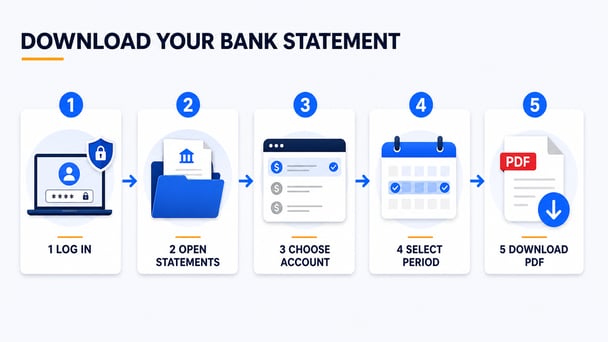
This is the fastest method for most account holders, and it follows roughly the same path across virtually every major bank:
- Log in to your online banking portal.
- Navigate to the statements or documents section: often labeled "Statements," "e-Documents," or "Account Documents."
- Select the account, if you have multiple accounts linked.
- Choose the date range or statement period you need.
- Download or view the document.
Most banks automatically save statements as PDFs, which makes them easy to store, print, or upload directly to a loan or rental application. Statements are typically available within one to two business days after the period closes, and most banks store at least 12 to 24 months online; older records may require a separate request.
What's the Easiest Way to Get a PDF Bank Statement From My Bank App?
For most people, the mobile app is where they spend the most time managing their account, and it's usually the fastest place to grab a statement too. The process mirrors the online portal but is built for a smaller screen, so labeling sometimes differs slightly: look under account settings, a documents or inbox tab, or within the account activity section.
Once you find it, statements can be downloaded as PDFs directly to your device, shared via email, or uploaded to another app. One practical workaround: if the PDF doesn't download automatically, selecting the print option and choosing "Save as PDF" from the print menu works reliably on both iOS and Android.
What Other Ways Can I Request a Bank Statement?
Not every situation calls for a digital statement. Three other methods are available:
Paper Statements by Mail
Paper statements let you receive a printed statement each month by updating your delivery preferences in online banking settings. Mailed statements typically arrive within five to ten business days after the period closes, and some institutions charge a monthly fee, often $1 to $5, for continued paper delivery.
In-Branch Requests
In-branch requests work well when you need a statement quickly and don't have digital access. Bring valid government-issued ID, and most branches can print a copy same-day. Fees may apply for older records, depending on the institution.
Phone Requests
Phone requests are handled through your bank's customer service line. You'll need to verify your identity before the request is processed, and both timing and fees vary by bank.
For most readers, online or app access will be faster and simpler, but these alternatives exist for when you need them. You can also read how to get a bank statement from your financial institution with 5 methods!
What Is an Electronic Statement and How Do I Enroll for Paperless Delivery?
An electronic statement, often called an e-statement, is the digital equivalent of a paper bank statement. It contains the same information and carries the same official status, and it's accepted by lenders, landlords, and tax authorities the same way a mailed copy would be. The only difference is delivery: instead of arriving in the mail, it's stored securely in your online banking portal, accessible any time.
Enrolling for paperless delivery is usually a quick, self-service process:
- Log in to your online banking settings.
- Look for "Statement Delivery," "Paperless Preferences," or "ePreferences."
- Select the electronic or paperless delivery option to enroll.
Once enrolled, most banks send an email notification whenever a new statement is ready. Switching often removes any monthly paper statement fee too, and a digital statement can't be lost, damaged, or intercepted in the mail: a meaningful upside for both convenience and security.
Notably, U.S. consumers have been shifting toward digital account management for years: the share of consumer payments made using a mobile phone rose from 28% to 32% between 2023 and 2024, according to the Federal Reserve Bank of Atlanta's Survey and Diary of Consumer Payment Choice, a trend that lines up with how quickly paperless statement adoption has grown industry-wide.
What Does a Bank Statement Actually Contain?
Statement layouts vary slightly between banks, but every bank statement contains the same core sections:
| Section | What It Shows |
|---|---|
| Account information | Your name, address, account number, and the statement period dates |
| Account summary | Opening balance, total deposits, total withdrawals, total fees, and closing balance |
| Transaction history | Each individual transaction: date, description, amount, and running balance |
| Fees and charges | Bank-applied charges: maintenance fees, overdraft fees, ATM fees, wire fees |
| Interest and credits | Interest earned on the account, refunds, or bank adjustments |
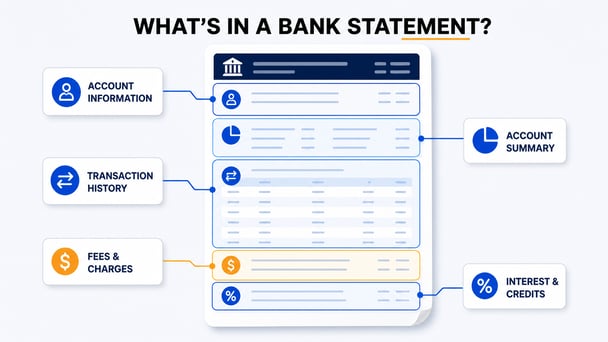
A good reading habit follows that same order: start with the account summary for the big picture, move to the transaction list to review individual items, and check the fees section separately to spot anything worth querying with the bank. If you're ever asked to submit statements as part of a mortgage application, this is exactly the level of detail a lender reviews.
Lenders like Truss Financial Group look at these statements closely, and getting comfortable reading your own statement makes that process considerably less stressful when the time comes.
What Are Common Reasons Someone Might Need a Bank Statement?
Most people looking for their bank statement aren't doing it out of curiosity; they've been asked to provide one, or they know they'll need one soon. Common reasons include:
- Loan and mortgage applications: Lenders typically request two to three months of recent statements to assess income, cash flow, and spending patterns. For self-employed borrowers whose tax returns don't tell the full income story, a bank statement loan uses statements themselves as the primary qualifying document instead.
- Rental applications: Landlords and property managers rely on statements as proof of income and financial stability.
- Tax filing and record-keeping: Statements support income reporting and deductible expense claims; the IRS notes that taxpayers should generally keep supporting records for three years from the date a return is filed, or six years if income was underreported by more than 25%.
- Visa and immigration applications: Many applications require recent statements as proof of funds.
- Financial dispute resolution: Official statements are accepted as evidence when challenging an unauthorized charge or billing error.
- Personal financial tracking: Reviewing your statements monthly is simply one of the easiest habits for catching errors, spotting forgotten subscriptions, and keeping an accurate picture of your financial health.
Is There a Charge for Obtaining Historical Bank Statements?
For recent statements, generally the past 12 to 24 months, most banks provide access free of charge through the online portal or app. Cost becomes more relevant once you need records older than what's available digitally, and fees vary by institution:
| Statement Type | Typical Cost |
|---|---|
| Recent statements (online/app, last 12–24 months) | Free |
| Historical statements (beyond the online window) | Free at some banks; per-statement or per-page fee at others |
| In-branch printed copies of older records | May carry a small fee, depending on the institution |
| Ongoing paper statement delivery by mail | Often $1–$5 per month |
Before calling your bank or visiting a branch for an older statement, check the online portal first. Many institutions make statements available further back than account holders expect, and pulling them digitally avoids fees that might apply to a formal request.
How Do I Get a Bank Statement If My Account Has Been Closed?
Closing an account doesn't mean the records disappear. Under federal recordkeeping rules that apply to U.S. banks, most account records, including deposit account statements, must generally be retained for at least five years, a standard set out in the FFIEC's Bank Secrecy Act examination manual.
Former account holders can typically request copies by contacting customer service by phone, visiting a branch with valid ID, or submitting a written request. Having your account number on hand, even for a closed account, speeds up the process considerably. Processing times run longer than for active accounts, and fees are more likely to apply. If your bank has since been acquired or merged, the acquiring institution typically holds the records and handles the request the same way.
Frequently Asked Questions
Can I get my bank statements emailed to me automatically each month?
Yes, through paperless enrollment. Most banks send an email notification when a new statement is ready, with a link to view or download it from your online banking portal: the statement itself typically isn't attached directly to the email for security reasons.
How far back can I access bank statements online?
This varies by institution. Most banks make 12 to 24 months available through the online portal or app, and some offer longer history. For anything older, a formal request to the bank is usually required, and fees may apply.
What do I do if there's an error on my bank statement?
Contact your bank's customer service as soon as you spot it. Under Regulation E, the federal rule that governs electronic funds transfer errors, consumers generally have 60 days from when the statement was sent to report an error in order to trigger the bank's investigation obligations, according to the Consumer Financial Protection Bureau. Keep a record of the statement, the transaction, and any correspondence throughout the process.
Can I request a bank statement by phone?
Most banks allow this through their customer service line, though you'll need to verify your identity first. Digital statements can sometimes be emailed or made available online within a day; mailed copies follow standard postal timelines of five to ten business days.
How do I view bank statements for multiple accounts in one place?
Most banks consolidate all linked accounts within the same online banking portal or app. Statements for each account are usually accessible separately within the documents section, filtered by account.
How do I retrieve a bank statement if I've lost access to my online banking?
Contact your bank directly, either by phone or in person at a branch with valid government-issued ID. Customer service can restore your access or provide another way to get the statement, and branches can typically print copies on the spot for active accounts.
Ready to Make Sense of Your Bank Statement?
Getting a bank statement - whether online, through the app, by mail, or in person - is a straightforward process once you know where to look and what to expect. The real value isn't just ticking a box on a loan application or tax form; it's having a clear, verified record of your financial activity you can reference and rely on whenever you need it.
If you're gathering statements because you're exploring a mortgage or refinance, especially as a self-employed borrower, it helps to work with a lender who looks at the full picture, not just a tax return. Mortgage brokers like Truss Financial Group work directly with applicants to figure out which documentation path actually fits their situation, whether that's a traditional income-verified loan or a bank statement-based option.

.svg)

Discuss your unique requirements
Get direct answers and a roadmap for your future.
.png?width=202&height=202&name=image%20588255187%20(1).png)

-1.png?width=389&height=221&name=Blog%20covers%20(26)-1.png)


-1.png?width=389&height=221&name=Blog%20covers%20(30)-1.png)


.svg)

.svg)
.svg)