.svg)



%20(1).svg)
%20(2).svg)
.png?width=480&height=420&name=Img%20(1).png)
%20(3).svg)
%20(4).svg)

%20(5).svg)


 View all states

16 mins

In this blog
Key Takeaways:
- A condo can qualify for a reverse mortgage, subject to borrower and property requirements.
- For an HECM, the condo project generally needs current FHA approval, or the individual unit must qualify through Single-Unit Approval.
- Single unit approval does not approve the entire condominium project.
- The FHA-approved lender handles the FHA submission and review.
- HOA or management company records can be critical to the review.
- An appraisal does not make an otherwise ineligible condo project FHA eligible.
- An old FHA-approval should not be treated as current.
- HUD's database distinguishes statuses such as approved, expired, rejected, and withdrawn.
If you own a condominium and are considering a reverse mortgage, the property may qualify for an FHA-insured Home Equity Conversion Mortgage (HECM). However, both you and the condo must meet certain eligibility requirements. In addition to meeting the borrower requirements, the condominium must generally be part of an FHA-approved project or qualify through FHA’s Single-Unit Approval process.
Generally, the unit must be either in an FHA-approved condominium project or qualified through FHA's Single-Unit Approval process.
A proprietary reverse mortgage may offer another route if the condo does not meet FHA requirements, but private programs have their own property, borrower, valuation, insurance, state, and project standards. Availability also varies by lender and program.
The important point: a condo not currently showing as FHA approved is not necessarily the end of the road for HECM. The lender needs to determine whether Single-Unit Approval is available and whether the project and unit satisfy current FHA requirements.
What is a HECM reverse mortgage?
A Home Equity Conversion Mortgage (HECM) is an FHA-insured reverse mortgage for eligible homeowners age 62 and older.
To qualify, the borrower generally must:
- Live in the home as their principal residence
- Pay off any existing mortgage or eligible liens at closing
- Complete counseling with a HUD-approved counselor
- Show they can keep up with ongoing costs, including property taxes, homeowners insurance and required maintenance
Unlike a traditional mortgage, an HECM reverse mortgage generally does not require monthly principal-and-interest payments as long as the borrower meets the loan requirements. However, homeowners are still responsible for ongoing housing costs.
These may include:
- Property taxes
- Homeowners insurance
- Applicable condominium or HOA fees
- Special assessments
- Required property maintenance
Borrowers must have the financial ability to keep up with these obligations. Failing to pay them can put the loan into default and may ultimately lead to foreclosure.
The homeowner also retains title to the property. An HECM is a loan secured by the home, not a transfer of ownership to the lender.
Can a condo qualify for a reverse mortgage?
Yes. A condominium can qualify for an HECM, but both the individual unit and the condominium project must meet applicable FHA requirements.
The process generally starts with confirming that the property is legally classified as a condominium. The unit may then need to be:
- In an FHA-approved condominium project, or
- Eligible through FHA’s Single-Unit Approval process
Properties such as townhouses and homes in planned unit developments can have different legal and underwriting treatment, the lender should confirm the property's classification rather than relying on how the home is described in a listing.
For a HECM, FHA provides two relevant paths:
- The condominium project is FHA approved.
- The project is not currently FHA approved, but the individual unit qualifies for Single-Unit Approval.
HUD states that a project eligible for Single-Unit Approval must be complete and ready for occupancy, contain at least five dwelling units and not be manufactured housing, among other requirements. The project must also satisfy applicable requirements covering matters such as FHA concentration, owner occupancy, and financial condition.
The condo must also satisfy the basic HECM property and borrower rules. It cannot simply be a vacation or investment unit being used as the collateral for HECM. The home must serve as the borrower's principal residence.
Is Your Condo FHA Approved? How To Check
HUD maintains an online condominium database that allows users to search for FHA-approved projects by location, name, or status.
A practical way to check this is by:
- Searching the condo's name, city, zip code, or other identifying information.
- Opening relevant project record.
- Checking the address, project/phase information, and current status.
- Checking the current approval status and expiration information where available.
- Having an FHA-approved HECM lender confirm that the specific unit and project information applies to the proposed plan.
Do not rely solely on an FHA representative, real estate agent, or an old closing package. HUD's database shows that condominium approval records can have different statuses, including approved, expired, rejected, and withdrawn.
A project that was FHA approved several years ago may not have current approval.
FHA Project Approval vs. Single-Unit Approval
| FHA Project Approval | Single-Unit Approval | |
|---|---|---|
| What is reviewed? | The condominium project or applicable phase/submission | A specific unit in a project that is not currently FHA approved |
| Does the entire project become FHA approved? | Yes, subject to the applicable approval | No |
| Who handles the submission? | The FHA-approved lender/project applicant under the applicable process | The FHA-approved lender |
| Key review areas | Project legal status, insurance, finances, title, physical condition, litigation and other FHA requirements | A subset of project requirements plus unit and loan-level requirements |
| When may it apply? | When the project seeks FHA approval or recertification | When an individual eligible unit is in a project without current FHA approval |
| Form | HUD-9992 for project approval | HUD-9991 for loan-level/Single-Unit Approval |
HUD specifically states that Single-Unit Approval is a case-specific path and does not turn the entire condominium project into an FHA-approved project.
For Single-Unit Approval, The lender uses Form HUD-9991. The current form expressly covers both forward FHA financing and HECM transactions.

What FHA Reviews In a Condo Project
The review can involve several aspects of the project, including:
- Legal and completion status
- Property and master insurance
- Financial condition and reserves
- Owner-occupancy information
- FHA concentration
- Delinquent assessments
- Commercial or non-residential space
- Pending litigation
- Title and governing-document restrictions
- Physical condition and marketability
Special assessments or pending litigation, for example, are not issues that should automatically be treated as a denial. They need to be reviewed against the current FHA requirements and the circumstances of the particular project.
What Documents Might the HOA Need to Provide?
The lender may need information from the condominium association or management company to complete its review.
Depending on the project and approval route, this may include:
- Governing documents
- Current budget and financial statements
- Master insurance information
- Owner-occupancy information
- Delinquency information
- Litigation disclosures
- Reserve or engineering information, where applicable
- Details of current or proposed special assessments
- Completed HOA questionnaire information
- Information needed to complete Form HUD-9991
HUD's current single-unit approval documentation list specifically identifies information such as:
- FHA insurance concentration
- Owner occupancy
- Individual owner concentration
- Unit in arrears
- Reserves
- Operating funds
- Commercial/non-residential space
- Association dues and special assessments
This is not necessarily a universal closing checklist. The documents required can vary based on the project and the review path. However, it is worth asking the HOA early about document fees, turnaround times, and who handles lender questionnaires. HUD and the lender cannot control how quickly an association supplies its records.
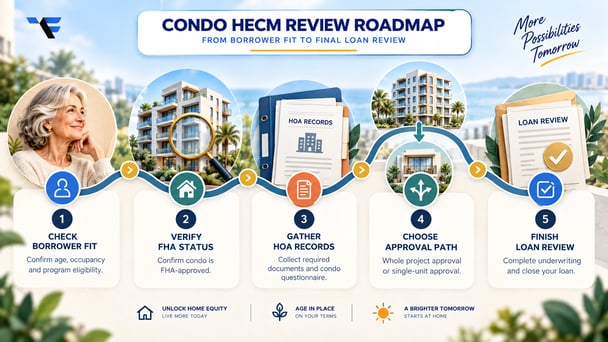
Applying For a HECM on a Condo
- Confirm basic HECM eligibility
Check age, principal-residence status, existing mortgage or lien obligations, financial assessment requirements and other borrower criteria.
- Confirm the property’s legal classification
Make sure the property is actually recorded as a condominium and determine the applicable project and phase.
- Check the current FHA project status
Search HUD’s condominium database and have the lender verify the result.
- Discuss the available reverse mortgage options
If the condo fits FHA requirements, a HECM may be considered. If it does not, ask whether Single-Unit Approval or a proprietary reverse mortgage may be appropriate.
- Complete required HECM counseling
HECM borrowers must receive counseling from a HUD-approved counselor
- Authorize the condo review
The lender determines which project documents and forms are required.
- Gather HOA documents
The association or management company may need to provide financial, insurance, occupancy and other project information.
- Complete the remaining loan review
This can include financial assessment, appraisal, title review and other underwriting requirements.
- Review the loan disclosures and terms
- Close if the loan is approved and all requirements are satisfied.
There is no universal approval timeline for a condo reverse mortgage. The process can be affected by the project’s FHA status, HOA responsiveness, document quality, appraisal, title issues and lender or HUD review.
An appraisal helps determine the condo’s value and is used in calculating the potential loan amount. However, an appraisal alone does not make a condominium project eligible for an FHA-insured HECM. The property must still meet the applicable FHA condominium requirements.
What if the Condo is Not FHA Approved?
A condo showing no current FHA approval does not necessarily mean you have no reverse mortgage options. Ask the lender to work through the following:
Could the unit qualify for Single-Unit Approval?
This is the first question when a HECM is otherwise appropriate. The homeowner generally cannot complete this process alone because the FHA-approved lender submits the required case information and relies on project documentation.
Could the association pursue project approval?
If the condominium association is willing and the project meets FHA's requirements, project approval may be another route. This is a project-level process rather than something the individual homeowner can simply establish for their own unit.
Would a proprietary reverse mortgage fit?
Private reverse mortgage programs can have different property and project requirements. However, "not FHA approved" does not automatically mean a condo qualifies for a proprietary loan. The lender still has to review the project, unit, borrower and applicable state and program requirements.
Are other financing options more appropriate?
Depending on the borrower's circumstances, alternatives could include another home-equity product, refinancing, downsizing or waiting while a project issue is addressed.
HECM vs. proprietary reverse mortgage for a condo
| Feature | HECM | Proprietary reverse mortgage |
|---|---|---|
| Federal insurance | FHA-insured | Not federally insured |
| Minimum age | Generally 62 | Program-specific |
| Condo approval | FHA-approved project or qualifying Single-Unit Approval | Program-specific |
| Counseling | HUD-approved counseling required | Program-specific |
| Home-value considerations | Subject to FHA HECM limits and calculations | Program-specific |
| Payment options | Fixed or adjustable HECM options, subject to program rules | Program-specific |
| Non-recourse protection | HECM includes federal mortgage insurance protections | Review the actual loan terms |
| Availability | Subject to FHA, lender and state requirements | Varies by lender, state and program |
HECMs are FHA-insured, while proprietary reverse mortgages are private loans that are not federally insured.
Please note: For either type of loan, review the actual written terms rather than assuming that a private program will accept a condo simply because it does not meet FHA requirements.
How payout, interest and the loan balance work
A HECM can have either a fixed or adjustable interest rate. The payment-plan structure and available funds depend on the loan terms and FHA calculations. HUD notes that HECM borrowers may choose fixed-rate or adjustable-rate options.
With a reverse mortgage, the balance generally grows rather than declines. Amounts received by the borrower, interest and financed charges can be added to the balance over time. As the balance increases, the homeowner's remaining equity can decrease.
That does not eliminate the homeowner's responsibility for condo expenses. HOA or condominium dues, property taxes, insurance, applicable special assessments and maintenance still need to be paid.
Risks, estate planning and situations to pause
A reverse mortgage can be a significant long-term financial decision. Before proceeding, consider what happens if your circumstances change.
A HECM can become due and payable if you no longer occupy the property as your principal residence, fail to meet required property obligations or otherwise violate the loan terms. Failure to pay applicable property charges or maintain the home can lead to default and potentially foreclosure.
The growing loan balance can also reduce the equity available to you or your heirs.
When the last borrower dies, heirs generally have to repay the HECM to keep the property. If they sell the home and the loan balance exceeds the home's value, federal HECM protections can limit the amount they need to repay.
Spouse protections can also depend on whether the spouse is a co-borrower or qualifies as an eligible non-borrowing spouse under HUD rules.
If the property is in a trust, involved in a lawsuit, has a large HOA special assessment, or the loan could affect your taxes, government benefits or estate plans, consider speaking with a legal, tax, benefits or financial professional before moving forward.
HECM for Purchase: Can you buy a condo with a reverse mortgage?
Potentially, yes. HECM for Purchase allows eligible borrowers to use a HECM to purchase a new principal residence in a single transaction. An eligible condominium unit can potentially be used, provided the property and project satisfy applicable FHA requirements.
The buyer contributes the required funds toward the purchase, while the HECM provides the remaining eligible financing under FHA's calculations.
Do not rely on a universal down-payment percentage. The required contribution can vary based on factors such as the borrower's age, interest rate, purchase price and FHA calculations. The lender should confirm the current requirements for the specific transaction.
The Bottom Line
A condo does not automatically rule out a reverse mortgage. The additional question is whether the project and individual unit satisfy the requirements for the loan program you are considering.
For a HECM, start by checking the condo's current HUD status and then have an FHA-approved lender determine whether the project is approved or whether Single-Unit Approval may apply. Gather HOA documents early, because project information can be just as important as the borrower's own eligibility.
If the condo does not fit FHA requirements, a lender can also review whether a current proprietary reverse mortgage or another financing option may fit the situation. Truss Financial Group can help you review the available HECM and private-program paths for the specific condo, project, state and borrower profile, subject to program and lender requirements.
Frequently asked questions
Can you get a reverse mortgage on a condo?
Yes. A condo can qualify for a reverse mortgage, but the requirements depend on the loan type. For a HECM, the project generally must have current FHA approval or the individual unit must qualify through Single-Unit Approval. The borrower must also satisfy the normal HECM requirements, including age, principal-residence and financial-assessment requirements.
Does a condo have to be FHA approved for a HECM?
Not necessarily. FHA allows an eligible condominium unit in a project that is not currently FHA approved to be considered through Single-Unit Approval. The project and unit must satisfy applicable FHA requirements. Single-Unit Approval is different from full project approval and does not make the entire condominium FHA approved.
What is FHA Single-Unit Approval?
Single-Unit Approval is an FHA process for determining whether a specific condominium unit in a project that is not currently FHA approved can qualify for FHA financing. HUD requires the project to meet certain conditions, including being complete and ready for occupancy, having at least five dwelling units and not being manufactured housing.
Does Single-Unit Approval approve the whole building?
No. Single-Unit Approval applies to the individual unit and the related loan transaction. It does not grant FHA approval to the entire condominium project. The distinction matters because another unit in the same project may need its own eligibility determination for a future FHA-insured transaction.
Who submits the Single-Unit Approval request?
The FHA-approved lender handles the FHA submission. Form HUD-9991 is the FHA Condominium Loan Level/Single-Unit Approval Questionnaire and is used for HECM transactions as well as certain forward FHA loans. A homeowner should not be instructed to submit the form independently.
How do I find out whether my condo is FHA approved?
Use HUD's FHA-approved condominium database to search by location, project name or status. Then have the lender verify the exact project, address and applicable phase or submission. HUD's database distinguishes between statuses including approved, expired, rejected and withdrawn, so an old approval should not be assumed to remain current.
How long does condo approval take?
There is no single timeline that applies to every condo reverse mortgage. Timing can depend on the project's current FHA status, the availability and quality of HOA documents, association response times, appraisal and title work, and lender or HUD review. Ask the lender for an estimated process based on the specific project rather than relying on a standard number of days.
Can a condo with a special assessment or pending litigation qualify?
Possibly. A special assessment or pending litigation requires review against the current FHA requirements and the circumstances of the project. These issues should not automatically be treated as an approval or denial. The lender may need updated financial, legal or project documentation before determining whether the condo can qualify.
Do I still have to pay HOA dues with a reverse mortgage?
Yes. A reverse mortgage does not eliminate condominium or HOA obligations. Condo fees and applicable special assessments remain property charges that the homeowner is responsible for paying. Failure to meet required property obligations can result in default and, if unresolved, foreclosure.
Can a proprietary reverse mortgage work if the condo is not FHA approved?
It may, depending on the specific private program. Proprietary reverse mortgages are not governed by the same FHA condominium approval framework as HECMs, but they still have their own borrower, property, valuation, insurance, project and state requirements. A lender must review the actual program terms before determining whether a particular condo qualifies.
Can I use HECM for Purchase to buy a condo?
Potentially. HECM for Purchase allows an eligible borrower to use a HECM to purchase a new principal residence. An eligible condo may qualify if the unit and project meet current FHA requirements. The borrower's required cash contribution and other transaction requirements depend on the current HECM rules and the specific purchase.
Are co-ops or manufactured-home condo units eligible?
Do not assume that every property described as a condo qualifies for a HECM. Condominium, cooperative and manufactured-housing classifications can have different FHA treatment. A lender should verify the property's legal classification and current FHA eligibility before determining whether a HECM is available.

.svg)

Discuss your unique requirements
Get direct answers and a roadmap for your future.
.png?width=202&height=202&name=image%20588255187%20(1).png)



.png?width=389&height=221&name=Blog%20covers%20(52).png)



.svg)

.svg)
.svg)