.svg)



%20(1).svg)
%20(2).svg)
.png?width=480&height=420&name=Img%20(1).png)
%20(3).svg)
%20(4).svg)

%20(5).svg)


 View all states
%20(1)-1.png?width=40&height=40&name=image%20(65)%20(1)-1.png)
11 mins
.png)
In this blog
Should you get pre-approved or pre-qualified first? If you're actively touring homes or about to make an offer, go straight to pre-approval: it's the step sellers and agents actually trust. If you're still early in the process and just want a ballpark budget, pre-qualifying first is a reasonable, no-pressure starting point. The two terms get used interchangeably online, but they're not the same thing, and mixing them up can cost you time or a home you wanted later.
This article walks through what each step actually involves, how they compare, what happens to your credit either way, and how to figure out which path fits your situation, including options for buyers whose income doesn't come from a W-2. Lenders like Truss Financial Group work with both traditional and non-traditional borrowers, helping buyers figure out which qualification path actually fits before they commit to one.
What's the Difference Between Pre-Qualified and Pre-Approved?
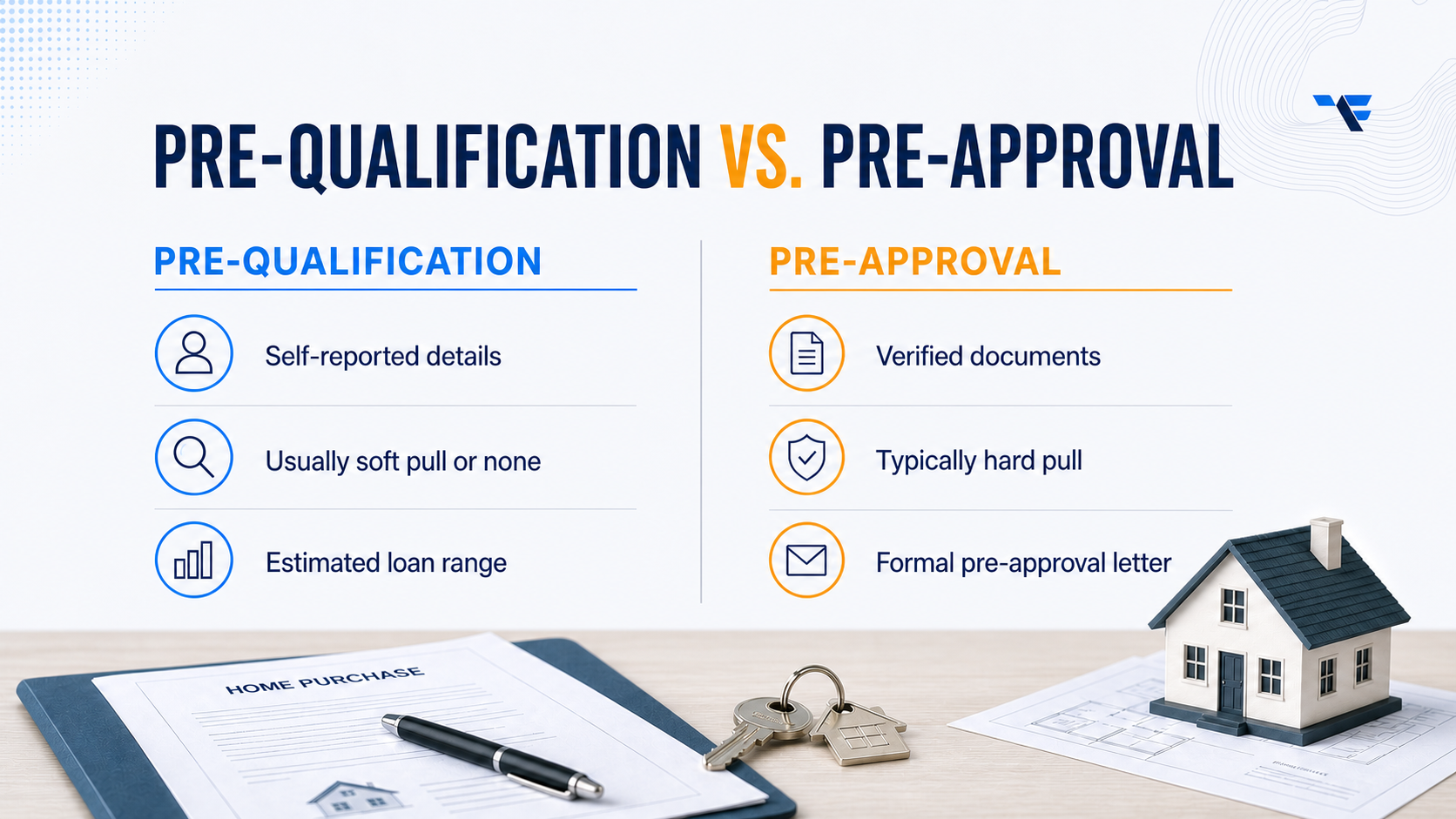
Pre-qualification is a lender's rough estimate of what you might be able to borrow, based on what you report about your income, debts, and assets. There's usually no documentation involved, and most lenders don't require a hard credit pull; some run a quick soft check, others skip credit entirely. It takes minutes and gives you a useful ballpark, but the number isn't verified.
Pre-approval is a different level of scrutiny. The lender reviews actual documentation, including pay stubs, bank statements, and other proof of income and assets, and typically runs a hard credit check. The result is a pre-approval letter stating the loan amount the lender is prepared to offer, subject to underwriting and appraisal once you're under contract. The CFPB notes that both prequalification and preapproval letters estimate how much a lender is willing to lend, but neither is a guaranteed loan offer: the difference is how much verification stands behind the number.
| Pre-Qualification | Pre-Approval | |
|---|---|---|
| Based on | Self-reported information | Verified documentation |
| Credit check | Usually soft pull or none | Typically hard pull |
| Documents required | Usually none | Varies by loan program |
| Time to complete | Minutes to hours | Often 1–5 business days |
| Output | Estimated loan range | Formal pre-approval letter |
| Weight with sellers | Limited | Significant |
How Does the Pre-Approval Process Work: Step by Step?
What a lender asks for depends heavily on your income type and the loan program you're pursuing. For W-2 employees applying for a conventional or government-backed loan, the process generally follows a standard path: gather your documentation, submit it to the lender, and wait for review.
A typical W-2 borrower's pre-approval checklist includes:
- Two years of federal tax returns (W-2s and/or 1099s)
- Recent pay stubs covering at least 30 days of income
- Two to three months of bank statements
- Government-issued photo ID and Social Security number
- A gift letter, if part of the down payment is coming from a family member
Once submitted, the lender reviews your income, assets, and debt load, then typically runs a hard credit inquiry. Most return a decision within a few business days. If approved, you receive a pre-approval letter, but it's important to understand this isn't a guarantee of final approval. It's conditional on the property appraisal, final underwriting, and no major changes to your finances before closing.
That standard checklist, though, assumes W-2 income and a conventional or FHA loan path. Plenty of buyers don't fit that mold, which is where things get more interesting.
Can You Get Pre-Approved Without W-2s or Tax Returns?
Yes, and this is one of the more misunderstood parts of the mortgage process. W-2s and tax returns are the standard for conventional and FHA loans, but they aren't the only route to pre-approval.
Bank-Statement Mortgages
Self-employed borrowers and others with non-traditional income are often evaluated through bank-statement mortgage programs, where 12 to 24 months of personal or business bank statements establish income instead of tax returns. This matters because tax returns often understate a self-employed borrower's true cash flow after deductions: Freddie Mac's own guidance on evaluating self-employment income walks through how lenders reconstruct income for exactly this reason.
Asset-Depletion Loans
Asset-rich borrowers with significant liquid holdings but limited traditional income may qualify through asset-depletion programs, where the lender calculates a hypothetical monthly income by spreading qualifying assets across the loan term.
DSCR Loans for Investors
Real estate investors purchasing income-producing property may explore DSCR (Debt Service Coverage Ratio) loans, where the property's projected rental income, not the borrower's personal income documentation, drives qualification.
All three paths still involve full underwriting, and each carries its own requirements: credit score thresholds, cash reserves, down payment minimums, rate structures, and property eligibility can all differ from conventional loan standards. These aren't shortcuts; they're different lenses for evaluating creditworthiness.
Mortgage brokers like Truss Financial Group help borrowers identify which qualification path actually fits a given financial situation, rather than defaulting everyone into the same conventional or FHA process.
What Does Pre-Approval Do to Your Credit Score?
Here's how pre-qualification and pre-approval affect your credit differently:
- Pre-qualification typically uses a soft credit pull or no pull at all, which generally has no effect on your credit score.
- Pre-approval typically involves a hard inquiry, which may cause a small, temporary dip; the size varies by scoring model and your overall credit profile.
- Rate shopping within a short window doesn't multiply that impact. The CFPB states that within a 45-day window, multiple credit checks from mortgage lenders are recorded on your credit report as a single inquiry, because credit bureaus recognize you're shopping for one loan, not opening several new lines of credit. Some older scoring models use a narrower 14-day window, so it's smart to concentrate your rate shopping into as short a timeframe as practical.
- Minimum credit score requirements vary by lender and program. Conventional loans commonly cite a 620 threshold, while HUD's FHA loan program allows a down payment as low as 3.5% for qualifying borrowers, with credit flexibility that differs from conventional guidelines. Alternative-documentation and DSCR programs may apply entirely different standards.
If you want a deeper look at how lenders weigh credit alongside income and collateral, see our breakdown of the 5 C's of credit.
Is Pre-Approval Required to Make a Serious Offer on a House?
Not legally, but practically, yes, in most markets today. Many real estate agents won't show homes or submit offers for buyers who can't produce a pre-approval letter, because doing so risks wasting everyone's time if the buyer doesn't actually qualify.
In competitive markets, sellers routinely field multiple offers. One backed by a verified pre-approval letter signals real financial credibility; a pre-qualification letter, being self-reported and unverified, tells a seller comparatively little. The CFPB notes that a pre-approval helps you shop for a home because it signals to the seller that you're a serious buyer, which is exactly the credibility gap between the two documents. If you're ready to tour homes and make offers, the practical answer is to go straight to pre-approval rather than stopping at pre-qualification.
Should You Get Pre-Qualified First, or Go Straight to Pre-Approval?
It depends on where you are.
- Early-stage buyer: not yet touring homes, still working out a budget, or unsure of your financial standing. Pre-qualifying first is a low-stakes way to get a realistic number without a formal application or hard credit pull.
- Ready-to-move buyer: already working with a real estate agent, actively touring homes, or close to making an offer. Skip straight to pre-approval. It saves time and immediately positions you as a credible buyer.
- Comparison shopper: pre-qualify with one or more lenders to compare estimated amounts, then convert to pre-approval with the lender you choose. Doing both with the same lender often makes that transition smoother.
If you already own another property and are weighing whether to tap its equity alongside a new purchase, that's a separate decision from mortgage pre-approval: a HELOC is a distinct product from the loan used to buy a new home. Eligible homeowners and investors can explore standard, no-tax-return, or DSCR-based HELOC options depending on their income documentation and the property generating the equity.
How Long Does a Pre-Approval Last, and What Happens If It Expires?
Pre-approval letters are commonly valid for 60 to 90 days, though this window varies by lender and loan program. If you haven't gone under contract within that time, you'll generally need to resubmit updated documentation and have the letter reissued- a routine refresh, not a new application from scratch.
More important than the expiration date itself: a pre-approval can be affected before it expires if your financial situation changes significantly. New debt, a job change, or a large purchase can all shift your qualifying picture. The practical guidance is simple: avoid major financial moves between pre-approval and closing, and confirm your specific validity window with your lender. Once you're ready to compare actual loan terms, see today's rates to understand what your pre-approval might translate to.
Frequently Asked Questions
Does pre-qualification hurt my credit score?
Generally no, it typically uses a soft inquiry or no credit pull at all, though this varies by lender.
Does getting pre-approved affect my credit score?
It typically involves a hard inquiry causing a small, temporary dip. Shopping multiple lenders within a short window is usually counted as one inquiry.
Is pre-approval required to make an offer on a house?
Not legally, but practically expected in most markets; many agents and sellers won't seriously consider offers without one.
How long does a mortgage pre-approval last?
Commonly 60 to 90 days, though this varies by lender and program.
Can I get pre-approved without W-2s or tax returns?
Yes, through bank-statement, asset-depletion, or DSCR loan programs, depending on your income type. Each still involves full underwriting with its own requirements.
Does pre-approval work differently for a DSCR loan?
Yes, a DSCR loan evaluates the property's projected rental income relative to the mortgage payment, rather than your personal income documentation.
Can I get pre-qualified first, then switch lenders for pre-approval?
Yes. Pre-qualification doesn't commit you to any lender.
How quickly can I get pre-approved?
Often within one to five business days, though alternative-documentation programs may take longer depending on complexity.
Ready to Find Out Which Step Is Right for Your Situation?
Pre-qualification and pre-approval serve different purposes at different stages of the buying process, and knowing which one you need right now is what actually moves you forward. The real question isn't which term sounds more official; it's which step fits where you are today, and which loan program fits how your income is documented.
Lenders like Truss Financial Group look at your actual situation and give a straight answer on what makes sense: whether that's pre-qualifying to start, going straight to pre-approval, or exploring an alternative-documentation path.

.svg)

Discuss your unique requirements
Get direct answers and a roadmap for your future.
.png?width=202&height=202&name=image%20588255187%20(1).png)


.jpg?width=389&height=221&name=Blog%20covers%20(2).jpg)





.svg)

.svg)
.svg)