.svg)



%20(1).svg)
%20(2).svg)
.png?width=480&height=420&name=Img%20(1).png)
%20(3).svg)
%20(4).svg)

%20(5).svg)


 View all states
Reverse Mortgage at 55: HECM, Jumbo Options & Eligibility

15 mins

In this blog
Key Takeaways:
- HECMS are available only to homeowners age 62 and older.
- Some private reverse mortgages may start at 55, but eligibility varies by lender, state and program.
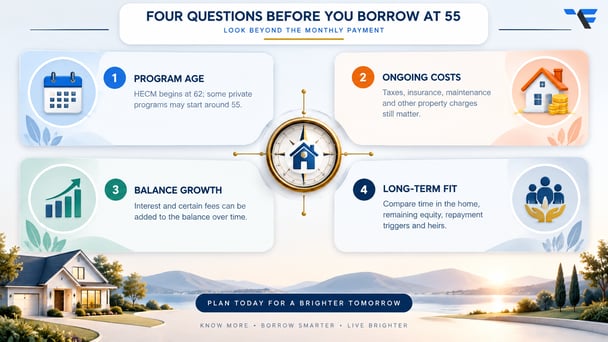
- Not making monthly principal and interest payments does not mean the home has no ongoing costs. Taxes, insurance, maintenance and other required property charges still matter.
- A reverse-mortgage balance generally grows because interest and certain fees are added to the balance.
- Compare the long-term cost, remaining home equity, repayment obligations and impact on your estate, not simply the absence of a monthly mortgage payment.
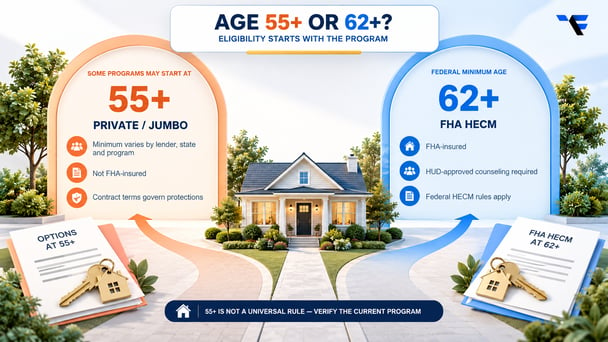
If you are 55 and wondering whether you can get a reverse mortgage, the short answer is no: not an FHA-insured HECM, but potentially a private reverse mortgage. HECM eligibility starts at age 62. Some proprietary or jumbo reverse-mortgage programs may accept younger borrowers, including borrowers starting around age 55, depending on the lender, state, property and financial requirements.
That distinction matters. “55+” is not a universal reverse-mortgage age requirement. A 55-year-old homeowner may have to compare a private reverse mortgage with a HELOC option, home equity loan or another way to access equity.
Minimum Age for a Reverse Mortgage
Depending on the type of loan you choose, the eligible minimum age is subject to change. Insured by the FHA and offered by FHA-approved lenders, you can qualify for a Home Equity Conversion Mortgage (HECM) if you are 62-years-old and above. These types of loans follow federal rules for eligibility and how the loan works.
Private or proprietary reverse mortgages are different. They are not FHA-insured and are created by individual lenders. Some private programs may accept borrowers at 55 or older, but the minimum can vary by program and state.
For example, TFG currently describes some proprietary and jumbo programs as available to borrowers 55+, while its proprietary reverse-mortgage page also notes that exact minimum ages vary by lender and state. That is why a lender’s current program guidelines, rather than a blanket “age 55” rule, should determine eligibility.
To learn more, explore TFG’s reverse-mortgage options
A traditional HELOC or home equity loan does not have a reverse-mortgage age threshold. Instead, these products generally involve conventional mortgage underwriting, including income, credit, debt and property considerations.
HECM Eligibility at Age 62 and Older
To qualify for a HECM, you generally must:
- Be at least 62 years old
- Live in the home as your primary residence
- Meet the required financial requirements
- Own the home outright or have enough equity to pay off any existing mortgage at closing
- Complete counseling with a HUD-approved housing counselor
The amount available is not based on home value alone. HUD says the calculation considers factors including:
- Age of the eligible borrowing and/or non-borrowing spouse
- Current interest rate
Your HECM calculation will use the lowest amount on the home’s appraised value, the HECM maximum claim amount or the home’s sales price, wherever applicable.
As of 2026, the HECM maximum claim amount is said to be $1,249,125. This is simply the maximum home value that can be used in the HECM calculation. It does not mean a homeowner will receive $1,249,125 in cash. The amount you may actually receive depends on factors such as your age, interest rate, home value, existing mortgage balance and loan costs.
Lenders also look at whether you can afford the ongoing costs of owning the home. These may include:
- Property taxes
- Homeowners insurance
- Flood insurance, if required
- HOA or condo fees
- Regular home maintenance
In some cases, part of the loan may need to be set aside to cover certain expenses.
Read TFG's HECM reverse-mortgage guide
One Spouse Under 62? Here’s What You Must Know
There’s a difference between a co-borrower and a non-borrowing spouse. And here’s why it matters.
If both spouses are HECM borrowers, the age of the younger spouse is used to determine how much they can borrow.
If one spouse is not a borrower but meets HUD’s requirements as an eligible non-borrowing spouse, they may have certain protections if the borrowing spouse dies or permanently moves out of the home.
For example, an eligible non-borrowing spouse may be allowed to stay in the home without the HECM becoming immediately due after the borrower dies. However, they generally cannot receive any more money from the reverse mortgage and must continue to meet the program’s requirements.
Because these protections can depend on factors such as home ownership, who lives in the home, and marital status, couples should discuss their situation with their lender and a HUD-approved housing counselor before closing.
Proprietary and jumbo reverse mortgages for borrowers age 55+
A proprietary reverse mortgage is a reverse mortgage offered by a private lender, rather than one backed by the FHA. Whereas, a jumbo reverse mortgage is a type of private reverse mortgage for homeowners with higher-value homes who may want to borrow more than a HECM allows.
This can make private reverse mortgages an option worth exploring for some homeowners between 55 and 61. However, age requirements, loan amounts and other rules vary by lender and program.
HECM vs. proprietary/jumbo reverse mortgage at a glance
| Feature | HECM | Proprietary / Jumbo |
|---|---|---|
| Minimum age | 62 | Varies by program; some start at 55 |
| Federal insurance | FHA-insured | Not FHA-insured |
| Availability | Subject to federal and property rules | Varies by lender and state |
| Home-value fit | Subject to annual HECM maximum claim amount | Often designed for higher-value homes |
| Payout choices | Lump sum, line of credit, term/tenure and combinations, subject to HUD rules | Varies by program |
| Mortgage insurance | FHA mortgage insurance applies | Varies; no FHA mortgage insurance |
| Counseling | HUD-approved counseling required | Varies by program |
| Non-recourse protection | HECM has federal non-recourse protections | Contract-specific |
| Property eligibility | HUD/FHA rules apply | Lender-specific |
| Source of rules | HUD/FHA | Private lender/program documents and applicable state law |
Please note: The above table is for educational comparison only. Private reverse-mortgage terms must be checked against the specific program and loan documents.
Age and Interest Rates Affect Available Proceeds, Here’s How
With a HECM, the amount you can access is based partly on a principal-limit factor.
In simple terms, the initial principal limit is calculated using the applicable factor, the HECM maximum claim amount and the borrower's age and expected interest rate. Existing liens, financed costs and required set-asides can then reduce the amount available to the borrower.
Age matters because, generally, an older borrower receives a higher HECM principal-limit factor. The expected interest rate moves in the opposite direction: a higher expected rate generally produces a lower principal-limit factor.
That does not mean someone can take a HECM at age 55 and simply apply a 55-year-old factor. HECM eligibility begins at 62.
The same factors should not be used to estimate a proprietary or jumbo reverse mortgage. Private programs use their own underwriting and pricing rules.
Reverse-Mortgage Payments, Interest, Costs and How Do They Work
With a reverse mortgage, you generally do not have to make monthly principal-and-interest payments while you meet the loan's requirements. But interest and certain fees can be added to the balance over time. That means the amount owed generally increases rather than decreases.
For HECMs, borrowers can choose among different payment structures. Depending on the plan, funds can be taken as a fixed-rate single lump sum or through adjustable-rate options such as a line of credit, term payments, tenure payments or combinations of these options, subject to HUD limits.
HECM costs can include:
- Origination fees
- Appraisal and other third-party closing costs
- Initial FHA mortgage insurance premium
- Ongoing interest
- Annual FHA mortgage insurance premium
- Servicing charges, where applicable
Some costs can be financed into the loan, which means they reduce the amount of equity available and increase the balance owed. CFPB notes that ongoing interest and certain fees are added to the loan balance.
Compare reverse mortgage costs with CFPB guidance
Money you receive from a reverse mortgage is generally considered loan money, not taxable income, so you typically don’t pay income tax on it. However, keeping the money in your bank account could affect eligibility for certain needs-based benefits.
Repayment triggers, homeowner duties and heirs
A reverse mortgage does not mean the homeowner can stop paying for the home.
You generally remain responsible for:
- Property taxes
- Homeowners insurance
- Flood insurance where required
- Applicable HOA or condominium charges
- Keeping the property in reasonable condition
Failing to keep up with these responsibilities can put the loan into default and, in some cases, may lead to foreclosure.
A reverse mortgage can also become due and payable if you sell or transfer the home, stop living there as your primary residence, or the last borrower dies. Protections may apply if there is an eligible non-borrowing spouse.
With a HECM, federal rules generally protect the borrower or their estate from owing more than the home is worth when the loan becomes due. If heirs want to keep the home, they generally must repay the loan balance or 95% of the home’s appraised value, whichever is less, if the loan balance is higher than the home’s value.
Private reverse mortgages should be treated separately. Do not assume their non-recourse provisions are identical to HECM. Check the actual contract.
Is Reverse Mortgage a Good Idea for a 55-year-old
At 55, the more useful question is whether accessing your equity now makes sense compared with waiting until 62 or using another form of financing.
A reverse mortgage may fit if:
- You have substantial equity in your home.
- You expect to remain in the property for a long time.
- You have a clear reason for accessing the equity.
- You can continue paying property taxes, insurance and maintenance costs.
- Preserving every dollar of home equity is not your primary financial objective.
It may not fit if:
- You expect to move in the near future.
- You want to leave as much home equity as possible to heirs.
- You may struggle to maintain property-related expenses.
- A HELOC, home equity loan or another option provides the needed funds at a more suitable overall cost.
- You need only a relatively small amount of cash.
For a HECM, HUD-approved counseling can help you understand the program before you commit. For a proprietary loan, an independent attorney or financial adviser may also be useful, particularly when estate planning is involved.
Reverse mortgage alternatives to compare before age 62
You may have other ways to access money from your home, depending on what you need it for.
- Need money you can access gradually? A HELOC lets you borrow as needed, but you’ll generally have monthly payments and may have a variable interest rate.
- Need a fixed amount upfront? A home equity loan gives you a lump sum that you repay through monthly payments.
- Need to access a larger amount while keeping your current home? A cash-out refinance could be an option, but it replaces your existing mortgage and may change your rate, term and monthly payment.
- Want to unlock equity without taking on another loan? Downsizing could free up money by selling your current home and buying a less expensive one.
- Don't need to borrow immediately? Look at your budget or retirement plan first. Reducing expenses, delaying a major purchase or adjusting retirement withdrawals may reduce the amount you need to take from your home.
TFG also offers Truss Equity Select, a home equity line for homeowners age 55 and older. Unlike a reverse mortgage, it requires monthly payments. Availability and terms depend on the borrower, property and other eligibility requirements.
How to compare offers and apply
Before applying, start with the reason you need the money and the amount you actually need.
Then:
- Check which products are available in your state.
- Review your home's current value, mortgage balance and equity.
- Compare a private reverse mortgage with HECM eligibility at 62 and other equity options.
- Complete required counseling if you're pursuing a HECM.
- Request written illustrations and disclosures.
- Compare interest rate, index and margin where applicable.
- Review the loan’s fees and terms carefully.
- Consider how the loan may affect your home equity, heirs and estate
- Ask about origination fees, servicing charges, prepayment rules, payout limits
- Ask whether the loan has non-recourse protection if you default.
If needed, have the loan reviewed by a trusted financial, legal or tax professional before you decide. TFG can help homeowners compare available reverse mortgage and home equity options based on factors such as age, state, property type, home value and equity. Please note: programs and terms can change so it’s important to learn about current program-specific comparison, if any.
The bottom line
Some private programs may serve borrowers starting around age 55, particularly homeowners with substantial equity or higher-value properties. The important comparison is bigger than the monthly payment. Look at the interest and fees, how quickly the balance may grow, your responsibility for taxes and insurance, how long you expect to stay in the home, and what happens to the equity your heirs may receive.
If you're considering a reverse mortgage at 55, Truss Financial Group can help you review currently available HECM, proprietary reverse mortgages, jumbo and other home-equity options based on your age, state, property and financial situation. Terms and availability vary, so ask for a current, written comparison before making a decision.
Frequently asked questions
Can you get a reverse mortgage at age 55?
Yes, potentially, but not an FHA-insured HECM. HECMs require the borrower to be at least 62. Some proprietary or jumbo reverse-mortgage programs may accept borrowers starting around age 55, but the exact minimum age, state availability, property requirements and underwriting rules vary by program.
What is the youngest age for an FHA HECM?
The minimum age for an FHA-insured HECM is 62. The age of the youngest borrower generally affects the HECM calculation, so a younger eligible borrower can affect available proceeds. HECM rules should not be confused with private reverse mortgages, which have their own eligibility requirements.
Can one spouse be 55 while the other is 62 or older?
Yes, but the structure matters. For a HECM, both borrowers must be at least 62. A spouse aged 55 cannot be a HECM co-borrower, but may qualify as an eligible non-borrowing spouse under applicable rules. Private reverse-mortgage age rules vary. Eligibility and title requirements should be reviewed before closing.
How much can a 55-year-old receive from a proprietary reverse mortgage?
There is no universal amount. Private reverse-mortgage proceeds depend on the specific program, the homeowner's age, property value, equity, interest rate, existing liens and underwriting requirements. Some jumbo programs are designed for high-value properties and may offer substantially higher limits than HECMs, but actual proceeds require a current program assessment.
Do you still own your home with a reverse mortgage?
Yes. A reverse mortgage does not transfer ownership of the home to the lender. The homeowner generally remains on title while the property secures the loan. The homeowner must continue meeting obligations such as property taxes, insurance and maintenance.
Are reverse-mortgage proceeds taxable?
Generally, no. The IRS treats reverse-mortgage payments as loan proceeds rather than taxable income. However, the way the funds are retained or used can affect certain means-tested benefits, and interest treatment has its own tax rules. Consult a tax professional for advice based on your circumstances.
Will a reverse mortgage affect Social Security, Medicare, SSI or Medicaid?
It depends on the benefit. Reverse-mortgage proceeds generally are not taxable income, and borrowed funds are not income for SSI. However, SSI has resource limits, so funds retained into a subsequent month can affect eligibility. Medicaid and other means-tested programs can have their own rules. Check with the relevant benefits agency before taking the loan.
Do jumbo reverse mortgages have mortgage insurance or non-recourse protection?
Not necessarily. A proprietary or jumbo reverse mortgage is not FHA-insured, so it does not automatically have HECM's federal mortgage-insurance structure. Non-recourse treatment also depends on the specific private program and contract. Review the loan documents rather than assuming that every jumbo reverse mortgage has identical protections.
When does the loan have to be repaid?
A reverse mortgage generally becomes due when a triggering event occurs, such as selling the home, transferring ownership, no longer living there as the principal residence, or the death of the last borrower, subject to applicable eligible non-borrowing spouse protections. Other default events, including failure to meet property obligations, can also matter.
Can heirs keep the home?
Yes, with a HECM, heirs can generally keep the home by satisfying the loan according to the applicable rules. If the HECM balance exceeds the home's appraised value, heirs generally can satisfy the debt by paying 95% of the appraised value rather than the full balance. Private reverse mortgages may have different contractual terms.

.svg)

Discuss your unique requirements
Get direct answers and a roadmap for your future.
.png?width=202&height=202&name=image%20588255187%20(1).png)




.png?width=389&height=221&name=Blog%20covers%20(37).png)



.svg)

.svg)
.svg)