.svg)



%20(1).svg)
%20(2).svg)
.png?width=480&height=420&name=Img%20(1).png)
%20(3).svg)
%20(4).svg)

%20(5).svg)


 View all states

15 mins
In this blog
Buying an investment property through an LLC can make sense for real estate investors who want cleaner separation between their property and personal finances. But getting a mortgage for LLC ownership is a little different from getting a mortgage in your own name.
The available loan programs, documentation, down payment, and personal liability can all change. Some financing is based heavily on rental income, while other options focus more on the property or your overall financial position. Truss Financial Group created this guide to help investors understand the main financing routes, what lenders look at, and what to sort out before applying.
Can an LLC Get a Mortgage?
Yes, an LLC can get financing for eligible real estate, but an LLC mortgage isn't a single, standardized loan product. The term simply describes financing where a limited liability company owns the property and is involved as the borrowing entity. The actual loan program can vary quite a bit depending on the property, its intended use, the lender and the borrower's financial profile.
The LLC may own the property, but that doesn't necessarily mean the LLC is the only party responsible for the debt. The borrower signing the note may be the LLC, its member, or both. A lender may also require one or more members to sign a personal guarantee. If that happens, the lender has an additional path to repayment if the LLC defaults.
So there are really three things to keep separate:
- Property owner: The LLC that holds title to the real estate.
- Borrower: The entity or individual legally responsible for the mortgage.
- Guarantor: A person who agrees to personally back the LLC's debt if required.
Another common misconception involves residential property. A rental home does not automatically become a commercial property simply because an LLC owns it. The property's physical use and the financing program still matter. An investment property can be financed through business-purpose lending while remaining a residential rental.
The same isn't true for an owner-occupied primary residence. Financing a home you live in is treated differently from financing an investment property held for rental income.
Traditional residential mortgages also aren't generally designed for business entities. Fannie Mae, for example, generally requires eligible individual borrowers, subject to specific exceptions. So investors shouldn't assume that a conventional mortgage for an LLC can simply be placed in its name.
Buying Through an LLC vs. Your Own Name
Ownership and Organization
When the LLC owns the property, you can keep rental income and property expenses flowing through a dedicated business account instead of mixing them with your personal finances. That separation makes bookkeeping easier and creates a clearer record of the property's business activity.
Liability Protection
There may also be liability protection. If something goes wrong at a rental property, the LLC can provide a layer between the property-related claim and your personal assets. That protection isn't absolute, though. The way the LLC is managed, the applicable state law, insurance coverage and your own actions all matter.
Personal Guarantee
A personal guarantee is another major consideration. If you personally guarantee the mortgage for an LLC, you may still have personal liability for the debt even though the LLC owns the property. In other words, the LLC doesn't magically make your mortgage liability disappear.
Cost Considerations
Forming and maintaining a business entity involves filing fees, annual requirements and potentially franchise taxes depending on the state. You may also need an EIN from the Internal Revenue Service, a separate business bank account and professional bookkeeping or tax help.
Financing
Financing is another trade-off. Investors buying in their own name may have access to traditional residential mortgages that aren't available to an LLC. LLC loans can instead involve DSCR loans, commercial loans, bridge financing or hard money, depending on the property and transaction.
Loan Options for Property Held in an LLC
| Financing Route | Appropriate Use | Underwriting Focuses on | Main Trade-Off |
|---|---|---|---|
| DSCR loans for LLCs | Rental properties where income is used to support the mortgage for an LLC | Rental income, property value, credit and reserves | Often requires a larger down payment and still involves borrower and property review |
| Bridge loans | Short-term financing when a property will later be sold or refinanced | Exit strategy, property value and repayment plan | Short repayment period and potentially higher costs |
| Hard money/fix-and-flip financing | Renovation projects with a defined exit strategy | Property condition, collateral and renovation plan | Expensive short-term financing with pressure to sell or refinance |
| Portfolio/commercial financing | Larger multifamily or mixed use properties and other entity-owned real estate | Property income, business records, loan history and borrower strength | More documentation and highly variable loan terms |
| Asset-depletion qualification | Situations where rental income doesn't meet the required coverage but eligible assets are available | Liquid assets, reserves and property information | Uses financial assets to support qualification, leaving less liquidity available |
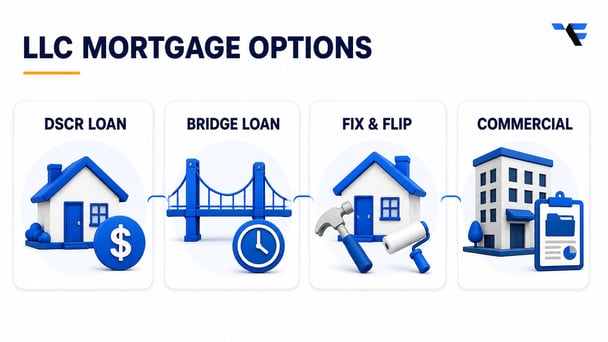
These categories can overlap. A bridge loan, for example, may be used while an investor improves a property and later refinances into longer-term financing. Hard money can also be part of a broader investment strategy rather than a completely separate category.
How DSCR Loans Work for LLC-Owned Rentals
DSCR loans are particularly relevant to investors looking for LLC loans for investment property because the property's rental income plays a central role in qualification.
DSCR stands for debt service coverage ratio. In a residential rental context, the basic idea is fairly simple: compare the property's accepted rental income with the payment used by the loan program to determine whether the income covers the debt obligation.
That can be useful for investors who don't want traditional personal income verification to be the main focus of the application. Instead of putting all the attention on your salary or employment history, the lender evaluates whether the investment property itself produces enough income under the program's calculation.
Mortgage lenders may still review personal credit, reserves, identification, property eligibility, leases and other documentation. The exact requirements depend on the financing program. DSCR loans for LLCs simply put more emphasis on the property's income-producing ability than many traditional residential loans do.
How to Calculate DSCR
For a simple residential DSCR explanation, suppose a rental property has accepted monthly rental income of $3,000. The monthly payment used for the calculation is $2,400, including principal, interest, taxes, insurance and association dues, commonly referred to as PITIA.
| Item | Illustrative amount |
|---|---|
| Accepted monthly rental income | $3,000 |
| Monthly PITIA | $2,400 |
| DSCR | $3,000 ÷ $2,400 = 1.25 |
The resulting DSCR is 1.25. That means the accepted rental income is 1.25 times the monthly PITIA used in the example. On paper, the property produces more income than the payment being evaluated. But don't mistake the $600 difference for actual profit.
What if the Property’s DSCR Is Below 1.0?
A DSCR below 1.0 generally means the property's accepted income doesn't fully cover the debt payment under the calculation being used. That creates a qualification problem for programs that require the rental income to cover the required payment.
For eligible situations, Truss Financial Group has an asset-depletion approach that can consider qualifying financial assets when the property's DSCR falls below 1.0. The basic concept is different from simply claiming the property earns more rent than it actually does. Eligible assets may help support qualification when the property's income alone isn't enough.
That distinction is important. Asset depletion doesn't increase the property's actual rental income. It uses qualifying financial resources as part of the borrower's ability to meet the program's requirements.
The details matter, including what assets qualify, how those assets are documented, how the LLC is structured and what the specific financing program permits. Don't assume that having substantial assets automatically guarantees approval. The lender still needs to evaluate the property, borrower and documentation.
What Do Lenders Check on an LLC Mortgage?
Applying for an LLC mortgage usually means gathering information from three areas: the LLC itself, the property and the people and funds behind the transaction.
| Category | Documents and Questions to Cover |
|---|---|
| The LLC | Formation documents, operating agreement, ownership details, authorized signers, good standing where required and tax-identification information |
| The property | Purchase agreement or existing mortgage statement, appraisal, rent assessment, leases or rent roll, insurance, condition, occupancy and location |
| Members and funds | Identification, relevant credit or background checks, down payment or equity, bank statements, reserves and any required personal guarantees |
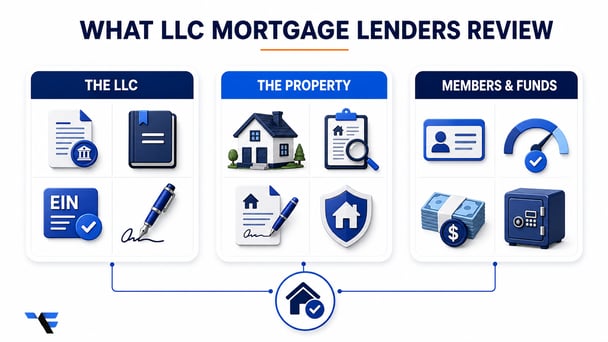
The LLC paperwork establishes that the business entity exists and shows who controls it. Depending on the program, that can include Articles of Organization, an operating agreement, proof of good standing and an EIN.
Personal tax returns and income documentation aren't identical across every financing route. Some programs may place less emphasis on personal income, while others can require more extensive documentation.
And that supposed universal two-year LLC operating-history requirement? It isn't a rule that applies to every program. A new LLC may be eligible for certain financing, while another program may have different requirements. Confirm the rules before assuming your entity is too new or automatically qualifies.
Down Payment, Rates and Other Costs
- Lenders can consider the property type, credit profile, loan amount relative to value, DSCR, transaction purpose, documentation and available reserves.
- The down payment is the portion of the purchase price you're contributing yourself. LLC financing commonly involves a 20% to 30% down payment, although the actual requirement can vary by program and borrower.
- Then there are closing costs. These can include appraisal fees, title-related expenses, lender origination charges, legal costs and other transaction expenses.
- You may also need cash reserves. Reserves are liquid funds kept available after closing to demonstrate that you can continue meeting the property's debt obligations if rental income temporarily drops.
- Then look at the loan-to-value ratio, or LTV. For a purchase, the relevant value basis can depend on the program and may involve the lower of the purchase price or appraised value. A lower LTV generally reduces the lender's exposure, which can affect pricing.
And don't stop at the interest rate. Check:
- Origination fees and discount points
- Appraisal and other third-party costs
- Prepayment penalties
- Extension fees
- Balloon-payment requirements
- Other property or entity-related expenses
- The full repayment schedule
One detail that trips people up is the difference between a loan term and amortization. A loan could have a five-year term with a 30-year amortization schedule. You may make payments calculated over 30 years, but the loan itself matures after five years. At maturity, the remaining balance could become due unless the loan is refinanced or otherwise paid off.
Personal Guarantees, Liability and Tax Considerations
An LLC can create a separate legal entity, but it doesn't automatically eliminate personal liability.
Personal Guarantees
The biggest issue is often the personal guarantee. If you personally guarantee an LLC mortgage, you've agreed to take responsibility for the debt under the terms of that guarantee. If the LLC defaults, your personal assets could be exposed. That doesn't make the LLC pointless. It simply means the liability protection is not absolute.
Credit Reporting
Credit reporting is another area where investors sometimes make assumptions. A lender may check your personal credit when you apply even if the mortgage is held by the LLC. Routine payment reporting can be structured differently from reporting after a default or foreclosure, so ask the lender exactly how the loan is reported.
Clear Records
You also need to treat the LLC like a real business entity. Keep separate bank accounts. Maintain clean records. Don't casually move money between personal finances and business accounts without proper documentation.
Otherwise, you can create problems with the very liability protection you were trying to establish. Courts can potentially look beyond the entity when owners fail to maintain appropriate separation, sometimes referred to as piercing the corporate veil.
Insurance and Taxes
Insurance matters just as much. Property insurance, landlord coverage and appropriate liability insurance are still important. Owning a rental through an LLC isn't a substitute for insurance.
Taxes deserve separate attention. LLCs are often treated as pass-through entities, but the tax treatment depends on factors such as the number of members and the entity's tax elections. LLC status by itself doesn't guarantee tax advantages or automatically allow you to avoid double taxation.
Property Sales
Property sales can also create capital gains tax consequences, and the tax treatment of an LLC-owned property may differ from what an individual homeowner expects. A tax professional and, where appropriate, a real estate attorney can help you understand the consequences before you structure the ownership or financing.
Can You Transfer a Mortgaged Property Into an LLC?
Your existing mortgage may contain a due on sale clause. Depending on the loan documents and applicable rules, transferring ownership can trigger the lender's right to demand repayment of the outstanding loan. Even a transfer to an LLC you own shouldn't be treated as automatically harmless.
Some loans have specific provisions allowing certain transfers under defined conditions. Fannie Mae, for example, has conditional provisions involving transfers to an LLC, but those provisions come with requirements relating to factors such as when the LLC was established, borrower control and occupancy. They do not create a universal right to transfer every mortgaged property into an LLC.
Also, don't confuse permission to transfer ownership with refinancing. A lender agreeing to a change in title doesn't necessarily mean the borrower has been released from the existing mortgage.
How to Apply for an LLC Mortgage
Applying becomes much easier when you know what the lender needs before the paperwork starts piling up.
- Identify the property, intended use and proposed ownership structure: Decide whether you're buying a rental, refinancing an existing investment property or pursuing another type of real estate transaction.
- Confirm entity and property eligibility: Make sure the LLC, property type and intended use fit the financing route you're considering. This is especially important for mixed use properties, larger multifamily properties and properties that don't fit a standard rental profile.
- Prepare the LLC documents: Have formation documents, the operating agreement, ownership information, good-standing documentation where required and the appropriate tax identification ready.
- Gather property and financial records: Pull together the purchase agreement or existing mortgage statement, leases or rental-income records, appraisal-related information, bank statements, reserves and other requested documentation.
- Review the loan terms carefully: Don't just ask about the interest rate. Ask about the down payment, closing costs, personal guarantee, prepayment penalty, loan term, amortization, balloon payment and any other repayment obligations.
- Complete underwriting and close correctly: Once the lender approves the transaction, make sure the property is closed in the ownership structure that was approved. Changing the setup at the last minute can create unnecessary problems.
Timelines vary by financing route and transaction complexity. Rather than relying on a generic number of days, ask the lender for a realistic timeline based on your particular property, documentation and loan program.
Frequently Asked Questions
Can a newly formed LLC get a mortgage?
Yes, some financing programs allow a new LLC to borrow. There isn't one universal operating-history requirement that applies to every mortgage for an LLC. The lender will look at the specific program, entity documents, ownership and source of funds.
Do I have to personally guarantee an LLC mortgage?
Often, yes. Many lenders require at least one LLC member to provide a personal guarantee. That guarantee can create personal liability for the debt, so don't treat it as a minor piece of paperwork.
Will the loan appear on my personal credit report?
Your personal credit may be checked during the application even when the LLC is the borrower. How the loan is reported afterward depends on the lender and loan structure. Default or foreclosure can have different consequences from routine payment history.
How much down payment does an LLC need?
A 20% to 30% down payment is common for many LLC financing arrangements, but the actual amount depends on the lender, property, DSCR, credit profile and other factors. Some transactions may require more.
Can an LLC use FHA or VA financing to buy a rental?
Don't assume an LLC can use FHA or VA financing simply because an individual borrower might qualify. Government-backed residential programs have specific borrower, title and occupancy requirements. LLC ownership and investment-property use can make the transaction ineligible.
What changes for mixed-use or larger multifamily properties?
The financing can move into commercial lending territory. Larger multifamily and mixed use properties may require more documentation, different underwriting and different loan terms. Commercial loans can also carry higher interest rates than some traditional residential financing. The property size, use, income and lender requirements all matter.
Next Steps for Your LLC Mortgage
Before you start calling mortgage for LLC lenders, get the basics together. Know what property you're buying, how you want the property ownership structured, what the expected rental income looks like and how much cash you have available for the down payment and reserves.
Have your LLC documents and bank statements ready. If the property already has tenants, gather the leases or rental records. If you're buying a new investment property, understand the expected rent and the property's overall numbers.
Then compare financing based on the entire deal, not just the advertised interest rate. A loan with a slightly lower rate can still cost more if it comes with expensive points, restrictive repayment terms or a large balloon payment.
Buying or refinancing a rental property through an LLC? Speak with a Truss Financial Group loan officer about your property, ownership structure and financing options.

.svg)

Discuss your unique requirements
Get direct answers and a roadmap for your future.
.png?width=202&height=202&name=image%20588255187%20(1).png)

.png?width=389&height=221&name=Blog%20covers%20(8).png)


.png?width=389&height=221&name=xxxxxx%20header%20(14).png)


.svg)

.svg)
.svg)