.svg)



%20(1).svg)
%20(2).svg)
.png?width=480&height=420&name=Img%20(1).png)
%20(3).svg)
%20(4).svg)

%20(5).svg)


 View all states

10 mins

In this blog
Key Takeaways
- Bridge loans provide short-term financing for time-sensitive real estate transactions.
- Homeowners and investors can use bridge financing to cover funding gaps before a sale or refinance.
- The right bridge lender should fit your property, financing needs, timeline, and exit strategy.
- Bridge loans can cost more than traditional financing, so consider the total borrowing cost.
- Equity, LTV, property value, and existing debt can affect how much you can borrow.
- A clear repayment strategy is essential, whether you plan to sell or refinance.
- TFG offers bridge financing alongside other options for homeowners and real estate investors.
The timing of a real estate deal can be its biggest challenge.
You may find the property and agree on a price only to realise your funds are tied up elsewhere. Perhaps your current home hasn’t sold, you need to close an investment before securing a mortgage or you’re waiting for renovations to finish before arranging long-term financing.
Real estate opportunities rarely wait for paperwork to catch up. That’s where short-term bridge financing can help, providing capital to cover a financing gap. Truss Financial Group offers bridge financing for real estate transactions, including investor-focused scenarios.
What Is a Bridge Loan?
A bridge loan is a short-term loan for when you need financing for your real estate transaction. It is designed to provide capital before your longer-term financing or expected source of funds is available.
For homeowners, that could be buying a new house before selling the current house.
A bridge loan is rarely meant to be the final destination for your financing. It is built around a temporary need and, ideally, a clearly defined way out.
Why Work With Truss Financial Group for Bridge Financing?
A bridge loan only works when its structure matches the transaction.
Truss Financial Group's bridge financing program offers loan amounts from $100,000 to $3 million. Truss Financial Group's bridge financing program has terms that range from 6 months to 24 months. TFG’s bridge financing program lets borrowers make payments. The program lists single-family homes, condos and townhomes, as the property types.
If you have a property under contract, a required closing date and a specific amount of capital in mind, explore TFG bridge financing and discuss the transaction directly with the team.
How Do Bridge Loans Work?
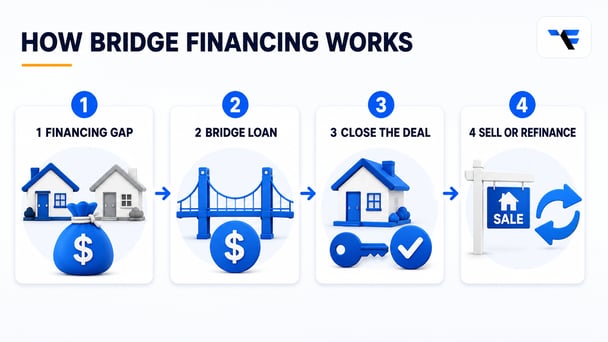
The first step is to figure out the financing gap. You need to know how much money you are short, what property will be used as collateral, how fast you need the cash and exactly how you plan to pay it back.
The lender then evaluates the property, the proposed transaction and the borrower's circumstances. Depending on the program, underwriting may focus heavily on the value and equity of the property rather than relying solely on traditional income documentation.
Once approved and closed, the bridge loan provides the capital needed to complete the transaction.
Payments during the bridge period may be structured as interest-only payments. That means you're paying the interest that accrues on the outstanding balance without reducing the principal balance during that period.
For instance, let’s say you borrow $500,000 at a hypothetical 10% annual interest rate. An interest-only payment would be approximately $4,167 per month:
$500,000 × 10% ÷ 12 = $4,167
At the end of the bridge period, the $500,000 principal would still need to be repaid.
What to Look for in Bridge Loan Lenders
Choosing a bridge lender is less about finding a generic "best" lender and more about finding a program that understands the particular gap you're trying to solve.
Start with program fit.
A lender may offer bridge financing, but that doesn't mean its loan structure works for your property type, loan amount or intended use.
Then look at the amount you can actually borrow. A lender offering an attractive rate that doesn't provide enough proceeds for your transaction isn't particularly useful.
Documentation matters, too. Traditional mortgage underwriting often revolves around tax returns, W-2s and other income documentation. Some bridge programs take a different approach, particularly when the property's value and the transaction itself are central to the financing decision.
Bridge Loan Rates, Fees and Repayment Terms
Bridge financing generally costs more than a conventional long-term mortgage.
You're paying for short-term access to capital, often with a financing structure designed around speed, flexibility or circumstances that don't fit traditional underwriting. Bridge loans can therefore carry higher interest rates and fees than conventional mortgage financing.
The interest rate is only one part of the calculation.
Depending on the lender and program, you may encounter:
- Origination fees or points
- Closing costs
- Interest-only payments
- Minimum-interest requirements
- Extension fees if the loan runs beyond its original term
- Prepayment terms or other loan-specific charges
When you speak with TFG, ask for terms based on your actual property, loan amount and expected holding period rather than relying on a generic rate range.
How Much Equity or Down Payment Do You Need?
Equity is one of the central pieces of a bridge-financing calculation.
As a simple illustration, imagine your existing property is worth $800,000 and you owe $400,000. You have approximately $400,000 in gross equity.
That does not mean you can automatically borrow $400,000 against equity. The lender's LTV limit existing liens, closing costs and the specific loan structure all affect how much equity can actually be used.
TFG's current bridge program advertises financing up to 80% LTV.
For example, if a property were valued at $500,000, an 80% LTV calculation would produce a hypothetical maximum loan amount of $400,000.
Please Note that this is an illustration, not a promise of available proceeds. The actual amount depends on the property, transaction, underwriting and program requirements.
The same principle applies to a purchase.
If you're buying a $600,000 property and putting 20% down, the hypothetical down payment would be $120,000, leaving a $480,000 financing requirement before considering other transaction costs.
Your actual bridge structure could look different. TFG can then assess the transaction against its available program parameters.
What Do You Need to Apply for Bridge Financing?
The application process becomes easier when you arrive with the transaction already mapped out.
For a homeowner, expect to provide information about:
- The current property
- Existing mortgage balance
- Estimated property value
- New property and purchase price
- Requested loan amount
- Expected sale timeline
- Planned repayment source
Investors will generally need additional transaction details, including the property's intended use, purchase price, renovation plans where applicable, estimated value and proposed exit strategy.
The documentation required depends on the bridge program and borrower.
TFG's bridge program currently advertises no personal income and/or tax-return requirement, although that should not be interpreted as "no underwriting." The property, transaction and applicable eligibility requirements still matter.
Bridge Financing for Real Estate Investors
For fix-and-flip investors, bridge financing can help fund a property purchase and necessary repairs before the property is sold.
TFG also offers fix-and-flip loans, along with bridge loans and hard-money financing and that acquisition and rehab funding is available, for projects that qualify.
For investors a bridge loan can give you short-term funding to buy or improve a property and then that bridge loan can move into permanent financing.
Planning Your Bridge Loan Repayment
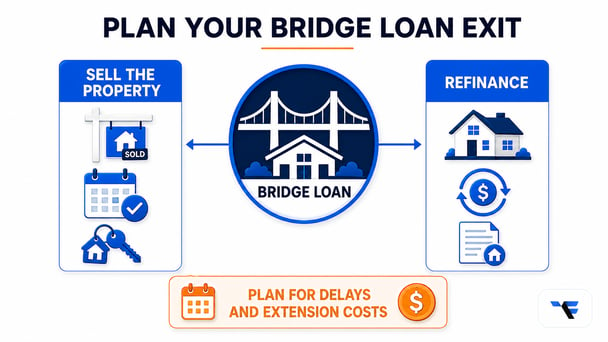
Getting the money is only half the transaction. You also need a realistic plan for getting out of the loan.
A sale may take longer than expected. Renovations can run over budget. An appraisal may come in below your projected value. A refinance may provide less money than anticipated.
Any of these can disrupt an exit strategy. That's why your repayment plan should include a little uncomfortable honesty.
If you're planning to sell in six months, what happens if the property is still sitting on the market in month seven?
If you're renovating, what happens if the contractor needs another six weeks?
If you're planning to refinance, what happens if the property doesn't appraise at the value you expected?
And if the bridge loan needs to be extended, what will that cost?
Before closing, discuss the intended exit and potential contingencies with TFG. Understanding the repayment path upfront can help you determine whether the bridge loan fits the transaction in the first place.
Bridge Loan Alternatives to Discuss With TFG
A bridge loan isn't automatically the right answer just because you have a short-term financing gap.
If you have substantial equity in an existing property, a no-tax-return HELOC may be worth exploring if you're eligible. A HELOC provides a revolving line of credit secured by home equity and can be useful when you need access to funds without taking out a traditional short-term bridge loan.
TFG's current HELOC offerings include options for primary residences, second homes and investment properties, with alternative documentation available on certain programs.
For qualifying rental properties, an investment-property HELOC may also be worth discussing. TFG describes investor HELOC options that can allow borrowers to leverage equity in investment properties, although eligibility and structure depend on the specific program.
Investors should also consider whether they actually need temporary financing.
If the property already generates sufficient rental income and qualifies for long-term investor financing, a DSCR loan could potentially be a better fit than taking on a bridge loan and refinancing again later.
Other options, including hard-money or fix-and-flip financing, may make more sense depending on the property and project.
Explore Bridge Financing With Truss Financial Group
If you're considering a bridge loan, get a bridge financing quote from TFG and bring your property details, existing debt, required funding amount and closing deadline to the conversation. Truss Financial Group can review the transaction and discuss available bridge-financing options and potential financing routes for the next stage of the deal.
Frequently Asked Questions
Which lenders offer bridge loans?
Bridge loans are available through mortgage lenders, specialty lenders and private financing companies. Programs vary by loan amount, LTV, property type, documentation, pricing and repayment terms.
How quickly can a bridge loan close?
Closing times vary based on the lender, property, documentation and underwriting process. TFG currently advertises bridge-loan closings in as little as 7–10 days, although that timeline is not guaranteed.
Can bridge financing support an investment-property purchase?
Yes. Bridge financing can be used for qualifying investment-property purchases, including situations where an investor needs short-term funding for an acquisition or renovation. The planned exit should be established before taking on the loan.
Should I consider a bridge loan or a HELOC?
It depends on the transaction. A bridge loan may be suitable when you need short-term financing for a specific purchase or time-sensitive deal, while a HELOC may be worth considering if you have qualifying equity and need a revolving source of funds. Each has different costs, structures and eligibility requirements.

.svg)

Discuss your unique requirements
Get direct answers and a roadmap for your future.
.png?width=202&height=202&name=image%20588255187%20(1).png)








.svg)

.svg)
.svg)